Ruins of ancient arena discovered outside Rome
Oct 02, 2009
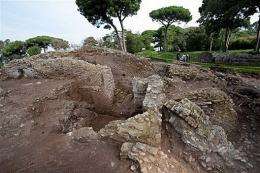
British archaeologists work at the discovered ruins of an arena built early in the third century BC outside Ostia, the ancient imperial port 25 kilometres (16 miles) from Rome.

British archaeologists have discovered the ruins of an arena built early in the third century BC outside Ostia, the ancient imperial port 25 kilometres (16 miles) from Rome, the team leader said Friday.

"Gladiators and wild animals may have fought in this place, but it also may have been used for important meetings, or, because of its proximity to the sea, to stage historical naval battle scenes," Simon Keay told AFP.

Since the small arena, measuring some 1,600 square metres (17,000 square feet), was next to the imperial procurator's palace, "we think it was intended mainly for private use," Keay said.

"More research will be needed to determine its use and the height of the amphitheatre -- which will give us a better understanding of the functioning of the entire port," he added.

The ruins were uncovered in three years of digging by the British team from Southampton and Cambridge Universities in cooperation with the British School at , an archaeological academy.

Italian archaeologist Rodolfo Lanciani determined the approximate location of the site in 1868, but more systematic research finally led to its discovery 140 years later.

(c) 2009 AFP

Explore further: Fossil brain teaser: New study reveals patterns of dinosaur brain development

add to favorites email to friend print save as pdf

Related Stories

Ancient seaside villa found near Rome

Apr 16, 2006

Workers digging a new sewage system for a coastal resort near Rome found the remains of a second-century villa belonging to two Roman senators.

Ancient ashes found buried in Rome

Feb 09, 2006

Archeologists have reportedly found the ashes of an ancient chief or priest who lived three centuries before the legendary founding of Rome.

3,000-year-old skeleton found in Rome

May 31, 2006

Italian archaeologists say they have found a well preserved, 3,000-year-old skeleton of a woman during a dig in the Roman Forum in central Rome.

Roman ruin found under Roman palazzo

Jul 25, 2006

Italian archaeologists say they have discovered the ruins of an ancient Roman official's home buried under a palazzo at the edge of the Roman forum.

Recommended for you

Tiny ancient bandicoot shines light on future

4 hours ago

(Phys.org) —A 20 million-year-old fossil skull identified as a 'pocket-sized' ancestor of the bandicoot will give insights into the future of Australia's modern endangered animals.

The eloquence of the otoliths

May 16, 2013

Fish fossils that are about 23 million years old give unprecedented insight into the evolutionary history of the gobioid order, one of the most species-rich groups among the modern bony fishes.

Light cast on lifestyle and diet of first New Zealanders

May 16, 2013

(Phys.org) —A University of Otago-led multidisciplinary team of scientists have shed new light on the diet, lifestyles and movements of the first New Zealanders by analysing isotopes from their bones and teeth.

User comments : 0

More news stories

Relaxed tourists share more

Tourists set on relaxing and socialising when they reach their holiday destination tend to do little advance research on the internet before making their trip, but are more likely to share travel information and photos on ...

Tiny ancient bandicoot shines light on future

(Phys.org) —A 20 million-year-old fossil skull identified as a 'pocket-sized' ancestor of the bandicoot will give insights into the future of Australia's modern endangered animals.

Daylight Saving Time spurs drop in crime rate

(Phys.org) —Researchers are no longer in the dark about when criminals are most likely to attack. William & Mary economist Nicholas Sanders teamed up with the University of Virginia's Jennifer Doleac to study the connection ...

Slow earthquakes: It's all in the rock mechanics

(Phys.org) —Earthquakes that last minutes rather than seconds are a relatively recent discovery, according to an international team of seismologists. Researchers have been aware of these slow earthquakes, ...

Computer model predicts when viruses become infectious

A new computer model could help scientists predict when a particular strain of avian influenza might become infectious from bird to human, according to a report to be published in the International Journal Data Mining an ...