MESSENGER Spacecraft Flies by Mercury
Sep 30, 2009
MESSENGER at Mercury
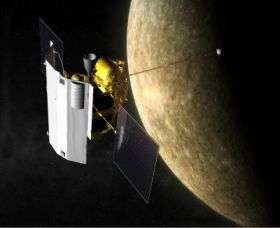
Artist's concept of the NASA's MESSENGER spaceraft at Mercury. Credit: NASA

Shortly before 5:55 p.m. EDT, MESSENGER skimmed 228 kilometers (141 miles) above the surface of Mercury in its third and final flyby of the planet.

Radio signals received after the spacecraft emerged from behind the planet indicate that the spacecraft is operating nominally. Its instruments are now collecting images and other scientific measurements from the planet as it departs Mercury.

Tonight at 9:34 p.m., the spacecraft will turn its high-gain antenna back toward Earth to start down linking real-time telemetry. Downlink of the data stored onboard will start two hours later. The first images from the will be released around 10:00 a.m. on September 30, 2009.

MESSENGER (MErcury Surface, Space ENvironment, GEochemistry, and Ranging) is a NASA-sponsored scientific investigation of the and the first space mission designed to orbit the planet closest to the Sun.

The MESSENGER launched on August 3, 2004, and after flybys of Earth, Venus, and Mercury will start a yearlong study of its target planet in March 2011.

Provided by JPL/NASA (news : web)

Explore further: Dark, massive asteroid to fly by Earth on May 31

add to favorites email to friend print save as pdf

Related Stories

NASA rescheduled MESSENGER start to Mercury to August 3

Aug 02, 2004

Today's launch of the MESSENGER spacecraft has been canceled due to weather constraints. The launch team will try again tomorrow, August 3, at 2:15:56 a.m. MESSENGER is a scientific investigation of the planet ...

MESSENGER flyby of Mercury

Jan 15, 2008

At 2:04 p.m. EST on Monday, MESSENGER skimmed 200 kilometers (124 miles) above the surface of Mercury in the first of three flybys of the planet. Initial indications from the radio signals indicate the spacecraft ...

MESSENGER Returns Images from Oct. 6 Mercury Fly-By

Oct 07, 2008

MESSENGER is the first mission sent to orbit the planet closest to the sun. On Oct. 6, 2008, at roughly 4:40 a.m. ET, MESSENGER flew by Mercury for the second time this year. During the encounter, the probe ...

Spacecraft Tandem Provide New Views of Venus

Jul 19, 2007

NASA's Mercury Surface, Space Environment, Geochemistry, and Ranging spacecraft, known as Messenger, and the European Space Agency's Venus Express recently provided the most detailed multi-point images of ...

MESSENGER On Its Way

Aug 04, 2004

The MESSENGER spacecraft lifted off on-time aboard a Boeing Delta II rocket from pad 17-B at Cape Canaveral Air Force Station, Fla., at 2:15:56.537 a.m. EDT. MESSENGER has successfully begun its mission to u ...

Recommended for you

Dark, massive asteroid to fly by Earth on May 31

18 hours ago

It's 1.7 miles long. Its surface is covered in a sticky black substance similar to the gunk at the bottom of a barbecue. If it impacted Earth it would probably result in global extinction. Good thing it is ...

Research team explains 'Lazarus' comets

21 hours ago

Astronomers from the University of Antioquia have discovered a graveyard of comets. These once-dormant comets, dubbed by astronomers as "The Lazarus comets," are now rejuvenated.

NASA ships sensors for seafaring satellite to France

22 hours ago

(Phys.org) —Three NASA-built instruments that are integral components of the next in a series of U.S./European ocean altimetry satellites have arrived in France for integration with their spacecraft in ...

Trip into space with DiCaprio costs $1.55m

22 hours ago

Leonardo DiCaprio is going to get closer to stars of a different kind as he heads into space aboard the Virgin Galactic, and a well-heeled bidder at the Cannes Film Festival has paid 1.2 million euros (1.5 million) to be ...

User comments : 0

More news stories

Galaxies fed by funnels of fuel

(Phys.org) —Computer simulations of galaxies growing over billions of years have revealed a likely scenario for how they feed: a cosmic version of swirly straws.

Source of life running out: water scientists

The majority of people on Earth people will face severe water shortages within a generation or two if pollution and waste continues unabated, scientists warned at a conference in Bonn Friday.

Dark, massive asteroid to fly by Earth on May 31

It's 1.7 miles long. Its surface is covered in a sticky black substance similar to the gunk at the bottom of a barbecue. If it impacted Earth it would probably result in global extinction. Good thing it is ...

Drones may violate international law

(Phys.org) —As President Obama gives a speech on national security—including defending U.S. use of drones to combat terrorism—Leila Sadat, JD, international law expert and professor of law at Washington University in ...