Nanotech researchers develop artificial pore
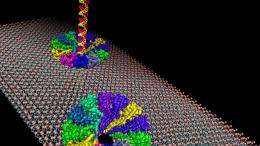
(PhysOrg.com) -- Using an RNA-powered nanomotor, University of Cincinnati (UC) biomedical engineering researchers have successfully developed an artificial pore able to transmit nanoscale material through a membrane.
In a study led by UC biomedical engineering professor Peixuan Guo, PhD, members of the UC team inserted the modified core of a nanomotor, a microscopic biological machine, into a lipid membrane. The resulting channel enabled them to move both single- and double-stranded DNA through the membrane.
Their paper, "Translocation of double-stranded DNA through membrane-adapted phi29 motor protein nanopores," will appear in online publication of the journal Nature Nanotechnology, Sept. 27, 2009. The engineered channel could have applications in nano-sensing, gene delivery, drug loading and DNA sequencing, says Guo.
Guo derived the nanomotor used in the study from the biological motor of bacteriophage phi29, a virus that infects bacteria. Previously, Guo discovered that the bacteriophage phi29 DNA-packaging motor uses six molecules of the genetic material RNA to power its DNA genome through its protein core, much like a screw through a bolt.
"The re-engineered motor core itself has shown to associate with lipid membranes, but we needed to show that it could punch a hole in the lipid membrane," says David Wendell, PhD, co-first author of the paper and a research assistant professor in UC's biomedical engineering department. "That was one of the first challenges, moving it from its native enclosure into this engineered environment."
In this study, UC researchers embedded the re-engineered nanomotor core into a lipid sheet, creating a channel large enough to allow the passage of double-stranded DNA through the channel.
Guo says past work with biological channels has been focused on channels large enough to move only single-stranded genetic material.
"Since the genomic DNA of human, animals, plants, fungus and bacteria are double stranded, the development of single pore system that can sequence double-stranded DNA is very important," he says.
By being placed into a lipid sheet, the artificial membrane channel can be used to load double-stranded DNA, drugs or other therapeutic material into the liposome, other compartments, or potentially into a cell through the membrane.
Guo also says the process by which the DNA travels through the membrane can have larger applications.
"The idea that a DNA molecule travels through the nanopore, advancing nucleotide by nucleotide, could lead to the development of a single pore DNA sequencing apparatus, an area of strong national interest," he says.
Using stochastic sensing, a new analytical technique used in nanopore work, Wendell says researchers can characterize and identify material, like DNA, moving through the membrane.
Co-first author and UC postdoctoral fellow Peng Jing, PhD, says that, compared with traditional research methods, the successful embedding of the nanomotor into the membrane may also provide researchers with a new way to study the DNA packaging mechanisms of the viral nanomotor. "Specifically, we are able to investigate the details concerning how double-stranded DNA translocates through the protein channel," he says.
The study is the next step in research on using nanomotors to package and deliver therapeutic agents directly to infected cells. Eventually, the team's work could enable use of nanoscale medical devices to diagnose and treat diseases.
"This motor is one of the strongest bio motors discovered to date," says Wendell, "If you can use that force to move a nanoscale rotor or a nanoscale machine... you're converting the force of the motor into a machine that might do something useful."
More information: www.nature.com/nnano/journal/v … /nnano.2009.259.html
Source: University of Cincinnati (news : web)


