French find prehistoric animal worship site
Sep 24, 2009
French archaeologists have discovered the oldest known place of worship dedicated to the dugong, or sea cow, on an island just north of Dubai, two research centres said Thursday.

French archaeologists have discovered the oldest known place of worship dedicated to the dugong, or sea cow, on an island just north of Dubai, two research centres said Thursday.

The sanctuary believed to date back to 3,500 to 3,200 years BC was discovered on Akab island in the , 50 kilometres (30 miles) north of Dubai.

The French archaeological mission in the Emirates and the Umm al-Quwain museum there said in the specialist magazine Antiquity that the sanctuary on the deserted island provided key details "on the rituals of prehistoric coastal societies in the Gulf."

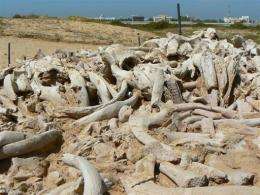
Akab was a tuna fisherman's village more than 6,500 years ago with circular buildings and a pile of dugong bones detected in the 1990s.

The scientifically named "Dugong dugon" still exists in the Gulf, with adults growing up to four metres (12 feet) long and weighing up to 400 kilogrammes (880 pounds).

The sanctuary was first thought to be an abattoir but on analysis was found to be a carefully constructed platform on two levels containing the remains of around 40 dugongs as well as tools, stones and ornaments.

The archeologists said the Akab monument was used for rituals celebrating the giant mammal and "has no parallel in neolithic times in other parts of the world."

Similar structures have been found off the Australian coast but are only several hundred years old.

(c) 2009 AFP

Explore further: Actor Johnny Depp immortalized in ancient fossil find

add to favorites email to friend print save as pdf

Related Stories

Harmful 'red tide' hits Dubai beaches

Apr 07, 2009

Beaches in the Gulf tourism hub of Dubai have been plagued by a bloom of algae known as the "red tide" that has killed fish and is potentially harmful to humans, a municipality official said on Tuesday.

Research reveals old timers in the frog world

Mar 26, 2009

(PhysOrg.com) -- Research at Victoria University has revealed remarkable longevity in wild populations of New Zealand native frogs, particularly in the threatened Maud Island frog (Leiopelma pakeka).

'Cursus' is older than Stonehenge

Jun 10, 2008

Archeologists have come a step closer to solving the 285-year-old riddle of an ancient monument thought to be a precursor to Stonehenge.

Recommended for you

The eloquence of the otoliths

May 16, 2013

Fish fossils that are about 23 million years old give unprecedented insight into the evolutionary history of the gobioid order, one of the most species-rich groups among the modern bony fishes.

Light cast on lifestyle and diet of first New Zealanders

May 16, 2013

(Phys.org) —A University of Otago-led multidisciplinary team of scientists have shed new light on the diet, lifestyles and movements of the first New Zealanders by analysing isotopes from their bones and teeth.

mtDNA study shows Minoans came from Europe not Africa

May 15, 2013

(Phys.org) —A new study conducted by a team of American and Greek researchers has found that the people of the ancient Minoan civilization living on the island of Crete most likely came from Europe. In ...

User comments : 0

More news stories

Evolution of lying

(Phys.org) —Ultimately, our ability to convincingly lie to each other may have evolved as a direct result of our cooperative nature.