Kepler Mission Update
Sep 23, 2009
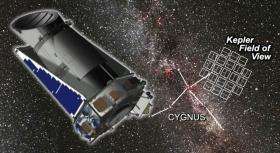
Artist concept of Kepler in space. Image credit: NASA/JPL

(PhysOrg.com) -- Kepler is approximately 18 million kilometers (11 million miles) from Earth, and continuing its drift-away orbit. All systems are operating normally. Last week, the Kepler project team completed another download of science data, and, in conjunction, a quarterly roll of the spacecraft.

Kepler is approximately 18 million kilometers (11 million miles) from Earth, and continuing its drift-away orbit. All systems are operating normally. Last week, the Kepler project team completed another download of science data, and, in conjunction, a quarterly roll of the .

About every 90 days, the team needs to roll the spacecraft about its line-of-sight, to realign the to the sun for the next season. Unlike the Earth, Kepler does not spin about its axis, so if we do not roll it occasionally, it would show a different side to the sun as it completes its orbit. We perform this maneuver four times a year, hence it is referred to as a quarterly roll.

Last week's operation was the second quarterly roll for Kepler since start of mission. The process began with the pausing of science data collection. The team then then turned the spacecraft so the main antenna pointed toward the Earth. After locking up on the Kepler high-gain antenna with the NASA Deep Space Network, the team downloaded all the data acquired over the previous month. After completion of the science data download, the team uploaded a few parameters and commands, and then turned the spacecraft back to the monitored star-field, but this time with the whole spacecraft rotated 90 degrees from where it was at the start.

After some calibration, data was taken and science observations began again for the next month's set of data. This whole process took only 41 hours, part of which is spent checking on pointing alignment and ensuring the spacecraft is thermally stable after these maneuvers. This data download was about 93 gigabits in size.

The science data are now in the hands of the Kepler Science Operations Center at NASA’s Ames Research Center, Moffett Field, Calif., where scientists and engineers are engaged in detailed analysis. The next scheduled science data download is October 17-18.

The first set of Kepler information is now available to the public at The Multimission Archive at STScI (MAST) and may be viewed at:
archive.stsci.edu/kepler/

Provided by JPL/NASA (news : web)

Explore further: Proba-V opens its eyes

add to favorites email to friend print save as pdf

Related Stories

Let the Planet Hunt Begin

May 13, 2009

(PhysOrg.com) -- NASA's Kepler spacecraft has begun its search for other Earth-like worlds. The mission, which launched from Cape Canaveral, Fla., on March 6, will spend the next three-and-a-half years staring ...

NASA's Kepler Spacecraft Ready to Ship to Florida

Dec 18, 2008

(PhysOrg.com) -- Engineers are getting ready to pack NASA's Kepler spacecraft into a container and ship it off to its launch site at Cape Canaveral Air Force Station, Fla. The mission, scheduled to launch ...

Innovative avionics enable search for habitable planets

Mar 09, 2009

The search for habitable planets continues with the March 6 launch of the Kepler spacecraft, the latest in NASA's series of low cost, highly focused Discovery missions. Kepler, built by Ball Aerospace & Technologies Corp., ...

Kepler Set to Launch Tonight on Planet Finding Mission

Mar 06, 2009

(PhysOrg.com) -- The Kepler spacecraft and its Delta II rocket are "go" for a launch tonight that is expected to light up the sky along Florida's Space Coast at 10:49 p.m. EST as the rocket lifts off from ...

Kepler Detects Atmosphere of Hot World

Aug 06, 2009

(PhysOrg.com) -- NASA's new exoplanet-hunting Kepler space telescope has detected the atmosphere of a known giant gas planet, demonstrating the telescope's extraordinary scientific capabilities. The discovery ...

Recommended for you

Proba-V opens its eyes

5 hours ago

(Phys.org) —Earth watcher Proba-V is in good health following its launch last week. The Vegetation imager has been switched on and the first image has been captured over western France.

Mice, gerbils perish in Russia space flight

May 19, 2013

A number of mice and eight gerbils sent into space in a Russian capsule destined to find out how well organisms can withstand extended flights perished during their journey, scientists said Sunday as the ...

Mars rover Opportunity examines clay clues in rock

May 18, 2013

(Phys.org) —NASA's senior Mars rover, Opportunity, is driving to a new study area after a dramatic finish to 20 months on "Cape York" with examination of a rock intensely altered by water.

NASA's STEREO detects a CME from the sun

May 17, 2013

On 5:24 a.m. EDT on May 17, 2013, the sun erupted with an Earth-directed coronal mass ejection or CME, a solar phenomenon that can send billions of tons of solar particles into space that can reach Earth ...

User comments : 0

More news stories

Slow earthquakes: It's all in the rock mechanics

(Phys.org) —Earthquakes that last minutes rather than seconds are a relatively recent discovery, according to an international team of seismologists. Researchers have been aware of these slow earthquakes, ...

Cracking the ice code

(Phys.org) —What happened the last time a vegetated Earth shifted from an extremely cold climate to desert-like conditions? And what does it tell us about climate change today?

Tiny, implantable coil promises hope for emphysema patients

A small, easily implantable device called the Lung Volume Reduction Coil (LVRC) may play a key role in the treatment of two types of emphysema, according to a study conducted in Europe. Results of the study indicate the beneficial ...