New beryllium reference material for occupational safety monitoring
Sep 22, 2009
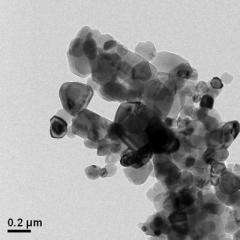
The new Standard Reference Material, Beryllium Oxide Powder (SRM 1877), shown in this scanning electron micrograph mimics the form of beryllium to which workers would be exposed much more closely and should facilitate much more representative and informative toxicological studies, more accurate monitoring and more effective clean up of contaminated areas. Credit: R. Dickerson, Los Alamos National Laboratory

(PhysOrg.com) -- Researchers at the National Institute of Standards and Technology, in collaboration with private industry and other government agencies, have produced a new reference material for beryllium. Beryllium, an exotic rare-earth metal used as a hardener in high-performance alloys and ceramics, can cause berylliosis—a chronic, incurable and sometimes fatal illness. The new reference material is expected to dramatically improve methods used to monitor workers' exposure and aid in contamination control as well as toxicological research.

The use of beryllium in manufacturing dates back to the advent of the atomic age. One of the scientists involved with the famous Chicago experiment known as Chicago Pile-1 to create the first artificial self-sustaining nuclear reaction in 1942 died of berylliosis in 1988. Aside from the nuclear industry, the unique properties of beryllium make it valuable in the manufacture of aircraft and supercolliders.

Beryllium dust can cause a condition characterized by chronic skin and/or respiratory inflammation resembling pneumonia in susceptible individuals and can increase the risk of lung cancers with long periods of exposure. Treating the particles as a threat, the body's immune system floods the affected area with white blood cells. The cells surround the beryllium particles and harden to form inflamed tissue nodules called granulomas. These granulomas can lodge under the skin or in where they cause difficulty breathing and a host of other symptoms including fatigue, weight loss and muscle pain. The condition, although treatable, is incurable.

The new Standard Reference Material, Beryllium Oxide Powder (SRM 1877), consists of high-fired crystalline beryllium oxide that has been thoroughly characterized physically and chemically. The particles that make up the powder have an average diameter of about 200 nanometers and have been separated into aggregated clusters that will pass through a 20 mesh screen. NIST scientists Greg Turk and Mike Winchester used a high performance inductively coupled plasma optical emission spectrometry technique developed at NIST to certify the mass fraction (the ratio of pure beryllium in the beryllium oxide) in the compound. NIST provided its partners with support to perform the preparations and did the final analysis of the solutions when they were completed.

According to Winchester, previous analytical tests for exposure monitoring relied on an easily dissolved form of beryllium that was not representative of what people would be exposed to in the field. The new SRM mimics the form of beryllium to which workers would be exposed much more closely and should facilitate much more representative and informative toxicological studies, more sensitive monitoring and more effective clean up of contaminated areas.

More information: Additional data and ordering information for SRM 1877, Oxide Powder, is available at https://srmors.nist.gov/view_detail.cfm?srm=1877 .

Source: National Institute of Standards and Technology (news : web)

Explore further: Atomic-scale investigations solve key puzzle of LED efficiency

add to favorites email to friend print save as pdf

Related Stories

Lab experiments mimic a star's energy bursts

Jan 26, 2005

A key process that enhances the production of nuclear energy in the interior of dense stars has been re-created in the laboratory for the first time by physicists at the National Institute of Standards and ...

Tandem Ions May Lead the Way to Better Atomic Clocks

Aug 01, 2005

NIST Detects “Ticks” in Aluminum, with Help from Intermediary Atom Physicists at the Commerce Department’s National Institute of Standards and Technology (NIST) have used the natural oscillations of two dif ...

Recipe for the perfect James Webb Space Telescope mirror

Mar 12, 2009

Mirrors are a critical part of any space telescope, and the James Webb Space Telescope's mirrors are made of a special element that will enable it to withstand the rigors of space and see farther back in time/distance ...

Recommended for you

Promising doped zirconia

May 17, 2013

Materials belonging to the family of dilute magnetic oxides (DMOs)—an oxide-based variant of the dilute magnetic semiconductors—are good candidates for spintronics applications. This is the object of ...

Nanocrystals grow from liquid interface

May 17, 2013

An international collaboration of scientists has discovered a unique crystalizing behavior at the interface between two immiscible liquids that could aid in sustainable energy development.

User comments : 0

More news stories

A quantum simulator for magnetic materials

Physicists understand perfectly well why a fridge magnet sticks to certain metallic surfaces. But there are more exotic forms of magnetism whose properties remain unclear, despite decades of intense research. ...

Engineers pioneer flat spray-on optical lens

A University of British Columbia engineer and a team of U.S. researchers have made a breakthrough utilizing spray-on technology that could revolutionize the way optical lenses are made and used.

Researchers forward quest for quantum computing

Research teams from UW-Milwaukee and the University of York investigating the properties of ultra-thin films of new materials are helping bring quantum computing one step closer to reality.

How do cold ions slide

Things not always run smoothly. It may happen, actually, that when an object slides on another, the advancement may occur through a 'stop and go' series in the characteristic manner which scientists call ...

Hormone replacement therapy—clarity at last

The British Menopause Society and Women's Health Concern have today released updated guidelines on Hormone Replacement Therapy (HRT) to provide clarity around the role of HRT, the benefits and the risks. The new guidelines ...

Controlling mood through the motions of mitochondria

(Medical Xpress)—Regulating the distribution of power in neurons is done by a system that makes the national electric grid look simple by comparison. Each neuron has several thousand mitochondria confined ...

A hidden population of exotic neutron stars

(Phys.org) —Magnetars – the dense remains of dead stars that erupt sporadically with bursts of high-energy radiation - are some of the most extreme objects known in the Universe. A major campaign using ...