Too scary to be real, research looks to quantify eeriness in virtual characters
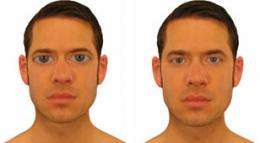
(PhysOrg.com) -- Indiana University's Karl MacDorman has been to the valley -- the uncanny valley of virtual humans so lifelike they give us real humans the creeps. What he's found is that things don't look so bad after all.
That's because MacDorman's research into human photorealism in robots, androids and computer-generated characters is calling into question a longstanding premise put forth by the pioneering Japanese roboticist Masahiro Mori that people become unsettled by any slight nonhuman imperfection in very human-looking forms. MacDorman is an IU School of Informatics associate professor in the Human-Computer Interaction program and the director of the Indiana University-Purdue University Indianapolis Android Science Center.
Nearly 40 years ago Mori identified the uncanny valley as that place where zombies, corpses and dancing mannequins reside. Developing impeccably humanlike computer-generated characters that will not fall into the uncanny valley is the Holy Grail for animators in the multi-billion dollar animation and video game industries.
And what MacDorman has found is that it is no longer your parents' art school.
"What is surprising is that some of the rules you learn in art school do not apply to computer graphics characters," he said. "For example, artists will typically enlarge the eyes of someone they paint to make the person look more attractive. In fact, artists tend to make their own eyes larger in self-portraits. But our results indicate that eye enlargement can have a decidedly negative effect when photorealistic textures are applied to a human model."
The same holds true when distorting other facial proportions such as eye separation and face height, as the changes have a more negative impact on very realistic human character models. So caricaturing can be effective for abstract faces, like the ones seen in Pixar's movie The Incredibles, but fails for human-looking faces like those seen the same year in another film, The Polar Express, that also relied on computer generated imagery.
"The Disney animation of Cinderella's stepmother can be horrid without being eerie, and Tom Hanks can be warm in Polar Express but still eerie," MacDorman said. "So our group is devising new scales that can deal with these nuances." MacDorman has developed the first "eeriness index" to help quantify how virtual characters influence human decision making.
"The index has been developed based on a pilot study, but we want to refine it further in a larger study on animated characters and robots," he said.
Developing design principles for human-looking characters, MacDorman believes, would not only have a huge economic impact on computer graphic animation and video games, but could also play an integral role in developing long-term beneficial relationships between robots and humans.
"Interventions could range from the treatment of autism to rehabilitation coaching to companionship for the elderly," he said. "One goal is to create robots and computer generated characters that are capable of interacting with people in humanlike ways to sustain long-term relationships that improve people's physical, cognitive and social well-being."
Research results to date reflect subjective measures used with human participants who viewed the characters, but MacDorman and his team plan to use results from objective sources like heart rate, galvanic skin response, electroencephalograms and functional magnetic imaging of the brain to gauge how far designers can go before characters creep out viewers.
His latest published research, "Too real for comfort? Uncanny responses to computer generated faces," (appearing in Computers in Human Behavior, and co-written with Robert D. Green, Chin-Chang Ho and Clinton T. Koch, all of the IU School of Informatics), called into question Mori's predictions that a computer generated face looks the eeriest when it looks nearly human.
"Even abstract faces can look eerie if they contain facets that seem unintended or arbitrary," MacDorman said.
To view a visualization of two different, side-by-side computer graphic characters as they undergo slight changes in skin and eye realism, visit the Uncanny Valley.
MacDorman's upcoming research with his colleague, Matthias Scheutz, turns in the direction of virtual versus physical representation influencing ethical decision making made via online and face-to-face interactions. Matthias Scheutz is an associate professor of Cognitive Science, Computer Science, and Informatics and the director of the Human-Robot Interaction Laboratory at Indiana University Bloomington.
"The purpose of one of these upcoming proposals is to determine whether the physical embodiment or virtual representation of a robot can influence human decision-making of ethical consequence," MacDorman explained.
And a research paper now in review, "Gender Differences in the Impact of Presentational Factors in Human Character Animation on Ethical Decisions about Medical Dilemmas," indicates that under certain similar conditions men and women make different decisions.
MacDorman, Chin-Chang Ho, Joseph Coram and Himalaya Patel found that using a computer-generated character instead of a human character, or using jerky movements instead of fluid movements, to present participants with an ethical dilemma produced no significant effect on female participants. Male participants, however, were much more likely to rule against the computer-generated character with jerky movements.
"From the standpoint of studying human interaction, it is important to get into and out of the uncanny valley. If you build a robot or computer-generated character that looks human, but you do not animate it well -- if its motion looks jerky or the timing of its responses are off -- it will look uncanny, no matter how realistic and attractive it looks when still," MacDorman said. "But this is useful because it indicates when the cognitive model I am testing in an android, or the artificial intelligence used to control a character in a computer game, is not working. The fact that we are so sensitive to flaws in the behavior of human-looking characters means that we know when our models of human interaction are wrong, so we can correct them. This is the beauty of human photorealism. Because if a cartoon character or a less human-looking robot does something that isn't human, we might not even notice it."
Provided by Indiana University (news : web)


