Study Positively Identifies Giant Squid Presence in Gulf of Mexico
Sep 21, 2009
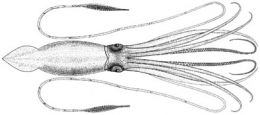
Architeuthis. Image: Wikimedia Commons

(PhysOrg.com) -- During a recent research cruise, a rare giant squid was captured in the Gulf of Mexico.

The research cruise was partially funded through an interagency agreement between the Department of the Interior’s Minerals Management Service (MMS) and the National Oceanic and Atmospheric Administration (NOAA). The 19.5 foot long, 103 pound squid was caught at a water depth of more than 1,500 feet in a special trawl net pulled by the NOAA vessel Gordon Gunter during a pilot study for the MMS, "Sperm Whale Acoustic Prey Study."

The two-year, $550,000 MMS prey study hopes to identify the species composition and biomass of squid and fish that represent the feeding base for sperm whales in the Gulf of Mexico.

“This is the first time a giant squid has been captured during scientific research in the Gulf of Mexico,” explained Dr. Deborah Epperson, the MMS biologist responsible for this study. Numerous MMS-sponsored studies of sperm whale abundance, distribution, habitat, and response to sound conducted since the 1990’s showed the need for more information about their prey which consist mainly of squid and fish.

Photos of the squid were sent to experts around the nation to confirm the specimen was indeed the Architeuthis (Ar-chi-teu-this) species. The giant squid is now at the Smithsonian Institution National Museum of Natural History where it will be studied.

Additional field work for the “ Acoustic Prey Study” is scheduled for early 2010. A survey to assess the relationship between sperm whales and their based on lessons learned from this pilot study will be conducted.

Provided by Minerals Management Service

Explore further: Ants and carnivorous plants conspire for mutualistic feeding

add to favorites email to friend print save as pdf

Related Stories

Giant squid photographed for first time

Sep 28, 2005

A mysterious sea creature -- the giant squid immortalized by Jules Verne's novel "20,000 Leagues Under the Sea" -- has been photographed for the first time.

Tracking sperm whales and jumbo squid

Mar 09, 2007

The sperm whale and its large prey, the jumbo squid, are among the deepest divers in the ocean, routinely reaching depths of 3,000 feet or more. Now, in a new study, a team of marine scientists reports the successful tagging ...

Sonar monitors California squid fishery

Feb 07, 2006

California's $30-million-a-year squid industry has quadrupled during the past decade and now scientists are using sonar to assess squid stocks.

Recommended for you

New cave-dwelling arachnids discovered in Brazil

5 hours ago

Two new species of cave-dwelling short-tailed whipscorpions have been discovered in northeastern Brazil, and are described in research published May 22 in the open access journal PLOS ONE by Adalberto Santos ...

Do songbirds hold key to stuttering?

10 hours ago

A tiny Australian songbird may hold the answer to discovering the biological source of stuttering, which affects 3 million Americans and is notoriously difficult to treat.

User comments : 1

Adjust slider to filter visible comments by rank

Display comments: newest first

cmn
not rated yet Sep 22, 2009
I'm assuming it's not alive now?

More news stories

Forecast for Titan: Wild weather could be ahead

(Phys.org) —Saturn's moon Titan might be in for some wild weather as it heads into its spring and summer, if two new models are correct. Scientists think that as the seasons change in Titan's northern hemisphere, ...