Test of Futuristic X-48C is Historic Wind Tunnel's Swan Song
Sep 18, 2009 by Kathy Barnstorff
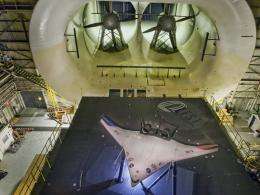
The X-48C test marked the last time the Langley Full Scale Tunnel that was built in 1930 will be used. Credit: NASA/Sean Smith

(PhysOrg.com) -- A historic wind tunnel at NASA's Langley Research Center in Hampton, Va., has been pressed into service one last time to help test the prototype of a new, more fuel-efficient, quieter aircraft design.

Boeing Research & Technology, Huntington Beach, Calif., recently partnered with NASA's Aeronautics Research Mission Directorate and the U.S. Air Force Research Laboratory, Wright Patterson Air Force Base, Ohio, to explore and validate the structural, aerodynamic and operational advantages of an advanced concept called the blended wing body or BWB.

"We have one version of the 21-foot (6.4 m) wingspan BWB prototype, called the X-48B, being flight tested at NASA's Dryden Flight Research Center, in Edwards, Calif.," said Dan Vicroy, senior research engineer at NASA Langley. "The other one we just tested in the Langley Full-Scale Tunnel is the X-48C. It's been modified to make it even quieter. We're assessing the aerodynamic effects of those modifications." Those changes include reducing the number of engines from three to two and the installation of vertical fins to shield the engine noise.

This video is not supported by your browser at this time.
Time lapse video of the assembly of the X-48C model prior to testing.

Cranfield Aerospace Ltd. in England built both ground-breaking aircraft scale models to Boeing's specifications. Made primarily of advanced lightweight composite materials, the models weigh about 500 pounds (227 kg) each. They are powered by turbojet engines and can fly up to 138 miles per hour (222 kph) and 10,000 feet (3,048 m) in altitude during flight-testing. The Air Force is interested in the plane's potential as a multi-role, long-range, high-capacity military aircraft.

The Langley test in July and August 2009 was the second time a BWB model was put through its paces at the huge that was built in 1930 and used to test World War II fighters, the Mercury space capsule, and concepts for a supersonic transport.

In 2006, preliminary tests helped engineers determine how the X-48B would perform during remotely piloted flight tests. Blended wing body designs are different from traditional tube-and-wing aircraft in that the tube and wings are blended for lower drag and better lift, and they rely primarily on multiple control surfaces on the wing for stability and control.

"It was actually a big thrill for me to be back at the Langley Full-Scale Tunnel," said Dharmendra Patel, project manager for the X-48C at Research & Technology. "I think it's a big privilege that we were the last test here, that we get to be part of the history of the tunnel. But it is a little bittersweet that the facility will be closed down."

Langley decommissioned the tunnel in 1995, and then leased it to Old Dominion University in Norfolk, Va., for research and student engineering training. That lease was up this summer and the tunnel is scheduled for demolition because of its lack of national strategic importance, limited testing capability, deteriorating condition and the environmental liability associated with the materials used in its construction.

Provided by JPL/ (news : web)

Explore further: Mice, gerbils perish in Russia space flight

add to favorites email to friend print save as pdf

Related Stories

Team Uses Historic NASA Tunnel to Test Blended Wing Body

May 04, 2006

A historic NASA wind tunnel is helping test the prototype of a new, more fuel-efficient aircraft design. Boeing Phantom Works, St. Louis, has partnered with NASA's Aeronautics Research Mission Directorate and ...

New Flying Wing Design Tested

Nov 10, 2005

For almost a hundred years most planes have looked like a tube with wings, but that may change thanks to NASA research. Engineers at NASA's Langley Research Center in Hampton, Va., are testing a design for ...

Flight Tests Confirm New Technologies Can Help Quiet The Skies

Nov 21, 2005

According to recent flight tests involving NASA and corporate industry, new technologies can help silence jet aircraft, both in the passenger cabin and on the ground. The three-week flight test program, called the Quiet Technology ...

Lancets Flights Probe Supersonic Shockwaves

Jan 22, 2009

(PhysOrg.com) -- NASA is concluding a series of flight tests to measure shock waves generated by an F-15 jet in an effort to validate computer models that could be used in designing quieter supersonic aircraft.

Recommended for you

Mice, gerbils perish in Russia space flight

16 hours ago

A number of mice and eight gerbils sent into space in a Russian capsule destined to find out how well organisms can withstand extended flights perished during their journey, scientists said Sunday as the ...

Mars rover Opportunity examines clay clues in rock

May 18, 2013

(Phys.org) —NASA's senior Mars rover, Opportunity, is driving to a new study area after a dramatic finish to 20 months on "Cape York" with examination of a rock intensely altered by water.

NASA's STEREO detects a CME from the sun

May 17, 2013

On 5:24 a.m. EDT on May 17, 2013, the sun erupted with an Earth-directed coronal mass ejection or CME, a solar phenomenon that can send billions of tons of solar particles into space that can reach Earth ...

Nine-year-old Mars rover passes 40-year-old record

May 17, 2013

While Apollo 17 astronauts Eugene Cernan and Harrison Schmitt visited Earth's moon for three days in December 1972, they drove their mission's Lunar Roving Vehicle 19.3 nautical miles (22.210 statute miles ...

Bright explosion on the Moon

May 17, 2013

For the past 8 years, NASA astronomers have been monitoring the Moon for signs of explosions caused by meteoroids hitting the lunar surface. "Lunar meteor showers" have turned out to be more common than anyone ...

User comments : 0

More news stories

Heat-related deaths in Manhattan projected to rise

Residents of Manhattan will not just sweat harder from rising temperatures in the future, says a new study; many may die. Researchers say deaths linked to warming climate may rise some 20 percent by the 2020s, ...

Mice, gerbils perish in Russia space flight

A number of mice and eight gerbils sent into space in a Russian capsule destined to find out how well organisms can withstand extended flights perished during their journey, scientists said Sunday as the ...

Honeybees trained in Croatia to find land mines

(AP)—Mirjana Filipovic is still haunted by the land mine blast that killed her boyfriend and blew off her left leg while on a fishing trip nearly a decade ago. It happened in a field that was supposedly ...

Kinks and curves at the nanoscale

One of the basic principles of nanotechnology is that when you make things extremely small—one nanometer is about five atoms wide, 100,000 times smaller than the diameter of a human hair—they are going ...