NASA's infrared satellite sees warmer cloud tops in Tropical Storm Marty
Sep 17, 2009
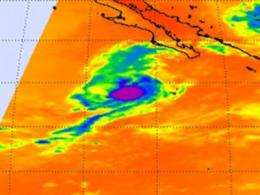
This NASA infrared AIRS satellite image shows Marty's clouds as the rounded area depicted in purple and blue, although the circulation is elongating indicating weakening. The image is from Sept. 17 at 5:11 a.m. EDT and indicates high, cold clouds and thunderstorms. Credit: NASA JPL, Ed Olsen

Marty is struggling to hold onto tropical storm status, and things are just going to get worse for him, as he moves into an area with stronger wind shear. Infrared satellite imagery from NASA's Aqua satellite showed that Marty's thunderstorm cloud tops are not as cold as they were earlier today, September 17, and his cloud pattern has become a little less organized.

Infrared imagery from NASA's Atmospheric Infrared Sounder (AIRS) indicates Marty's cloud tops have warmed slightly, indicating lower thunderstorm heights and a weakening in the storm. High thunderstorm cloud tops indicate a strong storm. When the thunderstorm cloud heights start dropping, they become less cold, and the thunderstorms are less powerful. Cloud-top temperatures are important because they tell forecasters how high thunderstorms are, and the higher the , the colder the cloud tops and the more powerful the thunderstorms.

AIRS also revealed that Marty's shape has become elongated, and when a storm begins to "stretch" its circulation becomes weaker.

Forecasters at the National Hurricane Center note, "Southwesterly shear is expected to increase during the next day or two and the cyclone will be moving into a drier and more stable air mass." As a result of moving into a more hostile environment, Marty is not expected to strengthen into a hurricane and instead begin weakening.

At 11 a.m. EDT, Marty's maximum sustained winds were near 45 mph, and he was moving north-northwest near 2 mph. His center was 300 miles southwest of the southern tip of Baja California, near 19.7 north and 113.1 west. He is expected to turn toward the northwest on Friday, September 18. Minimum central pressure is near 1003 millibars.

Marty is expected to weaken to a remnant low by the weekend.

Source: NASA/Goddard Space Flight Center

Explore further: Alaska volcano shoots ash 15,000 feet into the air

add to favorites email to friend print save as pdf

Related Stories

Recommended for you

Alaska volcano shoots ash 15,000 feet into the air

21 hours ago

(AP)—One of Alaska's most restless volcanoes has shot an ash cloud 15,000 feet into the air in an ongoing eruption that has drawn attention from a nearby community but isn't expected to threaten air traffic.

NASA sees Cyclone Mahasen hit Bangladesh

May 17, 2013

NASA's Tropical Rainfall Measuring Mission satellite known as TRMM measured Cyclone Mahasen's rainfall rates from space as it made landfall on May 16. Mahasen has since dissipated over eastern India.

Rapid climate change ruled out ice age trees

May 17, 2013

Short, sharp fluctuations in the Earth's climate throughout the last ice age may have stopped trees from getting a foothold in Europe and northern Asia, scientists say.

Earth's iron core is surprisingly weak, researchers say

May 17, 2013

The massive ball of iron sitting at the center of Earth is not quite as "rock-solid" as has been thought, say two Stanford mineral physicists. By conducting experiments that simulate the immense pressures deep in the planet's ...

User comments : 0

More news stories

Galaxy's Ring of Fire

Johnny Cash may have preferred this galaxy's burning ring of fire to the one he sang about falling into in his popular song. The "starburst ring" seen at center in red and yellow hues is not the product of ...

Alaska volcano shoots ash 15,000 feet into the air

(AP)—One of Alaska's most restless volcanoes has shot an ash cloud 15,000 feet into the air in an ongoing eruption that has drawn attention from a nearby community but isn't expected to threaten air traffic.

Chinese, Indian airlines face EU pollution fines

Eight Chinese and two Indian airlines face fines of up to several million euros for not paying for their greenhouse gas emissions during flights within the bloc, the European Commission said on Friday.

Morocco to harness the wind in energy hunt

Morocco is ploughing ahead with a programme to boost wind energy production, particularly in the southern Tarfaya region, where Africa's largest wind farm is set to open in 2014.

US seizes Bitcoin operator accounts

US authorities seized the accounts of a Bitcoin digital currency exchange operator, claiming it was functioning as an "unlicensed money service business," court documents showed Friday.