Gravitational Space Corridors Could Slash Space Travel Costs (w/ Video)
Sep 16, 2009 by Lin Edwards weblog
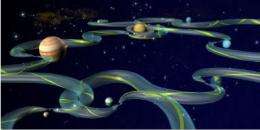
Gravitational Space Corridors. Image: Dr. Shane D. Ross

(PhysOrg.com) -- Scientists studying space travel possibilities have proposed that gravitational space corridors could be used by spacecraft, in much the same way as ships use ocean currents. Taking advantage of gravitational corridors could slash space travel costs.

A computer-generated representation of the gravitational pathways looks like flexible tubes connecting planets and moons in the . The corridors are formed by complex interactions of forces of attraction between the planets and between planets and their moons.

The gravitational corridors connect Lagrange points, which are locations where the of two large bodies exactly cancels the centripetal acceleration needed for a smaller body to rotate with them. Stable Lagrange points are positions at which a light body (such as a spacecraft or satellite) stays motionless with respect to the two larger bodies. Lagrange points, also known as L-points, were used to position the SOHO satellite in a stable, fixed position to observe the Sun.

This video is not supported by your browser at this time.
Interplanetary Superhighway animation (by Cici Koenig) Credit: Shane Ross

Scientists in the U.S. and Germany are attempting to map the corridors to allow them to be used by spacecraft exploring the solar system. One of the researchers, Shane D. Ross from the Virginia Polytechnic Institute in the U.S. described the system as a series of low energy corridors that wind between planets and moons. Once a spacecraft entered a corridor it would "fall" along the tube, much as an object falls to Earth.

The only energy required would therefore be to position the spacecraft into the tube. Professor Ross, speaking at the British Science Festival in Guildford, U.K., said the concept is different to the well-known "slingshot" effect that has been used many times in space exploration. This method puts the spacecraft in orbit around a moon, whereas the slingshot technique does not.

The gravitational corridors were used by the Genesis , which was launched in 2004. Using the pathways cut the fuel needed by the mission by a factor of ten. The mission aimed to capture samples of particles of solar wind and bring them back to Earth, and partially failed because of a parachute malfunction that resulted in some of the samples becoming contaminated.

Gravitational corridors would be particularly useful for travel between a planet's moons, Professor Ross said. For example, the corridors would allow travel between Jupiter's moons at almost no cost, since the only fuel needed would be for course corrections. The trade-off for the cost savings is time, since it would take months to travel around the system.

The gravitational corridors can slash the cost of interplanetary travel, Professor Ross said, but there will always be a need for some fuel.

More information: Optimal capture trajectories using multiple gravity assists; Stefan Jerga, Oliver Jungea, Shane D. Rossb; Communications in Nonlinear Science and Numerical Simulation, Volume 14, Issue 12, December 2009, Pages 4168-4175; doi: 10.1016/j.cnsns.2008.12.009

Dr. Shane D. Ross page: www.esm.vt.edu/~sdross/

© 2009 PhysOrg.com

Explore further: NASA head views progress on asteroid lasso mission

add to favorites email to friend print save as pdf

Related Stories

Mathematics Unites The Heavens And The Atom

Sep 28, 2005

In recent years, mathematicians have discovered an almost perfect parallel between the motion of spacecraft through the solar system and the motion of atoms in a chemical reaction - a hidden unity that has led to innovative ...

Wobbly planets could reveal Earth-like moons

Dec 11, 2008

Moons outside our Solar System with the potential to support life have just become much easier to detect, thanks to research by an astronomer at University College London (UCL).

LISA and the search for Einstein's waves

Jan 19, 2006

Scientists from across the world came together in London on 12-13 January to review the scientific and technical status of the LISA mission, the world’s first gravitational wave observatory, at a meeting ...

Grand Theft Pluto

Feb 26, 2007

When New Horizons, NASA's Pluto-bound spacecraft, swings by Jupiter on Feb. 28th, it will pick up a few souvenirs along the way – photos, data, and an extra 9000 miles per hour courtesy of the largest planet ...

Recommended for you

NASA head views progress on asteroid lasso mission

13 hours ago

Surrounded by engineers, NASA chief Charles Bolden inspected a prototype spacecraft engine that could power an audacious mission to lasso an asteroid and tow it closer to Earth for astronauts to explore.

Ecuador satellite collides with Russian space junk

13 hours ago

A small Ecuadoran satellite collided in orbit with the remains of a Russian rocket, but it is too soon to know how much damage it might have sustained, Quito's space agency said Thursday.

Forecast for Titan: Wild weather could be ahead

May 22, 2013

(Phys.org) —Saturn's moon Titan might be in for some wild weather as it heads into its spring and summer, if two new models are correct. Scientists think that as the seasons change in Titan's northern hemisphere, ...

SDO observes mid-level solar flare

May 22, 2013

UPDATE 16:30 p.m. EDT: The M7-class flare was also associated with a coronal mass ejection or CME, another solar phenomenon that can send billions of tons of particles into space. While this CME was not Ea ...

User comments : 6

Adjust slider to filter visible comments by rank

Display comments: newest first

poi
1 / 5 (1) Sep 16, 2009
so the shortest distance(+fuel over time) is no longer a straight line
Bob_Kob
not rated yet Sep 17, 2009
Well i think it would take longer by these routes, but save fuel.
Birger
not rated yet Sep 17, 2009
The "cost" is increased travel time, compared to a conventional Hochmann transfer ellipse. This method will therefore be restricted to automatic probes.
smiffy
not rated yet Sep 17, 2009
"The trade off was time, he said. It would take a few months to get round the Jovian moon system.

However, interplanetary travel would always require some fuel, Prof Ross pointed out. Attempting to get a free tube ride from Earth to Mars would take thousands of years."
http://www.telegr...ent.html
sender
not rated yet Sep 17, 2009
space fountains and energy beam relays should utilize this gravity corridor very well for energy and transport
oneuniverseonlybydefinition
not rated yet Sep 21, 2009
The article might be more palatable to a wider audience with a drifting analogy.

More news stories

A hidden population of exotic neutron stars

(Phys.org) —Magnetars – the dense remains of dead stars that erupt sporadically with bursts of high-energy radiation - are some of the most extreme objects known in the Universe. A major campaign using ...

Hubble reveals the ring nebula's true shape

(Phys.org) —The Ring Nebula's distinctive shape makes it a popular illustration for astronomy books. But new observations by NASA's Hubble Space Telescope of the glowing gas shroud around an old, dying, ...

Century-old science helps confirm global warming

(Phys.org) —Ocean measurements taken more than 135 years ago during the scientific expedition of HMS Challenger have provided further confirmation of human-produced global warming over the past century.

Hormone replacement therapy—clarity at last

The British Menopause Society and Women's Health Concern have today released updated guidelines on Hormone Replacement Therapy (HRT) to provide clarity around the role of HRT, the benefits and the risks. The new guidelines ...

Controlling mood through the motions of mitochondria

(Medical Xpress)—Regulating the distribution of power in neurons is done by a system that makes the national electric grid look simple by comparison. Each neuron has several thousand mitochondria confined ...