Electronic Nose to Return from Space Station (w/ Video)
Sep 11, 2009
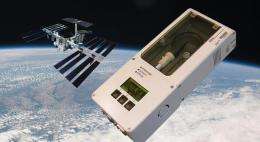
The ENose flew for six months on the International Space Station monitoring the air the astronauts breathed. Image credit: NASA/JPL

(PhysOrg.com) -- Sniffing out any potential contaminants on the International Space Station where it was stationed for the last six months, the JPL-built electronic nose, or ENose, is homeward bound.

While on the space station, the ENose sampled the air with 32 sensors that can detect various odors and pinpoint which ones are dangerous to humans. The sleek, shoebox-sized ENose, the third generation of its kind, monitored the air for 10 contaminants continuously.

"Our six-month test went very well. The ENose identified formaldehyde, Freon 218, methanol and ethanol, but all of them were at harmless levels," said Amy Ryan, principal investigator of the ENose at NASA's Jet Propulsion Laboratory, Pasadena, Calif. Ryan built the ENose at JPL and has managed the project from its early beginnings in 1996. "An instrument like this could one day remain on the Space Station and monitor air quality in real-time."

This video is not supported by your browser at this time.

In the future, the ENose could be used in monitoring crew cabins for vehicles to the moon and other destinations or be stationed on a moon base. Other potential applications include detecting a smoldering fire before it erupts, sniffing for unexploded land mines and monitoring for chemical spills in a work area. There are also possible applications in medical diagnosis.

"A human nose is not always as sensitive to chemicals as the ENose and our noses cannot even detect some hazardous chemicals," said Ryan. "The ENose can smell trouble and give people advance warning before contamination levels cause harm."

The ENose was flown to the by the Space Shuttle Endeavour STS-126 mission in December 2008. It is set to return home today on the Space Shuttle Discovery STS-128, after its 13-day flight.

Provided by JPL/ (news : web)

Explore further: Field tests in Mojave Desert pave way for human exploration of small bodies

add to favorites email to friend print save as pdf

Related Stories

NASA's ENose can sense brain cancer cells

Apr 30, 2009

(PhysOrg.com) -- An unlikely multidisciplinary scientific collaboration has discovered that an electronic nose developed for air quality monitoring on Space Shuttle Endeavour can also be used to detect odour differences in ...

NASA revises shuttle launch dates

Feb 18, 2008

The U.S. space agency has revised the launch dates for space shuttle flights during the second half of 2008, necessitated by the delayed STS-122 launch.

NASA Amends Crew Assignment for STS-126 Mission

Nov 21, 2007

NASA has replaced a crew member assigned to space shuttle mission STS-126. Astronaut Donald R. Pettit will take the place of astronaut Joan E. Higginbotham, who has left NASA to accept a position in the private sector. The ...

Recommended for you

Mars rover Opportunity examines clay clues in rock

20 hours ago

(Phys.org) —NASA's senior Mars rover, Opportunity, is driving to a new study area after a dramatic finish to 20 months on "Cape York" with examination of a rock intensely altered by water.

NASA's STEREO detects a CME from the sun

May 17, 2013

On 5:24 a.m. EDT on May 17, 2013, the sun erupted with an Earth-directed coronal mass ejection or CME, a solar phenomenon that can send billions of tons of solar particles into space that can reach Earth ...

Nine-year-old Mars rover passes 40-year-old record

May 17, 2013

While Apollo 17 astronauts Eugene Cernan and Harrison Schmitt visited Earth's moon for three days in December 1972, they drove their mission's Lunar Roving Vehicle 19.3 nautical miles (22.210 statute miles ...

Bright explosion on the Moon

May 17, 2013

For the past 8 years, NASA astronomers have been monitoring the Moon for signs of explosions caused by meteoroids hitting the lunar surface. "Lunar meteor showers" have turned out to be more common than anyone ...

User comments : 0

More news stories

Galaxy's Ring of Fire

Johnny Cash may have preferred this galaxy's burning ring of fire to the one he sang about falling into in his popular song. The "starburst ring" seen at center in red and yellow hues is not the product of ...

Earth's center is out of sync

(Phys.org) —We all know that the Earth rotates beneath our feet, but new research from ANU has revealed that the center of the Earth is out of sync with the rest of the planet, frequently speeding up and ...