Japan sends first cargo spacecraft to ISS
Sep 11, 2009
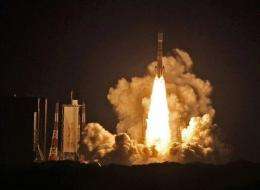
Japan's H-2B rocket carrying an unmanned HTV transportation vehicle launches from the Tanegashima Space Center on Tanegashima island, Kagoshima prefecture, Japan's southern island of Kyushu, September 11. Japan launched its first unmanned cargo spacecraft to the International Space Station, aiming for a share of space transport after the retirement of the US space shuttle fleet next year.

Japan on Friday launched its first unmanned cargo spacecraft to the International Space Station, aiming for a share of space transport after the retirement of the US space shuttle fleet next year.

The Japan Aerospace Exploration Agency (JAXA) launched the HTV transportation vehicle atop an H-2B rocket, which is also on its first flight, as scheduled just after 2:00 am (1700 GMT Thursday), agency images showed.

The vehicle separated from the rocket, as planned, about 15 minutes later.

"We want to build on this success and continue the programme," president Keiji Tachikawa told a news conference.

The agency plans to launch one such cargo spacecraft every year until 2015.

The rocket blasted off from the Tanegashima Space Centre on a southern Japanese island, with the HTV carrying 4.5 tonnes of supplies including food and daily necessities for the six ISS crew, as well as materials for experiments, such as seeds for growing plants in space.

Later this month, astronauts will for the first time operate a Canadian at the ISS to grab the HTV and dock it as the vehicle approaches the station.

The 10-metre (33-foot) long cylindrical vehicle, which cost 20 billion yen (217 million dollars), will deliver the supplies, load waste materials and return to Earth, burning up as it reenters the atmosphere.

Japan has spent 68 billion yen developing the vehicle, which could be modified in future to carry humans.

Japan currently has no spacecraft that can send people into space.

But, like China and India, it has been stepping up its space operations and in June ended the world's most extensive mission to the moon in decades, using an unmanned lunar orbiter. It hopes to send an astronaut there by 2020.

Japan faced an embarrassing failure in November 2003, when it had to destroy a rocket carrying a spy satellite 10 minutes after lift-off because one of the failed to separate from the fuselage.

Mitsubishi Heavy Industries, which helped develop the H-2B programme, hailed Friday's successful launch.

"Until now, we have not been able to meet wishes of our clients to launch large satellites," said Hideaki Omiya, Mitsubishi Heavy president. "But H-2B allows us to meet most of the requests."

The HTV can carry up to six tonnes of supplies to the ISS, compared with 7.5 tonnes for the Automated Transfer Vehicle developed by the European Space Agency, and 2.5 tonnes for Russia's Progress spacecraft, the Japanese agency said.

(c) 2009 AFP

Explore further: Curiosity Mars rover drills second rock target

add to favorites email to friend print save as pdf

Related Stories

Japan sends first cargo spacecraft to ISS

Sep 10, 2009

Japan early Friday launched its first cargo spacecraft to the International Space Station, aiming for a share of space transport after the retirement of the US space shuttle fleet next year.

Jules Verne ATV launch approaching

Feb 11, 2008

After the successful launch of ESA’s Columbus laboratory aboard Space Shuttle Atlantis on Thursday (7 February), it is now time to focus on the next imminent milestone for ESA: the launch of Jules Verne, ...

Recommended for you

Proba-V opens its eyes

20 hours ago

(Phys.org) —Earth watcher Proba-V is in good health following its launch last week. The Vegetation imager has been switched on and the first image has been captured over western France.

Mice, gerbils perish in Russia space flight

May 19, 2013

A number of mice and eight gerbils sent into space in a Russian capsule destined to find out how well organisms can withstand extended flights perished during their journey, scientists said Sunday as the ...

User comments : 1

Adjust slider to filter visible comments by rank

Display comments: newest first

earls
3 / 5 (1) Sep 11, 2009
Damn, "only" six tons, eh?

"Male African elephants weigh usually 6 tons"

That's a lot of work and fuel for one elephant. :p

More news stories

Seniors are attractive targets for online fraud

Victims of online fraud need greater support to help them overcome the often serious health effects that follow discovery of the deception, QUT cybersecurity researcher Cassandra Cross says.

Study puts Huntington's disease trials on TRACK

(Medical Xpress)—A three-year multinational study has tracked and detailed the progression of Huntington's disease (HD), predicting clinical decline in people carrying the HD gene more than 10 years before ...

No new H7N9 cases in China for a week

No new human cases of the H7N9 virus have been recorded in China for a week, national health authorities said, for the first time since the outbreak began in March.

Slow pokes: Acupuncture helps hypothermic turtles

Two endangered sea turtles that are shells of their former selves after getting stranded on Cape Cod during a cold spell are getting some help easing back into the wild—from an acupuncturist.