Japan sends first cargo spacecraft to ISS
Sep 10, 2009
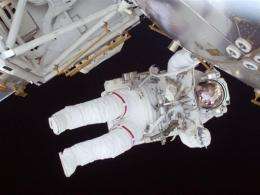
A flight engineer participates as construction and maintenance continue on the International Space Station. Japan is readying to launch its first cargo spacecraft to the International Space Station, aiming for a share of space transport after the retirement of the US space shuttle fleet next year.

Japan early Friday launched its first cargo spacecraft to the International Space Station, aiming for a share of space transport after the retirement of the US space shuttle fleet next year.

The Japan Aerospace Exploration Agency (JAXA) launched the unmanned H-II Transfer Vehicle (HTV) atop an H-IIB rocket, which is also on its first flight, as scheduled just after 2:00 am (1700 GMT Thursday), agency images showed.

The HTV was separated from the H-IIB, as planned, about 15 minutes after the launch.

The rocket blasted off from the Tanegashima Space Center on a southern Japanese island, with the HTV carrying 4.5 tons of supplies including food and daily necessities for the six ISS crew, as well as experiment materials.

Later this month, in an unprecedented attempt, astronauts will operate a Canadian at the ISS to grab the HTV and dock it as the vehicle approaches the station.

The 10-metre (33-foot) long cylindrical vehicle, which cost 20 billion yen (217 million dollars), will deliver the supplies, load waste materials and return to Earth, burning up as it reenters the atmosphere.

Japan has spent 68 billion yen developing the vehicle, which is designed to be modified in future to carry humans.

Japan currently has no spacecraft that can send man into space.

JAXA plans to launch one HTV every year until 2015.

The HTV can carry up to six tons of supplies to the ISS, compared with 7.5 tons for the Automated Transfer Vehicle developed by the , and 2.5 tons for Russia's , the Japanese agency said.

The H-IIB is also a new rocket for Japan, developed jointly by JAXA and Mitsubishi Heavy Industries.

(c) 2009 AFP

Explore further: Field tests in Mojave Desert pave way for human exploration of small bodies

add to favorites email to friend print save as pdf

Related Stories

Russian cargo spacecraft nearing ISS

Jun 17, 2005

MOSCOW, June 17 (UPI) -- A Russian cargo spacecraft has been launched into orbit successfully and will reach the International Space Station Saturday, Russian space officials said.

Japan postponed space satellite launch

Jan 18, 2006

The Japan Aerospace Exploration Agency announced Wednesday it has postponed the launch of an advanced land observation satellite due to a malfunction.

Recommended for you

Mars rover Opportunity examines clay clues in rock

1 hour ago

(Phys.org) —NASA's senior Mars rover, Opportunity, is driving to a new study area after a dramatic finish to 20 months on "Cape York" with examination of a rock intensely altered by water.

NASA's STEREO detects a CME from the sun

14 hours ago

On 5:24 a.m. EDT on May 17, 2013, the sun erupted with an Earth-directed coronal mass ejection or CME, a solar phenomenon that can send billions of tons of solar particles into space that can reach Earth ...

Nine-year-old Mars rover passes 40-year-old record

23 hours ago

While Apollo 17 astronauts Eugene Cernan and Harrison Schmitt visited Earth's moon for three days in December 1972, they drove their mission's Lunar Roving Vehicle 19.3 nautical miles (22.210 statute miles ...

Bright explosion on the Moon

23 hours ago

For the past 8 years, NASA astronomers have been monitoring the Moon for signs of explosions caused by meteoroids hitting the lunar surface. "Lunar meteor showers" have turned out to be more common than anyone ...

User comments : 2

Adjust slider to filter visible comments by rank

Display comments: newest first

RayCherry
not rated yet Sep 10, 2009
Good luck Jaxa.
docknowledge
not rated yet Sep 10, 2009
Japan really got some hard knocks in their space program -- investing all that money in the ISS, then having use of their work delayed for years by shuttle problems.

They deserved this success.

Congratulations, JAXA

More news stories

Alaska volcano shoots ash 15,000 feet into the air

(AP)—One of Alaska's most restless volcanoes has shot an ash cloud 15,000 feet into the air in an ongoing eruption that has drawn attention from a nearby community but isn't expected to threaten air traffic.

Chinese, Indian airlines face EU pollution fines

Eight Chinese and two Indian airlines face fines of up to several million euros for not paying for their greenhouse gas emissions during flights within the bloc, the European Commission said on Friday.

Bright explosion on the Moon

For the past 8 years, NASA astronomers have been monitoring the Moon for signs of explosions caused by meteoroids hitting the lunar surface. "Lunar meteor showers" have turned out to be more common than anyone ...

US seizes Bitcoin operator accounts

US authorities seized the accounts of a Bitcoin digital currency exchange operator, claiming it was functioning as an "unlicensed money service business," court documents showed Friday.