Bananas Gone Bad Glow Blue in UV-Light
Sep 09, 2009
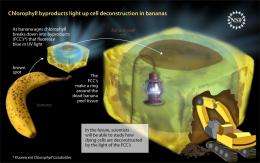
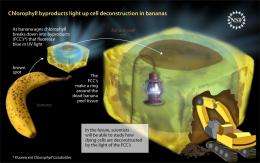
As bananas age, the chlorophyll in their peels breaks down into particles called FCCs (fluorescent chlorophyll catabolites). Since these glowing particles occur in close proximity to dying tissue, they hold promise of lighting the way in studying programmed cell death. Credit: Zina Deretsky, National Science Foundation

(PhysOrg.com) -- Nicholas Turro of Columbia University, Bernhard Krautler of the University of Innsbruck, Austria and their colleagues have found that, as chlorophyll ages and begins to disintegrate in banana peels it does not change color in the spectrum of visible light we see. Instead, it glows blue when observed under ultraviolet light.

While the light show adds a level of exoticism to the fruit in our eyes, and serves to attract a host of potential consumers in the eyes of insects and other animals who can appreciate the UV, the display is equally exciting to chemists. Because the glowing molecules occur in close proximity to dying tissue, they promise to be a literal beacon for the further study of the way organisms cleanse themselves of dying cells, or programmed cell death. A well known and poorly understood condition in which programmed cell death malfunctions is cancer.

Turro and his colleagues describe how ordinary brown spots that form on bananas as they transition from ripe to rotten, each show a glowing blue halo in UV, caused by the congregation of chlorophyll breakdown byproducts. Their research appears in the Proceedings of the National Academies of Science.
Ripening bananas glow blue in UV light, developing halos around the dying tissue of the dark spots. On the right is a photograph of a banana using "white" daylight. On the right is a photo showing the banana in "black" light. Credit: Simone Moser, University of Innsbruck, Austria, et al.

Chlorophyll is the molecule that makes much of the life on earth possible. It is the integral ingredient that allows plants to take in a mixture of carbon dioxide, water and sunlight and convert it to oxygen, sugars and starches. These are the same sugars and starches we eat every time we fix a salad, and the same oxygen that we breathe.

Chlorophylls are ubiquitous on earth and their life processes are clearly visible even from outer space. As chlorophylls age and break down they can do so in spectacular displays. The most familiar of these is the red and yellow of fall foliage. However, not every chlorophyll molecule that breaks down results in red or yellow.

"This work brings to fruition some of the remarkable principles of fundamental organic photochemistry harvested from more than four decades of Professor Turro's research at Columbia" says George Kenyon, program officer in the National Science Foundation's Chemistry Division.

Provided by NSF

Explore further: Overcoming resistance to anti-cancer drugs by targeting cell 'powerhouses'

add to favorites email to friend print save as pdf

Related Stories

Ripe Fruit Preferred

Nov 05, 2007

Fall, the season of colors: Leaves turn red, yellow, and brown. The disappearance of the color green and the simultaneous appearance of these other colors are also signs of ripening fruit.

Odd energy mechanism in bacteria analyzed

Nov 04, 2005

Scientists at Oregon State University have successfully cultured in a laboratory a microorganism with a gene for an alternate form of photochemistry – an advance that may ultimately help shed light on the ecology of the ...

How green is my planet?

Feb 15, 2006

Scientists from Bournemouth University and the University of Southampton have devised a new method of examining how much of the earth's surface is covered by vegetation and assessing the state of health of ...

Recommended for you

DNA damage: The dark side of respiration

2 hours ago

(Phys.org) —Adventitious changes in cellular DNA can endanger the whole organism, as they may lead to life-threatening illnesses like cancer. Researchers at LMU now report how byproducts of respiration cause mispairing ...

Protein study suggests drug side effects are inevitable

May 20, 2013

A new study of both computer-created and natural proteins suggests that the number of unique pockets – sites where small molecule pharmaceutical compounds can bind to proteins – is surprisingly small, meaning drug side ...

User comments : 1

Adjust slider to filter visible comments by rank

Display comments: newest first

RayCherry
not rated yet Sep 10, 2009
CSI Jamaica ...

More news stories

DNA damage: The dark side of respiration

(Phys.org) —Adventitious changes in cellular DNA can endanger the whole organism, as they may lead to life-threatening illnesses like cancer. Researchers at LMU now report how byproducts of respiration cause mispairing ...

How healthy are you for your age?

On May 22, JoVE will publish details of a technique to measure the health of human genetic material in relation to a patient's age. The method is demonstrated by the laboratory of Dr. Gil Atzmon at New York's Albert Einste ...

Addiction as a disorder of decision-making

New research shows that craving drugs such as nicotine can be visualized in specific regions of the brain that are implicated in determining the value of actions, in planning actions and in motivation. Dr. Alain Dagher, from ...