Space shuttle undocks from space station
Sep 08, 2009 By MARCIA DUNN , AP Aerospace Writer
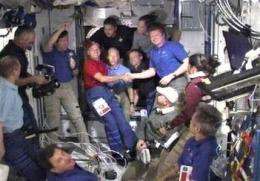
In this image made from video provided by NASA astronaut John "Danny" Olivas, STS-128 mission specialist, center left, shakes hands and thanks the commander of the space station Russia's Federal Space Agency cosmonaut Gennady Padalka before the hatches between the orbiting shuttle and station close Monday Sept. 7, 2009. The shuttle will undock Tuesday. (AP Photo/NASA)

(AP) -- Space shuttle Discovery has left the international space station.

Discovery undocked from the space station Tuesday afternoon as the two craft soared over China. Its departure ended more than a week of linked flight, in which tons of supplies and equipment were dropped off. The shuttle and its crew of seven are due back on Earth on Thursday.

Six were left behind on the orbiting outpost to continue their own lengthy missions.

The two crews embraced and said goodbye late Monday.

NASA, meanwhile, says it will not have to move the space station out of the way of a piece of space junk that will come within 15 miles Wednesday. It's a fragment from a Chinese satellite that was blasted by a missile two years ago.

©2009 The Associated Press. All rights reserved. This material may not be published, broadcast, rewritten or redistributed.

Explore further: NASA's STEREO detects a CME from the sun

add to favorites email to friend print save as pdf

Related Stories

Discovery Separates From Space Station

Aug 06, 2005

After more than a week of working together in space, the Space Shuttle Discovery and International Space Station crews bid each other farewell tonight. Space Shuttle Discovery undocked from the International Spa ...

Recommended for you

NASA's STEREO detects a CME from the sun

11 hours ago

On 5:24 a.m. EDT on May 17, 2013, the sun erupted with an Earth-directed coronal mass ejection or CME, a solar phenomenon that can send billions of tons of solar particles into space that can reach Earth ...

Nine-year-old Mars rover passes 40-year-old record

19 hours ago

While Apollo 17 astronauts Eugene Cernan and Harrison Schmitt visited Earth's moon for three days in December 1972, they drove their mission's Lunar Roving Vehicle 19.3 nautical miles (22.210 statute miles ...

Bright explosion on the Moon

20 hours ago

For the past 8 years, NASA astronomers have been monitoring the Moon for signs of explosions caused by meteoroids hitting the lunar surface. "Lunar meteor showers" have turned out to be more common than anyone ...

User comments : 0

More news stories

Chinese, Indian airlines face EU pollution fines

Eight Chinese and two Indian airlines face fines of up to several million euros for not paying for their greenhouse gas emissions during flights within the bloc, the European Commission said on Friday.

Alaska volcano shoots ash 15,000 feet into the air

(AP)—One of Alaska's most restless volcanoes has shot an ash cloud 15,000 feet into the air in an ongoing eruption that has drawn attention from a nearby community but isn't expected to threaten air traffic.

Fracking risks to ground water assessed

(Phys.org) —Extraction of "unconventional" gas from sedimentary rocks such as shale could provide a clean energy source and help some regions to become energy independent, but concerns have been raised ...

Bright explosion on the Moon

For the past 8 years, NASA astronomers have been monitoring the Moon for signs of explosions caused by meteoroids hitting the lunar surface. "Lunar meteor showers" have turned out to be more common than anyone ...

US seizes Bitcoin operator accounts

US authorities seized the accounts of a Bitcoin digital currency exchange operator, claiming it was functioning as an "unlicensed money service business," court documents showed Friday.

Temporal processing in the olfactory system

The neural machinery underlying our olfactory sense continues to be an enigma for neuroscience. A recent review in Neuron seeks to expand traditional ideas about how neurons in the olfactory bulb might encode information about ...