Improved seismology tools can detect and locate low-yield nuclear explosions
Aug 31, 2009
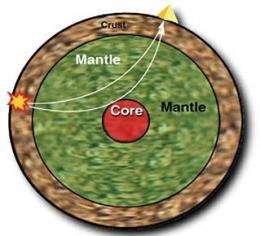
Energetic seismic waves propogate over long distances in the earth's crust and mantle.

Lawrence Livermore National Laboratory is leading a joint project with Los Alamos and Sandia national laboratories, as well as the Air Force Technical Applications Center (AFTAC) and Quantum Technology Sciences, Inc., to improve the accuracy of regional seismic travel time (RSTT) predictions to detect and locate low-yield nuclear explosions.

While seismic research is most often associated with earthquakes, seismic technology is also the primary means to detect, locate and identify underground nuclear explosions.

Underground nuclear testing plays a pivotal role in the persistent and well-documented efforts by states to develop and improve explosive nuclear devices.

Nuclear tests are no longer frequent. However, there are 30- 40 earthquakes of magnitude 4 and greater every day — about 10,000 per year. A magnitude 4 earthquake releases energy on the order of a one-kiloton nuclear explosion. Identification and location of the rare, and possibly covert nuclear test, within the cacophony of natural and man-made background seismic activity, is a major national security scientific challenge that NNSA and its labs are in a unique position to meet.

Scientists study the seismic traces (waveform records of the surface ground motion as a function of time, acquired by digital equipment) from networks of seismometers all over the world.

The long-term effort to improve seismic event location accuracy significantly increases the accuracy of RSTT predictions. The newly developed RSTT model embodies three-dimensional variations in seismic wave speed in the earth's crust as well as lateral variability in speed in the earth's upper mantle.

The RSTT model increases the location accuracy of small events, previously undetectable at great distance. Tests across Eurasia show that the RSTT model improves median location accuracy by 46 percent (from 17.3 km using a standard one-dimensional model to 9.3 km using the RSTT model).

NNSA efforts have reduced regional location error for small yield events to a level that, until recently, was only achieved for large, globally recorded events.

This NNSA-funded effort has resulted in a significant improvement in regional seismic event location accuracy and further improvement can be expected as complementary research projects mature, thus improving our ability to detect lower yield events.

Provided by Lawrence Livermore National Laboratory

Explore further: Comprehensive analysis of impact spherules supports theory of cosmic impact 12,800 years ago

add to favorites email to friend print save as pdf

Related Stories

Deadly Mine 'Bump' was Recorded as Seismic Event

Aug 17, 2007

The University of Utah Seismograph Stations recorded a magnitude-1.6 seismic event at the time of a Thursday, Aug. 16 "bump" that killed and injured rescuers at a Utah coal mine where six miners were trapped by an Aug. 6 ...

Liverpool scientist discovers new layer of the Earth

Apr 14, 2005

A University of Liverpool scientist has discovered a new layer near the Earth's core, which will enable the internal temperature of the Earth's mantle to be measured at a much deeper level than previously possible.

Seismologists confirm Utah mine collapse caused temblor

Aug 10, 2007

A 3.9 magnitude temblor recorded at the time of a mine collapse in southern Utah on Monday, Aug. 6, was not from an earthquake, but more likely the result of the collapse itself, according to an analysis by ...

Recommended for you

NASA's BARREL mission launches 20 balloons

7 hours ago

(Phys.org) —In Antarctica in January, 2013 – the summer at the South Pole – scientists released 20 balloons, each eight stories tall, into the air to help answer an enduring space weather question: ...

Power of US tornado dwarfs Hiroshima bomb

8 hours ago

Wind, humidity and rainfall combined precisely to create Monday's massive killer tornado in Oklahoma. The awesome amount of energy released dwarfed the power of the atomic bomb that leveled Hiroshima.

Origins of human culture linked to rapid climate change

15 hours ago

Rapid climate change during the Middle Stone Age, between 80,000 and 40,000 years ago, during the Middle Stone Age, sparked surges in cultural innovation in early modern human populations, according to new research.

User comments : 0

More news stories

NASA's BARREL mission launches 20 balloons

(Phys.org) —In Antarctica in January, 2013 – the summer at the South Pole – scientists released 20 balloons, each eight stories tall, into the air to help answer an enduring space weather question: ...

Power of US tornado dwarfs Hiroshima bomb

Wind, humidity and rainfall combined precisely to create Monday's massive killer tornado in Oklahoma. The awesome amount of energy released dwarfed the power of the atomic bomb that leveled Hiroshima.

If you can remember it, you can remember it wrong

(Medical Xpress)—Native peoples in regions where cameras are uncommon sometimes react with caution when their picture is taken. The fear that something must have been stolen from them to create the photo ...

Encouraging signs for bee biodiversity

Declines in the biodiversity of pollinating insects and wild plants have slowed in recent years, according to a new study. Researchers led by the University of Leeds and the Naturalis Biodiversity Centre in the Netherlands ...

B vitamins could delay dementia

(Medical Xpress)—Despite spending billions of dollars on research and development, drug companies have been unable to come up with effective treatments for dementia and Alzheimer's Disease (AD). Now, A. ...