Invasive mussel may inspire new adhesive
Aug 27, 2009
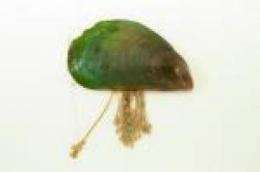
This is a Florida Green Mussel. Credit: Rod Rolle

(PhysOrg.com) -- The green mussel is known for being a notoriously invasive fouling species, but scientists have just discovered that it also has a very powerful form of adhesion in its foot, according to a recent article in the Journal of Biological Chemistry. The stickiness of the mussel's foot could possibly be copied to form new man-made adhesives.

Other mussels have inspired synthetic polymers that have been made into versatile adhesives and coatings, explained J. Herbert Waite, senior author and a professor in UC Santa Barbara's Marine Science Institute. They all rely on proteins that contain an amino acid called "Dopa," (identical to the Dopa used to treat Parkinson's disease) and have been studied extensively by Waite and his research group.

Waite learned that the green mussel, Perna viridis, relies on an alternative to the common "Dopa" chemistry, based on an elaborate modification of the amino acid tryptophan in the green mussel's adhesive protein. Its adhesive chemistry is much more complicated than that of mussels previously studied. It took Waite and his team six years to unravel the story.

The green mussel's sticky adhesiveness has the potential to help form strong bonds in wet surfaces, including teeth and bones. In addition, the adhesive could be used to repair ships that have developed cracks while at sea and must be repaired in a wet environment.

Waite was first alerted to the complicated adhesive of the green mussel when a Japanese group contacted him to comment on their research on the animal. He then learned of an infestation of green mussels in Tampa Bay, Fla.

On further study, he learned that the aggressive green mussel had moved from India's Sea of Bengal to many locations around the world, including the coasts of Japan, Australia, Korea, China, the Philippines, and Indonesia. Additionally, many Pacific Islands and the coasts of some countries surrounding the Gulf of Mexico have been invaded. "People are interested in how they invade, adapt, and spread so easily," said Waite.

Waite asked the U.S. Geological Survey and Florida Sea Grant to send him frozen specimens from Tampa Bay, as this is the only way that California would allow the green mussel to be shipped into the state. The feet were severed from about 100 freshly shucked mussels. After thawing, they were placed in a tissue grinder and then centrifuged for study.

"One aspect that is kind of scary is that the green mussel is more successful than other kinds of mussels at living in polluted water," said Waite. Coastal power plants that flush warm seawater into the ocean provide an ideal environment for the mussels. "Once they get a foothold, they stay."

Source: University of California - Santa Barbara (news : web)

Explore further: Attacking MRSA with metals from antibacterial clays

add to favorites email to friend print save as pdf

Related Stories

Study reveals details of mussels' tenacious bonds

Aug 15, 2006

When it comes to sticking power, marine mussels are hard to beat. They can adhere to virtually all inorganic and organic surfaces, sustaining their tenacious bonds in saltwater, including turbulent tidal environments. Little ...

Recommended for you

Attacking MRSA with metals from antibacterial clays

May 17, 2013

In the race to protect society from infectious microbes, the bugs are outrunning us. The need for new therapeutic agents is acute, given the emergence of novel pathogens as well as old foes bearing heightened antibiotic resistance.

Keeping fruit, vegetables and cut flowers fresh longer

May 15, 2013

New technology offers the promise of reducing billions of dollars of losses that occur each year from the silent, invisible killer of fruits, vegetables and cut flowers—a gas whose effects are familiar to everyone who has ...

Why don't beetles freeze in the winter?

May 14, 2013

For 37 years, Queen's University Biochemistry professor Peter Davies has been unraveling the mystery of why some organisms including insects and fish don't freeze in the winter. His research into insect antifreeze protein ...

The molecular basis of strawberry aroma

May 13, 2013

You know that summer is here when juicy red strawberries start to appear on the shelves. In Germany, this seasonal fruit has never been more popular: on average 3.5 kilos per head were consumed in 2012—a ...

A new dimension for 3-D protein structures

May 13, 2013

(Phys.org) —3D structures of biological molecules like proteins directly affect the way they behave in our bodies. EPFL scientists have developed a new infrared-UV laser method to more accurately determine ...

User comments : 0

More news stories

Attacking MRSA with metals from antibacterial clays

In the race to protect society from infectious microbes, the bugs are outrunning us. The need for new therapeutic agents is acute, given the emergence of novel pathogens as well as old foes bearing heightened antibiotic resistance.

Beautiful 'flowers' self-assemble in a beaker

By simply manipulating chemical gradients in a beaker of fluid, materials scientists at Harvard have found that they can control the growth behavior of crystals to create precisely tailored structures—such ...

Making gold green: New non-toxic method for mining gold

Northwestern University scientists have struck gold in the laboratory. They have discovered an inexpensive and environmentally benign method that uses simple cornstarch—instead of cyanide—to isolate gold from raw materials ...

Galaxy's Ring of Fire

Johnny Cash may have preferred this galaxy's burning ring of fire to the one he sang about falling into in his popular song. The "starburst ring" seen at center in red and yellow hues is not the product of ...

US seizes Bitcoin operator accounts

US authorities seized the accounts of a Bitcoin digital currency exchange operator, claiming it was functioning as an "unlicensed money service business," court documents showed Friday.