Discovery of natural odors could help develop mosquito repellents (w/ Video)
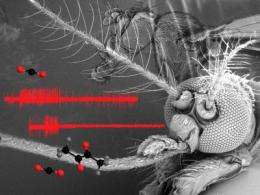
(PhysOrg.com) -- Entomologists at the University of California, Riverside working on fruit flies in the lab have discovered a novel class of compounds that could pave the way for developing inexpensive and safe mosquito repellents for combating West Nile virus and other deadly tropical diseases.
When fruit flies undergo stress, they emit carbon dioxide (CO2) that serves as a warning to other fruit flies that danger or predators could be nearby. The fruit flies are able to detect the CO2 and escape because their antennae are equipped with specialized neurons that are sensitive to the gas.
But fruits and other important food sources for fruit flies also emit CO2 as a by-product of respiration and ripening. If the innate response of the fruit fly is to avoid CO2, how then does it find its way to these foods?
Anandasankar Ray, an assistant professor in the Department of Entomology, and Stephanie Turner, his graduate student, now provide an answer to the paradox.
They have identified a new class of odorants - chemical compounds with smells - present in ripening fruit that prevent the CO2-sensitive neurons in the antennae from functioning. In particular two odors, hexanol and 2,3- butanedione, are strong inhibitors of the CO2-sensitive neurons in the fruit fly.
The research has strong implications for control of deadly diseases transmitted by Culex mosquitoes such as West Nile virus disease and filariasis, an infectious tropical disease affecting the lymphatic system. Since 1999, nearly 29,000 people in the United States have been reported with West Nile virus disease. Lymphatic filariasis has affected more than 120 million people in the world.
"CO2 emitted in human breath is the main attractant for the Culex mosquito to find people, aiding the transmission of these deadly diseases," Ray said. "In our experiments we identified hexanol, and a related odor, butanal, as strong inhibitors of CO2-sensitive neurons in Culex mosquitoes. These compounds can now be used to guide research in developing novel repellents and masking agents that are economical and environmentally safe methods to block mosquitoes' ability to detect CO2 in our breath, thereby dramatically reducing mosquito-human contact."
Study results appear Aug. 26 in the advance online publication of Nature.
"This is a beautiful study that breaks new ground in the field of olfaction," said John Carlson, the Eugene Higgins Professor of Molecular, Cellular and Developmental Biology at Yale University, who was not involved in the research. "It shows that certain odorants can strongly inhibit the response of receptors that detect CO2. The results suggest some very interesting new strategies for the control of certain insect pests."
Besides showing that inhibitory odors can play an important role in modifying insect behavior, the research paper also illustrates how some of these odors have a long-term effect. Ray and Turner found, for example, that some odors silenced the CO2 neuron in the fruit fly well beyond the period of application.
"To our surprise, we found that exposure to a long-term CO2 response inhibitor can exert a profound and specific effect on the behavior of the insect, even after the inhibitor is no longer in the environment," Ray said. "This means this odorant could potentially be used to keep mosquitoes at bay for longer periods of time, benefiting people in areas where mosquito-transmitted diseases are prevalent."
Ray received his doctoral degree in molecular, cellular and developmental biology from Yale University in 2005. He joined UC Riverside in 2007. His awards include Yale University's John Spangler Nicholas Prize and the Polak Young Investigator Award from the Association of Chemoreception Sciences.
Originally from India, Ray contracted malaria during childhood. When his wife caught dengue fever on a trip to India a few years ago, he decided to intensify his research on mosquito-borne diseases.
Stephanie Turner, the first author of the research paper, received her bachelor's degree in biochemistry from UC Santa Cruz, where she performed research as an undergraduate. She worked for two years in biotechnology before joining the Cell, Molecular and Developmental Biology Graduate Program at UCR.
The research related to this project was conceived, initiated and carried out at UCR over the past one year, and was supported by UCR startup funds. Ray has plans to launch a startup company in the near future to take his basic science research on the odorants from the lab to applications that directly benefit people.
Ray and Turner already have begun work in the lab on mosquitoes that cause malaria and dengue fever. They also are setting up collaborations with a number of scientists from around the globe to do research on various mosquito species and tsetse flies.
The UCR Office of Technology Commercialization has filed a patent application on the discovery.
Source: University of California - Riverside (news : web)


