The Perseids are Coming
Aug 10, 2009 by Dr. Tony Phillips
The Perseids are Coming
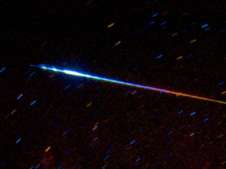
A "side window" Perseid Earthgrazer. Image Credit: S. Kohle & B. Koch (Astron. I., U. Bonn).

Splat! There goes another bug on the windshield. Anyone who's ever driven down a country lane has seen it happen. A fast moving car, a cloud of multiplying insects, and a big disgusting mess.

The next time that happens to you, instead of feeling grossed out, try thinking of the experience as an astronomy lesson. Your car is Earth. The bugs are tiny flakes of comet dust. The carnage on your windshield ... it's a meteor shower!

Earth, like a speeding car, races around the Sun sweeping up everything in its path. There are no insects in space, but there are plenty of meteoroids, little flakes of dust from comets and asteroids. They hit Earth's atmosphere and--splat!--they disintegrate as fiery streaks of light called meteors.

This week lots of meteors will appear over Earth's when our planet plows through a swarm of dust shed by periodic comet Swift-Tuttle. It's the annual , which peaks on August 11th and 12th.

Just as bugs tend to accumulate on the front windshield of a car, Perseids accumulate on the front windshield of Earth.

Earth has a windshield? It's the atmosphere, which protects us from solar wind and comet dust much as a car's windshield protects passengers from wind, rain and bugs. Earth's front windshield is the early morning sky. Earth circles the Sun dawn-side first, scooping up whatever lies on that side of the planet. That's why it's usually best to look for Perseids just before dawn.

A good time to see Perseids this year is before dawn on Wednesday morning, August 12th, when Earth's front windshield is overhead.

Side windows, the ones to the left and right of passengers in cars, are good, too. Zooming down a bug-infested lane, side windows don't intercept many insects, but the ones they do gather are worth examining. Bugs that strike side windows do so at a shallow angle, leaving long and colorful streaks.

This also happens to meteors. When the constellation Perseus (the source of the Perseids) hangs low near the horizon, meteors streaming from Perseus will skim the the top of Earth's atmosphere, much like a bug skimming the side window of an automobile. Astronomers call these meteors "Earthgrazers." They tend to be long and colorful.

Look for Perseid Earthgrazers on Tuesday night, Aug. 11th, between 9:00 and 11:00 p.m. local time.

This year, evening Earthgrazers on August 11th could be the best part of the show, because the Moon and its interfering glare will be below the horizon in early evening. Dark skies = good meteor watching. Later, when Earth's "front windshield" rises, the Moon will rise with it, reducing the number of Perseids you'll be able to see before sunrise on August 12th.

Earthgrazers don't come in large numbers. The special geometry required to produce them keeps counts low, but even one or two is enough. A breathtaking Earthgrazer is the sort of meteor you're likely to remember for years.

Best of all, there's no gooey residue.

Source: Science@NASA

Explore further: Curiosity Mars rover drills second rock target

add to favorites email to friend print save as pdf

Related Stories

Perseid Earthgrazers

Aug 08, 2006

Blame it on the Moon: The 2006 Perseid meteor shower is going to be a dud. Oh, Earth will pass through the Perseid meteoroid stream, as usual. And meteors will flit across the sky. But when the shower peaks ...

The Perseids are Coming

Jul 31, 2009

Earth is entering a stream of dusty debris from Comet Swift-Tuttle, the source of the annual Perseid meteor shower. Although the shower won't peak until August 11th and 12th, the show is already getting underway. ...

Perseid Meteor Shower To Peak Aug. 12

Aug 07, 2008

The annual Perseid meteor shower will be visible in the night sky throughout Colorado and will peak during the early morning hours of Aug. 12, according to an astronomy expert at the University of Colorado ...

Recommended for you

Proba-V opens its eyes

18 hours ago

(Phys.org) —Earth watcher Proba-V is in good health following its launch last week. The Vegetation imager has been switched on and the first image has been captured over western France.

Mice, gerbils perish in Russia space flight

May 19, 2013

A number of mice and eight gerbils sent into space in a Russian capsule destined to find out how well organisms can withstand extended flights perished during their journey, scientists said Sunday as the ...

Mars rover Opportunity examines clay clues in rock

May 18, 2013

(Phys.org) —NASA's senior Mars rover, Opportunity, is driving to a new study area after a dramatic finish to 20 months on "Cape York" with examination of a rock intensely altered by water.

User comments : 1

Adjust slider to filter visible comments by rank

Display comments: newest first

yyz
not rated yet Aug 11, 2009
You might want to check out how you can track Perseids using simple radio methods (impervious to clouds or time of day)over at the Universe Today post here: http://www.univer...lintott/ . Even if clouded out, this method could still be employed as a way to 'observe' Perseids and other major showers over the course of a year. Why not give it a try, since the components are very east to come by.

More news stories

Slow earthquakes: It's all in the rock mechanics

(Phys.org) —Earthquakes that last minutes rather than seconds are a relatively recent discovery, according to an international team of seismologists. Researchers have been aware of these slow earthquakes, ...

New immune system discovered

(Medical Xpress)—A research team, led by Jeremy Barr, a biology post-doctoral fellow, unveils a new immune system that protects humans and animals from infection.

Lab sets a new record for creating heralded photons

(Phys.org) —Entanglement, by general consensus of physicists, is the weirdest part of quantum science. To say that two particles, A and B, are entangled means that they are actually two parts of an inseparable ...