The Perseids are Coming
Jul 31, 2009

Earth is entering a stream of dusty debris from Comet Swift-Tuttle, the source of the annual Perseid meteor shower. Although the shower won't peak until August 11th and 12th, the show is already getting underway.

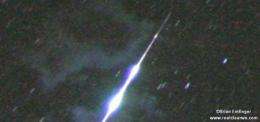
Brian Emfinger of Ozark, Arkansas, photographed this early Perseid just after midnight on Sunday, July 26th (see above).

"I used an off-the-shelf digital camera to capture this fireball and its smoky trail," says Emfinger. "It was a bright one!"

Don't get too excited, cautions Bill Cooke of NASA's Meteoroid Environment Office. "We're just in the outskirts of the debris stream now. If you go out at night and stare at the sky, you'll probably only see a few Perseids per hour."

This will change, however, as August unfolds.

"Earth passes through the densest part of the debris stream sometime on August 12th. Then, you could see dozens of meteors per hour."

For sky watchers in North America, the watch begins after nightfall on August 11th and continues until sunrise on the 12th. Veteran observers suggest the following strategy: Unfold a blanket on a flat patch of ground. (Note: The middle of your street is not a good choice.) Lie down and look up. Perseids can appear in any part of the sky, their tails all pointing back to the shower's radiant in the constellation Perseus. Get away from city lights if you can.

There is one light you cannot escape on August 12th. The 55% gibbous Moon will glare down from the constellation Aries just next door to the shower's radiant in Perseus. The Moon is beautiful, but don't stare at it. Bright moonlight ruins night vision and it will wipe out any faint Perseids in that part of the sky.

The Moon is least troublesome during the early evening hours of August 11th. Around 9 to 11 p.m. local time (your local time), both Perseus and the will be hanging low in the north. This low profile reduces lunar glare while positioning the shower's radiant for a nice display of Earthgrazers.

"Earthgrazers are meteors that approach from the horizon and skim the atmosphere overhead like a stone skipping across the surface of a pond," explains Cooke. "They are long, slow and colorful—among the most beautiful of meteors." He notes that an hour of watching may net only a few of these at most, but seeing even one can make the whole night worthwhile.

The Perseids are coming. Enjoy the show.

Source: Science@NASA, by Dr. Tony Phillips

Explore further: NASA head views progress on asteroid lasso mission

add to favorites email to friend print save as pdf

Related Stories

Perseid Earthgrazers

Aug 08, 2006

Blame it on the Moon: The 2006 Perseid meteor shower is going to be a dud. Oh, Earth will pass through the Perseid meteoroid stream, as usual. And meteors will flit across the sky. But when the shower peaks ...

Natural fireworks, courtesy of the Perseid meteor shower

Aug 07, 2007

As the Perseid meteor shower becomes visible in all its glory on 13 August, natural fireworks will fill the sky. Showers of meteors, or ‘shooting stars’, appear as bright streaks of light in the sky. The ...

Recommended for you

NASA head views progress on asteroid lasso mission

1 hour ago

Surrounded by engineers, NASA chief Charles Bolden inspected a prototype spacecraft engine that could power an audacious mission to lasso an asteroid and tow it closer to Earth for astronauts to explore.

Ecuador satellite collides with Russian space junk

1 hour ago

A small Ecuadoran satellite collided in orbit with the remains of a Russian rocket, but it is too soon to know how much damage it might have sustained, Quito's space agency said Thursday.

Forecast for Titan: Wild weather could be ahead

May 22, 2013

(Phys.org) —Saturn's moon Titan might be in for some wild weather as it heads into its spring and summer, if two new models are correct. Scientists think that as the seasons change in Titan's northern hemisphere, ...

SDO observes mid-level solar flare

May 22, 2013

UPDATE 16:30 p.m. EDT: The M7-class flare was also associated with a coronal mass ejection or CME, another solar phenomenon that can send billions of tons of particles into space. While this CME was not Ea ...

User comments : 2

Adjust slider to filter visible comments by rank

Display comments: newest first

Nartoon
3 / 5 (2) Aug 01, 2009
Don't forget the bug spray!
RayCherry
5 / 5 (1) Aug 04, 2009
:-) Good advice about the blanket, location and bug spray. I also recommend a flask of tea and a box of sandwiches, low power binoculars, an LED torch and a sky map indicating where the meteors are coming from.

Note that if you use the binoculars too much, you will miss the meteors that light up in the periphery of your vision, and your arms will ache like hell the next day!

Hope you have a great show.

More news stories

Hubble reveals the ring nebula's true shape

(Phys.org) —The Ring Nebula's distinctive shape makes it a popular illustration for astronomy books. But new observations by NASA's Hubble Space Telescope of the glowing gas shroud around an old, dying, ...

NASA head views progress on asteroid lasso mission

Surrounded by engineers, NASA chief Charles Bolden inspected a prototype spacecraft engine that could power an audacious mission to lasso an asteroid and tow it closer to Earth for astronauts to explore.

A hidden population of exotic neutron stars

(Phys.org) —Magnetars – the dense remains of dead stars that erupt sporadically with bursts of high-energy radiation - are some of the most extreme objects known in the Universe. A major campaign using ...