Wildfires set to increase 50 percent by 2050
Jul 28, 2009
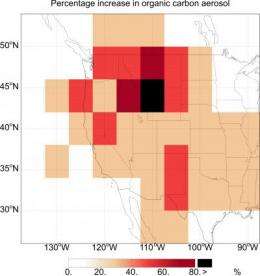
This graph shows the percentage increase in organic carbon particles at the surface, from the present-day to the 2050s, as calculated by the model of Spracklen et al. [2009] for the May-October fire season. The increase is due mainly to the simulated rise in wildfire frequency in the future, warmer climate. Credit: Loretta Mickley, Harvard School of Engineering and Applied Sciences

The area of forest burnt by wildfires in the United States is set to increase by over 50% by 2050, according to research by climate scientists.

The study predicts that the worst affected areas will be the forests in the Pacific Northwest and the Rocky Mountains, where the area of forest destroyed by wildfire is predicted to increase by 78% and 175% respectively.

The research is based on a conservative of 1.6 degrees Celsius over the next 40 years.

Published in the Journal of Geophysical Research, scientists also say that the increase in wildfires will lead to significant deterioration of the in the western United States due to greater presence of smoke.
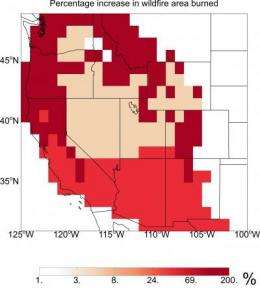
This graph shows the percentage increase in area burned by wildfires, from the present-day to the 2050s, as calculated by the model of Spracklen et al. [2009] for the May-October fire season. The model follows a scenario of moderately increasing emissions of greenhouse gas emissions and leads to average global warming of 1.6 oCelsius (3oFahrenheit ) by 2050. Warmer temperatures can dry out underbrush, leading to more serious conflagrations in the future climate. Credit: Loretta Mickley, Harvard School of Engineering and Applied Sciences

"Wildfires, such as those in California earlier this year, are a serious problem in the United States and this research shows that climate change is going to make things significantly worse," says Dr Dominick Spracklen, from the School of Earth and Environment at the University of Leeds who is the lead author of the research.

"Our research shows that wildfires are strongly influenced by temperature. Hotter temperatures lead to dryer forests resulting in larger and more serious fires," explains Spracklen.

"In the Rocky Mountains we are predicting that the area burnt by wildfires will almost triple by 2050."

Scientists used data documenting the area of forest burned on federal land since 1980 along with weather data from the United States Department of Agriculture Forest Service, to construct a computer model that takes into account the factors that can best predict the area burned in each ecosystem in the western US.

Significantly, the research also predicts a 40% increase in the western United States in the concentration of tiny soot particles in the air, known to scientists as organic carbon aerosol. This will have important consequences on western US air quality and visibility.

"The US government has introduced legislation to try to improve air quality and visibility by 2064. Currently the main focus for environment agencies and campaigners is industry, but this research shows that, especially in the western US, wildfires will become an increasing source of air pollution," explains Dr Spracklen.

More information: The paper 'Impacts of from 2000 to 2050 on wildfire activity and carbonaceous aerosol concentrations in the western United States', published in the .

Source: University of Leeds (news : web)

Explore further: Sea level influenced tropical climate during the last ice age

add to favorites email to friend print save as pdf

Related Stories

Bushfire impact on water yields

Jan 22, 2008

While forest fires can often result in an initial increase in water runoff from catchments, it’s the forests and bush growing back that could cause future problems for water supplies by reducing stream flows.

Daily forecasts track smoke from southern fires

May 30, 2007

At the request of the Georgia State Department of Health, scientists with the Southern Research Station Smoke Management Team located at the Center for Forest Disturbance Science in Athens, GA, are producing daily smoke forecasts ...

Recommended for you

Alaska volcano shoots ash 15,000 feet into the air

May 18, 2013

(AP)—One of Alaska's most restless volcanoes has shot an ash cloud 15,000 feet into the air in an ongoing eruption that has drawn attention from a nearby community but isn't expected to threaten air traffic.

NASA sees Cyclone Mahasen hit Bangladesh

May 17, 2013

NASA's Tropical Rainfall Measuring Mission satellite known as TRMM measured Cyclone Mahasen's rainfall rates from space as it made landfall on May 16. Mahasen has since dissipated over eastern India.

Rapid climate change ruled out ice age trees

May 17, 2013

Short, sharp fluctuations in the Earth's climate throughout the last ice age may have stopped trees from getting a foothold in Europe and northern Asia, scientists say.

User comments : 2

Adjust slider to filter visible comments by rank

Display comments: newest first

jonnyboy
3 / 5 (2) Jul 29, 2009
more BS
RAL
not rated yet Jul 29, 2009
Should be easy enough to compare the average US termperature increase from say 1900-1998 and see if there has been an increase of this magnitude historically, or whether this these folks are just "blowing smoke". I strongly suspect the latter.

Even better, let's look at the average temperature increase since the last ice age and marvel that there are any forests left unburned in the world.

More news stories

Heat-related deaths in Manhattan projected to rise

Residents of Manhattan will not just sweat harder from rising temperatures in the future, says a new study; many may die. Researchers say deaths linked to warming climate may rise some 20 percent by the 2020s, ...

Mice, gerbils perish in Russia space flight

A number of mice and eight gerbils sent into space in a Russian capsule destined to find out how well organisms can withstand extended flights perished during their journey, scientists said Sunday as the ...

Bold action, big money needed to curb Asia floods

Asia's flood-prone megacities should fund major drainage, water recycling and waste reduction projects to stem deluges and secure clean supply for their booming populations, experts said Sunday.

Kinks and curves at the nanoscale

One of the basic principles of nanotechnology is that when you make things extremely small—one nanometer is about five atoms wide, 100,000 times smaller than the diameter of a human hair—they are going ...

Honeybees trained in Croatia to find land mines

(AP)—Mirjana Filipovic is still haunted by the land mine blast that killed her boyfriend and blew off her left leg while on a fishing trip nearly a decade ago. It happened in a field that was supposedly ...