Bangladesh leopard renews hopes for species survival
Jul 23, 2009
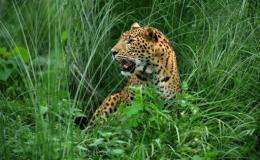
A leopard sits at India's Jaldapara Wild Life Sanctuary on July 4. Bangladeshi conservationists said Thursday the discovery of a rare leopard captured by villagers in the southeast of the country renewed hopes for the survival of the critically endangered species.

Bangladeshi conservationists said Thursday the discovery of a rare leopard captured by villagers in the southeast of the country renewed hopes for the survival of the critically endangered species.

Professor Anwarul Islam, chief executive of Wildlife Trust of Bangladesh, said the three-month-old clouded leopard cub had been released back into the wild.

It had been caged by villagers in the remote Chittagong Hill Tracts region, which borders Myanmar and Mizoram state in India, for the past three weeks, he said.

"Locals stumbled upon two cubs and their mother eating a monkey in the district of Rangimati three weeks ago. They were only able to capture one cub," he said

"It was tremendous news because many conservationists thought the animal was extinct from Bangladesh due to habitat loss."

He said in most cases where a rare species is captured, villagers sell the animal, but in this case had convinced them to release it back into the wild.

The species is timid and nocturnal and little is known about it, he added.

The clouded is listed as critically endangered by the International Union for Conservation of Nature, with 100,000 of the species believed to still be living worldwide.

It is mainly found in South and Southeast Asian countries, and the last reported sightings of the animal in Bangladesh were in 1992 and 2005.

(c) 2009 AFP

Explore further: How do bees make honey? It's not just bee barf

add to favorites email to friend print save as pdf

Related Stories

Critically endangered Amur leopard captured

Oct 23, 2007

A rare Amur leopard (Panthera pardus orientalis), one of only an estimated 30 left in the wild has been captured and health-checked by experts from a consortium of conservation organizations, before being ...

Clouded leopard cubs born at National Zoo

Mar 25, 2009

An endangered clouded leopard at the Smithsonian's National Zoo's Conservation & Research Center (CRC) in Front Royal, Va., gave birth to a genetically valuable litter of two cubs on Tuesday, March 24. The clouded leopard, ...

Orangutan release may begin next year

Dec 06, 2006

The first 90 of more than 1,000 orangutans are to be released in early 2007 in two areas of Borneo as part of a project to save the species.

First Far Eastern Leopard Captured in Southeast Russia

Nov 14, 2006

Just three days after catching a Siberian tiger in the Russian Far East, an international team led by biologists from the Wildlife Conservation Society captured another species last week that carries the dubious distinction ...

Rare pygmy hippos photographed

Mar 11, 2008

British conservationists have captured photographs of two extremely rare pygmy hippos living in the wild in Liberia.

Recommended for you

How do bees make honey? It's not just bee barf

19 minutes ago

(Phys.org) —Last weekend, my daughter asked me how bees made honey, and I realized that I didn't know the answer. How do bees make honey? I did some homework, and can now explain it to her – and to you.

Biological fitness trumps other traits in mating game

12 hours ago

When a new species emerges following adaptive changes to its local environment, the process of choosing a mate can help protect the new species' genetic identity and increase the likelihood of its survival. ...

Snail genetic tracks reveal ancient human migration

12 hours ago

Some snails in Ireland and the Pyrenees are genetically almost identical, perhaps because they were carried across the Atlantic during an 8000-year-old human migration. The snail genetics tie in with studies ...

User comments : 0

More news stories

How do bees make honey? It's not just bee barf

(Phys.org) —Last weekend, my daughter asked me how bees made honey, and I realized that I didn't know the answer. How do bees make honey? I did some homework, and can now explain it to her – and to you.

Have you had your cereal today?

Cereals are grasses that produce grains, the bulk of our food supply. Carnegie's Plant Biology Department is releasing genome-wide metabolic complements of several cereals including rice, barley, sorghum, and millet. Along ...

S.Korean airlines ban shark fin as cargo

South Korea's two largest airlines, Korean Air and Asiana, said Thursday they had both decided to ban shark fin from their cargo flights as part of a growing global campaign against the Asian delicacy.

Dusty surprise around giant black hole

(Phys.org) —ESO's Very Large Telescope Interferometer has gathered the most detailed observations ever of the dust around the huge black hole at the centre of an active galaxy. Rather than finding all of ...

NASA image: Rare clear view of Alaska

(Phys.org) —On most days, relentless rivers of clouds wash over Alaska, obscuring most of the state's 6,640 miles (10,690 kilometers) of coastline and 586,000 square miles (1,518,000 square kilometers) ...