Aus amateur tells of 'one in a million' Jupiter spot
Jul 22, 2009 by Amy Coopes
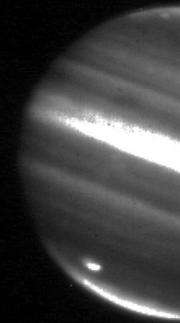
This image released by NASA shows Jupiter with an impact scar. Jupiter was recently struck by a large object -- possibly a stray comet or a block of ice -- which left a dent in its gaseous atmosphere the size of Earth, NASA officials said.

An Australian amateur stargazer who spotted a "one in a million" impact on Jupiter Wednesday told of his astonishment as he chanced upon the Earth-sized dent in its gassy atmosphere.

Anthony Wesley, 44, who has had a life-long passion for the stars, was photographing the planet close to midnight on Sunday when he noticed a black mark that hadn't been there two nights earlier.

The computer programmer, who watches the sky with his 14.5-inch (37 centimetre) in the backyard of his farm outside Canberra, said he first thought it was a shadow cast by one of the planet's 63 moons.

"But after a few minutes I realised it was in the wrong place and it was the wrong shape to be anything like that, and then it was a case of my eyes convincing my brain," Wesley told AFP.

"The eyes are saying 'There it is, it's on the screen, you can't deny it,' but the brain is saying 'Hang on, there's such an unlikely chance of this being an impact, it's a one in a million, or worse than that,' so it did take me a while to actually believe what I was seeing."

For the next two hours, Wesley said he frantically photographed the mark and then started emailing astronomers, desperate to alert as many other people as he could "to get the professional astronomers in and let them take over."

After experts spent six hours examining the spot with an infra-red telescope in Hawaii, the verdict came in -- had been hit, possibly by a stray comet or a planet-sized block of ice.

"It was completely unlike any of the weather phenomena that we observe on Jupiter," said Glenn Orton from NASA's Jet Propulsion Lab in California, on Tuesday.

"Our first image showed a really bright object right where that black scar was, and immediately we knew this was an impact," Orton said.

Wesley took up astronomy as a hobby aged 10, and said anyone with a telescope had been watching Jupiter since Monday, keen to watch the atmospheric fallout from the impact.

"A lot of material down low in Jupiter's atmosphere gets brought up by one of these impacts, so that gives some of the planetary scientists around the world invaluable opportunity to study parts of Jupiter that they can't normally see," Wesley said.

Jupiter, which is 11 times larger than Earth, was last hit by fragments of the Shoemaker Levy 9 in 1994, and Wesley said Sunday's collision also raised some interesting questions about how rare such events really were.

"Maybe there are more of these cometary objects up there that Jupiter sweeps up and maybe these impacts, rather than being once in a few thousand years, maybe they're happening several times every century," he said.

"Now that we've got better telescopes and now that we've got an army of amateur astronomers looking at Jupiter all the time these things will get picked up," he added.

Jupiter's massive gravitational pull had helped to shape the solar system and, thankfully for Earth's inhabitants, continued to draw such objects into its path, Wesley said.

"I think the last time, according to fossil records, any impact like that happened on Earth we had the extinction event hundreds of millions of years ago, which appears to have finished off the dinosaurs," he said.

"So if anything like that happened on Earth it would certainly finish off all of the life that's here as we know it."

(c) 2009 AFP

Explore further: NASA head views progress on asteroid lasso mission

add to favorites email to friend print save as pdf

Related Stories

New Images Indicate Object Hits Jupiter

Jul 21, 2009

(PhysOrg.com) -- Scientists have found evidence that another object has bombarded Jupiter, exactly 15 years after the first impacts by the comet Shoemaker-Levy 9.

Astronomers marvel at 'Red Spot Jr'

May 05, 2006

Astronomers say NASA's Hubble Space Telescope is giving them their most detailed view yet of a second red spot emerging on Jupiter.

Scientists Make Image, Movie of a Jupiter Moon Setting

Dec 18, 2008

(PhysOrg.com) -- Jupiter's largest moon, Ganymede, is seen just before it slips behind its giant planet in a new color image and a movie made by a University of Arizona scientist from images taken by NASA's ...

Chandra examines Jupiter during new horizons approach

Mar 01, 2007

On February 28, 2007, NASA's New Horizons spacecraft made its closest approach to Jupiter on its ultimate journey to Pluto. This flyby gave scientists a unique opportunity to study Jupiter using the package ...

Grand Theft Pluto

Feb 26, 2007

When New Horizons, NASA's Pluto-bound spacecraft, swings by Jupiter on Feb. 28th, it will pick up a few souvenirs along the way – photos, data, and an extra 9000 miles per hour courtesy of the largest planet ...

Guide: How To See NASA's Comet Crash In The Sky on July 4th

Jun 29, 2005

When NASA's Deep Impact slams an 800-pound projectile into Comet Tempel 1 at 23,000 miles per hour, the collision should create quite a splash. Cameras and other instruments on the main spacecraft will watch this first-ever com ...

Recommended for you

NASA head views progress on asteroid lasso mission

4 hours ago

Surrounded by engineers, NASA chief Charles Bolden inspected a prototype spacecraft engine that could power an audacious mission to lasso an asteroid and tow it closer to Earth for astronauts to explore.

Ecuador satellite collides with Russian space junk

4 hours ago

A small Ecuadoran satellite collided in orbit with the remains of a Russian rocket, but it is too soon to know how much damage it might have sustained, Quito's space agency said Thursday.

Forecast for Titan: Wild weather could be ahead

May 22, 2013

(Phys.org) —Saturn's moon Titan might be in for some wild weather as it heads into its spring and summer, if two new models are correct. Scientists think that as the seasons change in Titan's northern hemisphere, ...

SDO observes mid-level solar flare

May 22, 2013

UPDATE 16:30 p.m. EDT: The M7-class flare was also associated with a coronal mass ejection or CME, another solar phenomenon that can send billions of tons of particles into space. While this CME was not Ea ...

User comments : 1

Adjust slider to filter visible comments by rank

Display comments: newest first

A_Paradox
not rated yet Jul 22, 2009
I thought "death of the dinosaurs" was 65 million years ago.

More news stories

Hubble reveals the ring nebula's true shape

(Phys.org) —The Ring Nebula's distinctive shape makes it a popular illustration for astronomy books. But new observations by NASA's Hubble Space Telescope of the glowing gas shroud around an old, dying, ...

NASA head views progress on asteroid lasso mission

Surrounded by engineers, NASA chief Charles Bolden inspected a prototype spacecraft engine that could power an audacious mission to lasso an asteroid and tow it closer to Earth for astronauts to explore.

A hidden population of exotic neutron stars

(Phys.org) —Magnetars – the dense remains of dead stars that erupt sporadically with bursts of high-energy radiation - are some of the most extreme objects known in the Universe. A major campaign using ...

Controlling mood through the motions of mitochondria

(Medical Xpress)—Regulating the distribution of power in neurons is done by a system that makes the national electric grid look simple by comparison. Each neuron has several thousand mitochondria confined ...

Google Drive sports new view and scan enhancements

(Phys.org) —Google Drive has a new look and functions. The makeover in Google Drive features scanning and interface enhancements that put the user into "card" mode. The enhancements make it easy for the ...