How do you sneeze in a spacesuit? Very carefully
Jul 21, 2009 By MIKE SCHNEIDER , Associated Press Writer
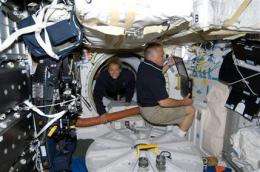
In this 19 July 2009 photo provided by NASA shows Canadian Space Agency astronaut Julie Payette float onto the mid deck of the space shuttle Endeavour, where she joins astronaut Dave Wolf, who makes an entry on a laptop computer. The two STS-127 mission specialists are part of a seven member shuttle crew currently visiting the International Space Station, which is now docked with the shuttle. (AP Photo/NASA)

(AP) -- When it comes to sneezing in a spacesuit during a spacewalk in the void of space, it is best to aim well.

That is the advice lead spacewalker David Wolf gave Tuesday to Dawn from Indianapolis, who along with more than a dozen others had questions they had posted on YouTube answered by some of the crew of space shuttle Endeavour.

"I've done it quite a few times, most recently yesterday," said Wolf, who led the mission's second spacewalk Monday and was set to go on a third spacewalk Wednesday. "You learn in training, and I don't know how to say this, aim well. It can mess up your view and there is no way to clear it."

The YouTube questioners, mostly children and teenagers, had posted their questions well before last week's launch of Endeavour on a 16-day mission to the international space station. Their posts were played one at a time for commander Mark Polansky, pilot Doug Hurley, Canadian astronaut Julie Payette and Wolf, who took turns answering the questions live, more than 200 miles above Earth.

Other questioners asked the astronauts what they missed most in space (friends and family), what they did in their spare time (look out the window) and what would happen if the shuttle or space station flew into a black hole (don't know). There are currently 13 crew members at the space station - seven visiting from the shuttle and six living at the station.

The YouTube questions were the latest effort by NASA to embrace social media. Polansky has a Twitter account with more than 37,500 followers, and since the mission began last Wednesday, Polansky has tweeted regularly with the help of workers at the Johnson Space Center who actually post his messages.

Last May, under the moniker Astro-Mike, Astronaut Mike Massimino became the first person to tweet from space during space shuttle Atlantis' repair mission to the Hubble Space Telescope.

While Wolf and astronaut Christopher Cassidy prepared for Wednesday's spacewalk, other crew members used robotic arms Tuesday to move a storage pallet holding equipment for three experiments from the belly of the docked space shuttle Endeavour to the outside of the orbiting outpost's Japanese-made lab.

Endeavour's seven astronauts had some rare off-duty hours Tuesday afternoon, when they had the opportunity to do nothing but look out the window.

---

On the Net:

NASA: http://www.nasa.gov/mission_pages/shuttle/main/index.html

Mark Polansky's Twitter page: http://twitter.com/Astro_127

©2009 The Associated Press. All rights reserved. This material may not be published, broadcast, rewritten or redistributed.

Explore further: NASA head views progress on asteroid lasso mission

add to favorites email to friend print save as pdf

Related Stories

Astronauts Move Japanese Exposed Section to Station

Jul 21, 2009

Space shuttle Endeavour's astronauts completed the delicate move of the Japanese Experiment Section from Endeavour's payload bay to the end of the Japanese Exposed Section, the so-called "porch" on the Kibo ...

Endeavour Astronauts Attach Japanese Module to Station

Mar 14, 2008

The crews of space shuttle Endeavour and the International Space Station completed a busy day with a spacewalk and the installation of the Japanese Logistics Module - Pressurized Section (JLP) on the station.

Endeavour 'Go' for Launch on June 13

Jun 03, 2009

(PhysOrg.com) -- NASA managers completed a review Wednesday of space shuttle Endeavour's readiness for flight and selected June 13 as the official launch date for the STS-127 mission to the International Space ...

Recommended for you

Dark, massive asteroid to fly by Earth on May 31

5 hours ago

It's 1.7 miles long. Its surface is covered in a sticky black substance similar to the gunk at the bottom of a barbecue. If it impacted Earth it would probably result in global extinction. Good thing it is ...

Research team explains 'Lazarus' comets

9 hours ago

Astronomers from the University of Antioquia have discovered a graveyard of comets. These once-dormant comets, dubbed by astronomers as "The Lazarus comets," are now rejuvenated.

NASA ships sensors for seafaring satellite to France

9 hours ago

(Phys.org) —Three NASA-built instruments that are integral components of the next in a series of U.S./European ocean altimetry satellites have arrived in France for integration with their spacecraft in ...

Trip into space with DiCaprio costs $1.55m

10 hours ago

Leonardo DiCaprio is going to get closer to stars of a different kind as he heads into space aboard the Virgin Galactic, and a well-heeled bidder at the Cannes Film Festival has paid 1.2 million euros (1.5 million) to be ...

User comments : 0

More news stories

Galaxies fed by funnels of fuel

(Phys.org) —Computer simulations of galaxies growing over billions of years have revealed a likely scenario for how they feed: a cosmic version of swirly straws.

Dark, massive asteroid to fly by Earth on May 31

It's 1.7 miles long. Its surface is covered in a sticky black substance similar to the gunk at the bottom of a barbecue. If it impacted Earth it would probably result in global extinction. Good thing it is ...

Source of life running out: water scientists

The majority of people on Earth people will face severe water shortages within a generation or two if pollution and waste continues unabated, scientists warned at a conference in Bonn Friday.

Google eyes emerging markets networks

Google has become deeply involved in a series of projects to build and operate wireless networks in emerging markets including sub-Saharan Africa and Southeast Asia, a report said Friday.

Facial-recognition technology proves its mettle

(Phys.org) —In a study that evaluated some of the latest in automatic facial recognition technology, researchers at Michigan State University were able to quickly identify one of the Boston Marathon bombing ...