July 3, 2009 feature
Physicists Demonstrate Quantum Memory with Matter Qubits
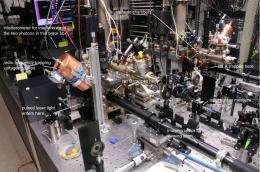
(PhysOrg.com) -- For the first time, scientists have successfully operated a quantum gate between two remote particles of matter, marking an important step toward the development of a quantum computer. In previous experiments, researchers have used photons, which are difficult to store. Using matter qubits enables the researchers to store the obtained quantum information, opening up new possibilities for the generation of remote networks of entangled qubits.
Physicists Peter Maunz and coauthors from the University of Maryland Department of Physics and National Institute of Standards and Technology in College Park, Maryland, and the University of Michigan in Ann Arbor, Michigan, published their study in a recent issue of Physical Review Letters.
“Our work demonstrates a probabilistic remote entangling quantum gate,” Maunz told PhysOrg.com. “Remote entangling gates are an essential building block for quantum repeaters which facilitate quantum communication over long distances. Furthermore, the remote link established by the entangling gate could be used to interconnect remote quantum processors and thus could be an important additional possibility to scale a future quantum computer.”
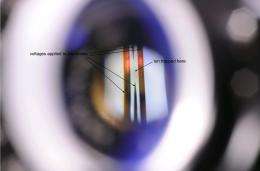
As the scientists explain, their quantum gate works by entangling two ytterbium ions, each confined in its own trap positioned one meter apart. The scientists suspended the ions into either a one or a zero state using microwave radiation. The use of ion traps prevents anything from interacting with the ytterbium. This allows the ions to hold states of both zero and one simultaneously so that the ions function as qubits.
Next, the scientists shined a laser on the ions, causing each ion to emit a single photon. The scientists collected a small amount of the emitted light from each ion and coupled the light into fibers. The outputs of the fibers were then sent to interfere at a beam splitter, after which single photons were detected. A simultaneous detection of two photons indicated the successful operation of the gate. Finally, the atomic states were identified to verify the claim.
As the physicists explain, this quantum gate could lead to the development of a “one-way” quantum computer. In this technique, a large collection of qubits is first prepared in a highly entangled state, and then single qubit rotations and measurements are performed on the qubits to realize quantum computation. Since the measurements destroy the state of the qubits, the technique is called “one-way.” Because it has certain advantages, this technique may be easier to implement than the quantum circuit model, which is the conventional model of quantum computing.
“The quantum circuit model and the one-way quantum computer a different but equivalent approaches to use quantum interactions and quantum entanglement for computation,” Maunz said. “The one-way quantum computer starts with a very sophisticated, highly entangled state of a collection of qubits. The computation is realized by measurements on single quantum bits and a classical feedforward of the results on rotations and measurements on the remaining qubits.”
In order to realize a useful one-way quantum computer, the physicists still face some challenges. For instance, they need to generate large collections of entangled qubits, since the current study demonstrates the technique with just one pair of qubits. The scientists also hope to improve the reliability and speed of their entanglement method.
“One focus of our research will be to increase the success probability of the remote gate,” Maunz said. “This can be done by increasing the fraction of scattered light that is collected and used for the gate. We hope to achieve an increase high enough to allow us to scale the entanglement to more than two ions. The remote entangling gate can also be combined with local gates which have been realized with trapped ions before. This should facilitate the development of deterministic remote quantum gates and the transmission of quantum information over larger distances.”
More information: P. Maunz, S. Olmschenk, D. Hayes, D.N. Matsukevich, L.-M. Duan, and C. Monroe. “Heralded Quantum Gate between Remote Quantum Memories.” Physical Review Letters 102, 250502 (2009).
Copyright 2009 PhysOrg.com.
All rights reserved. This material may not be published, broadcast, rewritten or redistributed in whole or part without the express written permission of PhysOrg.com.


