Relationships Improve Student Success
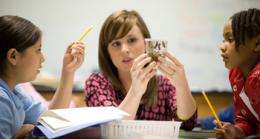
(PhysOrg.com) -- When students are underachieving, school policymakers often examine class size, curriculum and funding, but University of Missouri researchers suggest establishing relationships may be a powerful and less expensive way to improve students' success. In a review of the research they show that students with positive attachments to their teachers and schools have higher grades and higher standardized test scores.
"In this era of accountability, enhancing student-teacher relationships is not merely an add-on, but rather is fundamental to raising achievement," said Christi Bergin, associate professor in the MU College of Education. "Secure student-teacher relationships predict greater knowledge, higher test scores, greater academic motivation and fewer retentions or special education referrals. Children who have conflicted relationships with teachers tend to like school less, are less self-directed and cooperate less in the classroom."
The authors summarized a range of research on attachment-like relations with parents, teachers and schools. They found that student attachment influences school success through two routes: indirectly through attachment to parents which affects children's behavior at school and directly through attachment to teachers and schools. Children with healthy attachment are able to control their emotions and are more socially competent and willing to take on challenging learning tasks in the classroom.
"To be effective, teachers must connect with and care for children with warmth, respect and trust," said David Bergin, associate professor of educational psychology, and the other author of the article. "In addition, it is important for schools to make children feel secure and valued, which can liberate them to take on intellectual and social challenges and explore new ideas."
To help enhance student relations, the authors offer research-based tips for teachers and schools:
Teachers
• Increase warm, positive interactions with students
• Be well prepared for class and hold high expectations
• Be responsive to students' agendas by providing choices
• Use reasoning rather than coercive discipline that damages relationships
• Help students be kind, helpful and accepting of one another
• Implement interventions for difficult relations with specific students
Schools
• Provide a variety of extracurricular activities for students to join
• Keep schools small
• Keep students with the same teachers and/or peers across years
• Decrease transitions in and out of the classroom
Facilitate transitions to new schools or teachers
The review, "Attachment in the Classroom" was recently published in Education Psychology Review and was co-authored by C. Bergin and D. Bergin.
Provided by University of Missouri


