Indonesian elephant fossil opens window to past
Jun 23, 2009 By NINIEK KARMINI , Associated Press Writer
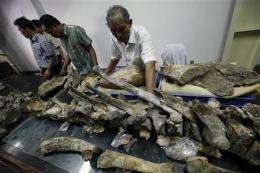
Scientists arrange the bones of an estimated 200,000 year-old giant elephant at Geology Museum in Bandung, West Java, Indonesia, Thursday, June 18, 2009. Indonesian scientists are reconstructing the largest, most complete skeleton of an ancient elephant ever found in the tropics, a finding that may offer new clues into the largely mysterious origins of its modern Asian cousin. Based on the fossil, the ancient elephant stood four meters (13-feet) tall, was five meters (16-feet) long and weighed more than 10 tons, considerably larger than the great Asian mammals now on Earth. (AP Photo/Dita Alangkara)

(AP) -- Indonesian scientists are reconstructing the largest, most complete skeleton of a prehistoric giant elephant ever found in the tropics, a finding that may offer new clues into the largely mysterious origins of its modern Asian cousin.

The prehistoric elephant is believed to have been submerged in quicksand shortly after dying on a riverbed in Java around 200,000 years ago. Its bones - almost perfectly preserved - were discovered by chance in March when an old sand quarry collapsed during monsoon rains.

The animal stood four meters (13-feet) tall, five meters (16-feet) long and weighed more than 10 tons - closer in size to the woolly mammoth of the same period than to the great Asian mammals now on Earth.

Animal fossils are rare in the humid, hot climate of the equator because decomposition occurs extremely quickly.

Following a monthlong excavation, a team of seven paleontologists from the Museum in Bandung, West Java, set the bones in plaster for the trip back to their office where they will be laboriously pieced back together.

"We believe from the shape of its teeth that it was a very primitive elephant," but little else has been verified, said paleontologist Fachroel Aziz, who is heading a 12-strong skeletal reconstruction team.

Scientists agree it is the first time an entire prehistoric elephant has been unearthed since vertebrate findings began to be recorded in Indonesia in 1863.

"It is very uncommon to discover a fossil like this in a tropical region like Indonesia," said Edi Sunardi, an independent expert at Indonesia's Pajajaran University in Bandung, West Java. "It apparently was covered by volcanic sediment that protected it from high temperatures, erosion and decay."

The next challenge will be removing the delicate bones from their molds and joining them into a stable, upright structure, a process that experts said is already being hampered by a lack of funding, inadequate tools and poor expertise.

Indonesia, an emerging and impoverished democracy of 235 million people, cannot afford to allocate more than a token sum to its aging museums, even for projects that have the potential to advance knowledge about the origin of key native species.

Gert van den Berg, a researcher at Australia's Wollongong University who helped dig up the skeleton, said tests are under way to determine its precise age and species, and that they will help provide details "about when the modern evolved into what they are now."

About 2,000 old elephant remains have been found across the island nation over the past 150 years, but never in such good condition, Aziz said.

"We want to exhibit it publicly because this is a spectacular discovery," he said.

©2009 The Associated Press. All rights reserved. This material may not be published, broadcast, rewritten or redistributed.

Explore further: Actor Johnny Depp immortalized in ancient fossil find

add to favorites email to friend print save as pdf

Related Stories

Study: Elephants thought extinct may have survived

Apr 17, 2008

The Borneo pygmy elephant may not be native to the island of Borneo after all. Instead, the population could be the last survivors of the Javan elephant race – accidentally saved from extinction by the Sultan ...

New dinosaur species found in Montana

Sep 24, 2007

A dinosaur skeleton found 24 years ago in Montana has finally been identified as a new species that links North American dinosaurs with Asian dinosaurs. The dinosaur would have weighed 30 to 40 pounds, walked on two feet ...

Researchers says Hobbit was human

Sep 24, 2005

A 3-foot-tall female skeleton discovered in Indonesia last year dubbed "The Hobbit" and believed to be separate human species may have been a diseased human.

Second ancient whale found in Italy

Apr 02, 2007

The skeleton of a 33-foot-long prehistoric whale has been discovered in what was once an ancient seabed in Italy's Tuscany region.

Fossil Is Missing Link in Elephant Lineage

Nov 01, 2006

A pig-sized, tusked creature that roamed the earth some 27 million years ago represents a missing link between the oldest known relatives of elephants and the more recent group from which modern elephants descended, ...

Recommended for you

The eloquence of the otoliths

May 16, 2013

Fish fossils that are about 23 million years old give unprecedented insight into the evolutionary history of the gobioid order, one of the most species-rich groups among the modern bony fishes.

Light cast on lifestyle and diet of first New Zealanders

May 16, 2013

(Phys.org) —A University of Otago-led multidisciplinary team of scientists have shed new light on the diet, lifestyles and movements of the first New Zealanders by analysing isotopes from their bones and teeth.

mtDNA study shows Minoans came from Europe not Africa

May 15, 2013

(Phys.org) —A new study conducted by a team of American and Greek researchers has found that the people of the ancient Minoan civilization living on the island of Crete most likely came from Europe. In ...

User comments : 1

Adjust slider to filter visible comments by rank

Display comments: newest first

Birger
not rated yet Jun 23, 2009
With the ongoing efforts (Google "Svante Pääbo" for details) to extract DNA from fossils, it will be exciting to see how this giant animal is related to the mammoth and the surviving elephant species.

More news stories

Evolution of lying

(Phys.org) —Ultimately, our ability to convincingly lie to each other may have evolved as a direct result of our cooperative nature.

Russia retrieves mice, newts from space

A Russian capsule filled with 45 mice and 15 newts along with other small animals returned from a month's mission in orbit on Sunday with data scientists hope will pave the way for a manned flight to Mars.

Honeybees trained in Croatia to find land mines

(AP)—Mirjana Filipovic is still haunted by the land mine blast that killed her boyfriend and blew off her left leg while on a fishing trip nearly a decade ago. It happened in a field that was supposedly ...

German energy shift faces headwinds

Tense engineers have their eyes peeled on complex colour-coded diagrams on a wall-sized screen that makes their control room look like the inside of a spaceship.

Internet in 'coma' as Iran election looms

Iran is tightening control of the Internet ahead of next month's presidential election, mindful of violent street protests that social networkers inspired last time around over claims of fraud, users and ...