Isolated forest patches lose species, diversity
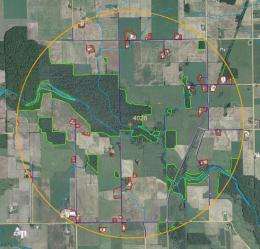
Failing to see the forest for the trees may be causing us to overlook the declining health of Wisconsin's forest ecosystems.
Even areas with apparently robust trees and lush canopies are threatened as forests are increasingly fragmented by roads and development, becoming isolated green islands in a sea of agricultural fields, housing tracts, and strip malls, say UW-Madison researchers.
A new study is revealing that decades of fragmentation of Wisconsin's forests have taken a largely unseen toll on the sustainability of these natural ecosystems.
The long generation times of trees and other plants have masked many of the ecological changes already under way in the patches of forest that remain, says study co-author Don Waller, a professor in the Department of Botany and Nelson Institute for Environmental Studies at UW-Madison. "Things may look healthy, but over time we see an erosion of biodiversity," he says.
To better catalog the changes at work, he and colleagues looked beyond the trees to the forest understory — the shrubs, grasses, and herbs covering the forest floor — to witness how Wisconsin's forests are really faring. Their results, published online June 8 and appearing in an upcoming issue of the journal Conservation Biology, show that fragmentation is reducing the abundance and diversity of native plants in southern Wisconsin forests.
The findings highlight the effects of increasing urban development and road density, especially in the southeastern part of the state. Land use changes have a pronounced impact on the islands of forest that remain, even when these are protected as parks or natural areas.
"These forest patches are not just losing species — their whole biological nature is changing," says David Rogers, an assistant professor of biological sciences at UW-Parkside who led the study while a UW-Madison graduate student. "Surrounding landscape factors, like urbanization and agricultural dominance, are now determining which species can survive in these little patches."
One unique quality of the current work is that it builds on a detailed trove of historical data collected throughout the state in the 1940s and 1950s by renowned UW-Madison ecologist John Curtis. More than 50 years later, Rogers and others revisited many of Curtis's sites in southern Wisconsin to see what changes time has wrought.
Though negative effects of fragmentation on biodiversity have gone largely unrecognized in the past, the impacts appear to be intensifying over time, the researchers say. Nearby cities and towns now strongly affect local woodlots, causing smaller plots in particular to lose species.
"When we isolated these forest patches 50 or 100 years ago, we were dooming species to extinction," says Waller. "It may not happen right away — and in that sense it's an 'extinction debt' — but it will accumulate over time."
They believe that isolation takes its biggest toll on forest plant diversity by cutting off routes for native plants to re-colonize areas where local populations may have disappeared. "Plant species might go locally extinct for lots of different reasons," including natural cycles of turnover, Waller says. "But typically the area will be re-colonized very soon by nearby populations of the same species. That's what does not happen once a habitat becomes isolated or that patch becomes smaller."
The connections between local plant communities and more distant landscapes have increased markedly. The bottom line is that humans appear to be having larger cumulative impacts on Wisconsin's forest communities than even ecologists previously appreciated.
This realization has important implications for how we should manage southern Wisconsin's remaining forests, Rogers says. The scientists are now working to identify the specific factors driving the observed ecological changes.
"People are a really important part of the system," Rogers says. "We are having a greater influence over our local ecology, whether we want to or not. That puts the responsibility on people to take care of it, protect it and maintain it."
Source: University of Wisconsin


