Midge keeps invasive mosquito in check, aiding native mosquitoes (w/Podcast)
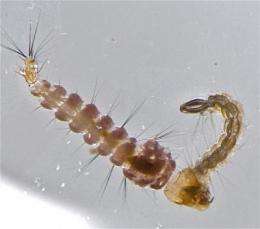
In a drama played out across the southeastern U.S. in containers as small as a coffee cup, native and invasive mosquito larvae compete for resources and try to avoid getting eaten. One of the invasive mosquitoes, the Asian tiger mosquito (Aedes albopictus), can carry dengue fever, a viral disease that sickens 50 to 100 million people a year in the tropics, so this seemingly inconsequential struggle has implications for human health.
In a new study in the British Ecological Society's Journal of Animal Ecology, researchers report that the larvae of a tiny fly, the midge Corethrella appendiculata, eat more of the larvae of the invasive Asian tiger mosquito than of the native Eastern treehole mosquito (Aedes triseriatus). This allows the native mosquitoes to survive even though the invasive mosquitoes are better at gobbling up resources.
The researchers found inherent size differences between the mosquito species. The treehole mosquito is larger than the Asian tiger mosquito, which makes it less vulnerable to predation from the small but voracious predatory midge. Previous studies have found that the native mosquito larvae also adopt less "risky" behaviors than the invasive mosquito larvae, making them less susceptible to being eaten.
"Size is having a major effect in terms of how the prey are getting consumed," said Barry Alto, a medical entomologist with the State Natural History Survey at the University of Illinois and principal investigator on the study.
"This is another mechanism that allows the native mosquito to hang on and co-exist with the invasive mosquitoes in certain areas where predators are present," Alto said.
The Asian tiger mosquito was first detected in the U.S. in 1985 in a shipment of used tires to a Texas port. Like the native mosquito, it lays its eggs in watery containers, including tires. Even if the water evaporates, a splash of rain and a supply of nutrients such as the microbes that feed on dead leaves are all that the larvae need to hatch and grow.

Once found only in tropical and subtropical regions of Southeast Asia, the Asian tiger mosquito has now spread to Africa, the Americas, Australia, the Caribbean, Europe and the Middle East. Like the yellow fever mosquito (Aedes aegypti), another invasive mosquito that is now well established in the Americas, the Asian tiger mosquito can carry several viral diseases that afflict humans.
The interaction between predators and native and invasive mosquitoes is one of several factors that may contribute to disease transmission, Alto said.
"We want to know: Where do the invasive and the native species co-exist? Where does one or the other go extinct? And what happens in the areas where there's no predator?" he said.
The insights that come from such studies may also apply to other native and invasive species, he said.
Source: University of Illinois at Urbana-Champaign (news : web)


