DNA molecules can detect pathogens, deliver drugs
May 20, 2009 By Anne Ju
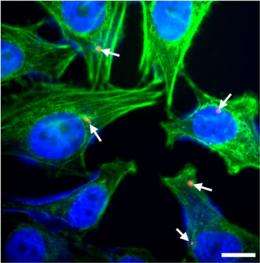
In the presence of certain pathogens, DNA-based molecules form chains and curl up into spheres. Visible here as red dots, the spheres are shown entering cells, which demonstrates their drug delivery capabilities. Image: Luo Labs

(PhysOrg.com) -- First, Cornell researchers created DNA "bar codes" -- strands of the genetic material that quickly identify the presence of different molecules by fluorescing. Now, they have created new DNA molecules that can detect pathogens and deliver drugs to cells when they form long chains called polymers.

Cornell researcher Dan Luo and colleagues describe in the May 4 online Nature that their simple DNA molecules, or monomers, link into polymers under and in the presence of such as SARS and HIV.

The research team, which included first author and postdoctoral associate Jong B. Lee and David Muller, associate professor of applied and engineering physics, report that the polymers, made up of thousands of monomers, allow for the fast detection of pathogens. The researchers used asymmetric strands of DNA, characterized by unique sequences at the ends of each branch, which they call zip codes. Each zip code can link to a corresponding sequence, including the DNA of such pathogens as HIV. When the zip codes and pathogens find each other, they form chains that curl up into spheres and are visible under a microscope.

Using the same principle, the researchers also demonstrated attaching multiple nucleic acid-based drugs, along with tracers, to the DNA strands, which were then absorbed by cells.

Luo, associate professor of biological and environmental engineering, explained that such work illustrates how DNA is not only a genetic material, but can be a useful structure to carry drugs or other substances.

"The genetic part is the recognition of the pathogen," he said. "The generic part is making the nanostructure."

Provided by Cornell University (news : web)

Explore further: Single-cell transfection tool enables added control for biological studies

add to favorites email to friend print save as pdf

Related Stories

Metal sheets with DNA framework may enable nanocircuits

May 20, 2009

(PhysOrg.com) -- Using DNA not as a genetic material but as a structural support, Cornell researchers have created thin sheets of gold nanoparticles held together by strands of DNA. The work could prove useful ...

Synthetic DNA Makes Better Hydrogels for Drug Delivery

Sep 26, 2006

Using synthetic DNA formed into crosses, Y's and T's, Cornell researchers have created biocompatible, biodegradable, inexpensive hydrogels that can be easily formed into any desired shape for biomedical applications.

Researchers create DNA buckyballs for drug delivery

Aug 29, 2005

DNA isn't just for storing genetic codes any more. Since DNA can polymerize -- linking many molecules together into larger structures -- scientists have been using it as a nanoscale building material, constructing ...

DNA-based gel produces proteins without live cells

Apr 01, 2009

(PhysOrg.com) -- A new method developed by Cornell biological engineers offers an efficient way to make proteins for use in medicine or industry without the use of live cells. The proteins made in this way ...

Recommended for you

Radioactive nanoparticles target cancer cells

May 21, 2013

Cancers of all types become most deadly when they metastasize and spread tumors throughout the body. Once cancer has reached this stage, it becomes very difficult for doctors to locate and treat the numerous tumors that can ...

How gold nanoparticles can help fight ovarian cancer

May 21, 2013

Positively charged gold nanoparticles are usually toxic to cells, but cancer cells somehow manage to avoid nanoparticle toxicity. Mayo Clinic researchers found out why, and determined how to make the nanoparticles effective ...

Advance in nanotech gene sequencing technique

May 20, 2013

(Phys.org) —The allure of personalized medicine has made new, more efficient ways of sequencing genes a top research priority. One promising technique involves reading DNA bases using changes in electrical ...

User comments : 1

Adjust slider to filter visible comments by rank

Display comments: newest first

NeilFarbstein
1 / 5 (1) May 20, 2009
Its sure to cause a big immune response, possibly pathogenic. Injecting them can result in lupus autoimmiune responses.

More news stories

Scientists develop cheaper, more efficient fuel cells

(Phys.org) —Using the Canadian Light Source (CLS) synchrotron, researchers have discovered a way to create cheaper fuel cells by dividing normally expensive platinum metal into nanoparticles (or even single ...

Weird science: Crystals melt when they're cooled

(Phys.org) —Growing thin films out of nanoparticles in ordered, crystalline sheets, to make anything from microelectronic components to solar cells, would be a boon for materials researchers, but the physics ...

Controlling mood through the motions of mitochondria

(Medical Xpress)—Regulating the distribution of power in neurons is done by a system that makes the national electric grid look simple by comparison. Each neuron has several thousand mitochondria confined ...

A quantum simulator for magnetic materials

Physicists understand perfectly well why a fridge magnet sticks to certain metallic surfaces. But there are more exotic forms of magnetism whose properties remain unclear, despite decades of intense research. ...

A hidden population of exotic neutron stars

(Phys.org) —Magnetars – the dense remains of dead stars that erupt sporadically with bursts of high-energy radiation - are some of the most extreme objects known in the Universe. A major campaign using ...