Let the Planet Hunt Begin
May 13, 2009
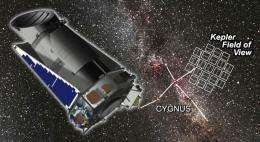
Artist concept of Kepler in space. Image credit: NASA/JPL

(PhysOrg.com) -- NASA's Kepler spacecraft has begun its search for other Earth-like worlds. The mission, which launched from Cape Canaveral, Fla., on March 6, will spend the next three-and-a-half years staring at more than 100,000 stars for telltale signs of planets. Kepler has the unique ability to find planets as small as Earth that orbit sun-like stars at distances where temperatures are right for possible lakes and oceans.

"Now the fun begins," said William Borucki, Kepler science principal investigator at NASA's Ames Research Center, Moffett Field, Calif. "We are all really excited to start sorting through the data and discovering the ."

Scientists and engineers have spent the last two months checking out and calibrating the Kepler spacecraft. Data have been collected to characterize the imaging performance as well as the noise level in the measurement electronics. The scientists have constructed the list of targets for the start of the planet search, and this information has been loaded onto the spacecraft.

"If Kepler got into a staring contest, it would win," said James Fanson, Kepler project manager at NASA's Jet Propulsion Laboratory, Pasadena, Calif. "The spacecraft is ready to stare intently at the same for several years so that it can precisely measure the slightest changes in their brightness caused by planets." Kepler will hunt for planets by looking for periodic dips in the brightness of stars -- events that occur when orbiting planets cross in front of their stars and partially block the light.

The mission's first finds are expected to be large, gas planets situated close to their stars. Such discoveries could be announced as early as next year.

Kepler is a NASA Discovery mission. NASA Ames Research Center, Moffett Field, Calif., is the home organization of the science principal investigator, and is responsible for the ground system development, mission operations and science data analysis. JPL manages the development. Ball Aerospace & Technologies Corp. of Boulder, Colo., is responsible for developing the Kepler flight system and supporting mission operations.

Provided by Jet Propulsion Laboratory (news : web)

Explore further: NASA's STEREO detects a CME from the sun

add to favorites email to friend print save as pdf

Related Stories

NASA's Kepler Spacecraft Ready to Ship to Florida

Dec 18, 2008

(PhysOrg.com) -- Engineers are getting ready to pack NASA's Kepler spacecraft into a container and ship it off to its launch site at Cape Canaveral Air Force Station, Fla. The mission, scheduled to launch ...

Innovative avionics enable search for habitable planets

Mar 09, 2009

The search for habitable planets continues with the March 6 launch of the Kepler spacecraft, the latest in NASA's series of low cost, highly focused Discovery missions. Kepler, built by Ball Aerospace & Technologies Corp., ...

Kepler Set to Launch Tonight on Planet Finding Mission

Mar 06, 2009

(PhysOrg.com) -- The Kepler spacecraft and its Delta II rocket are "go" for a launch tonight that is expected to light up the sky along Florida's Space Coast at 10:49 p.m. EST as the rocket lifts off from ...

Recommended for you

Mars rover Opportunity examines clay clues in rock

5 hours ago

(Phys.org) —NASA's senior Mars rover, Opportunity, is driving to a new study area after a dramatic finish to 20 months on "Cape York" with examination of a rock intensely altered by water.

NASA's STEREO detects a CME from the sun

18 hours ago

On 5:24 a.m. EDT on May 17, 2013, the sun erupted with an Earth-directed coronal mass ejection or CME, a solar phenomenon that can send billions of tons of solar particles into space that can reach Earth ...

Nine-year-old Mars rover passes 40-year-old record

May 17, 2013

While Apollo 17 astronauts Eugene Cernan and Harrison Schmitt visited Earth's moon for three days in December 1972, they drove their mission's Lunar Roving Vehicle 19.3 nautical miles (22.210 statute miles ...

Bright explosion on the Moon

May 17, 2013

For the past 8 years, NASA astronomers have been monitoring the Moon for signs of explosions caused by meteoroids hitting the lunar surface. "Lunar meteor showers" have turned out to be more common than anyone ...

User comments : 0

More news stories

Alaska volcano shoots ash 15,000 feet into the air

(AP)—One of Alaska's most restless volcanoes has shot an ash cloud 15,000 feet into the air in an ongoing eruption that has drawn attention from a nearby community but isn't expected to threaten air traffic.

Chinese, Indian airlines face EU pollution fines

Eight Chinese and two Indian airlines face fines of up to several million euros for not paying for their greenhouse gas emissions during flights within the bloc, the European Commission said on Friday.

Yahoo Japan suspects 22 million IDs stolen

Yahoo Japan Corp. has said it suspects up to 22 million user IDs may have been stolen during an unauthorised attempt to access the administrative system of its Yahoo! Japan portal.

US seizes Bitcoin operator accounts

US authorities seized the accounts of a Bitcoin digital currency exchange operator, claiming it was functioning as an "unlicensed money service business," court documents showed Friday.

Temporal processing in the olfactory system

The neural machinery underlying our olfactory sense continues to be an enigma for neuroscience. A recent review in Neuron seeks to expand traditional ideas about how neurons in the olfactory bulb might encode information about ...