NMR on a microscale

May 12, 2009
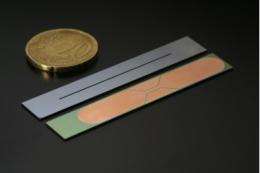
The system, with the fluid channel above and the coil below.

(PhysOrg.com) -- The technique well known from its use in MRI scanning - actually based on nuclear magnetic resonance (NMR) - can now also be applied to extremely small samples thanks to an ingenious combination of a compact coil and micro-scale fluidic channels. The sensitivity of this technique had hitherto been insufficient.

With the high-resolution ‘probe’ developed at the University of Twente's MESA+ Institute for Nanotechnology (The Netherlands), it is possible to observe chemical reactions in very close detail, for example. The results have been published in the Journal of the American Chemical Society.

NMR is the technology that is used in MRI scanners in hospitals. This powerful technique uses magnetic fields to create detailed images of so that abnormalities can be detected and viewed. NMR is also widely used in chemical and biological analysis. However, when an extremely small volume of a substance needs to be analysed, it is difficult to create a ‘coil’ on such a small scale which can generate the required magnetic field. Hitherto, planar circular coils were developed for this use.
NMR on a microscale
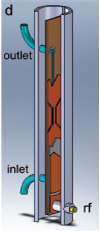
The complete system, with an inlet and outlet for the liquid and an RF connector for the coil.

These were mounted on a glass chip in which the fluid channels were made. However, diameters of less than 300 microns are difficult to achieve using this technique. The UT researchers therefore opted for the use of ‘stripline’ geometry which enabled a very compact coil to be made in combination with a fluid channel of only 600 nano-litres (one nano-litre is one billionth of a litre). This form means that there are no deviations in the magnetic field, and that selectivity is greater than with conventional flat coils.

The new NMR probe can be used, for example, to follow closely all the intermediate substances that are produced during a rapid chemical reaction. The researchers have also used the new probe to build up an extremely precise picture of the metabolic processes within human spinal fluid. The great advantage of the technique is that the samples do not first have to be pretreated. Ultimately, it will be possible to assemble a complete micro-system to detect and process raw samples.

More information: The article, entitled ‘A microfluidic high-resolution NMR Flow Probe’ and written by Jacob Bart, Ard Kolkman, Anna Jo Oosthoek-de Vries, Kaspar Koch, Pieter Nieuwland, Hans Janssen, Jan van Bentum, Kirsten Ampt, Floris Rutjes, Sybren Wijmenga, Han Gardeniers and Arno Kentgens, was published in the (JACS).

Provided by University of Twente (news : web)

Explore further: Chemical probe confirms that body makes its own H2S to benefit health

add to favorites email to friend print save as pdf

Related Stories

'NMR on a chip' features magnetic mini-sensor

Feb 19, 2008

A super-sensitive mini-sensor developed at the National Institute of Standards and Technology can detect nuclear magnetic resonance (NMR) in tiny samples of fluids flowing through a novel microchip. The prototype ...

Chip simulates metabolism of medicine in human body

Apr 24, 2009

(PhysOrg.com) -- A tiny electrochemical cell, developed by researchers of the MESA+ Institute for Nanotechnology, The Netherlands, is able to mimick the behaviour of medicine inside a human body. This chip ...

NMR Technology Comes to the Lab on a Chip

Oct 10, 2005

A breakthrough in the technology of nuclear magnetic resonance (NMR), one of the most powerful analytic tools known to science, is opening the door to new applications in microfluidic chips, devices for studying ...

Recommended for you

Counting small RNA in disease-causing organisms

Jun 18, 2013

Small molecules of RNA (tens to hundreds of nucleotides in length) play a key regulatory role in bacteria. Due to their small size, directly measuring the number of small RNA (sRNA) present in a single bacterium ...

Detecting homemade explosives, not toothpaste

Jun 13, 2013

(Phys.org) —Sandia National Laboratories researchers want airports, border checkpoints and others to detect homemade explosives made with hydrogen peroxide without nabbing people whose toothpaste happens ...

Breakthrough allows fast, reliable pathogen identification

Jun 12, 2013

Life-threatening bacterial infections cause tens of thousands of deaths every year in North America. Increasingly, many infections are resistant to first-line antibiotics. Unfortunately, current methods of culturing bacteria ...

Luminous bacterial proteins detect chemicals in water

Jun 12, 2013

While residual medications don't belong in the water, trace metals from industrial process waters handled by the recycling industry are, in contrast, valuable resources. Scientists at the Helmholtz-Zentrum ...

User comments : 0

More news stories

DNA constructs antenna for solar energy

Researchers at Chalmers University of Technology have found an effective solution for collecting sunlight for artificial photosynthesis. By combining self-assembling DNA molecules with simple dye molecules, ...

Pearly perfection

The mystery of how pearls form into the most perfectly spherical large objects in nature may have an unlikely explanation, scientists are proposing in a new study. It appears in ACS' journal Langmuir, named ...