Competition may have led to new dinosaur species in Grande Prairie area
May 12, 2009
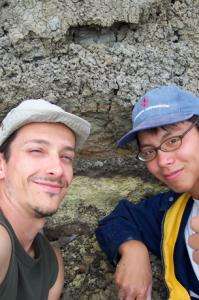
Tetsuto Miyashita and Frederico Fanti

(PhysOrg.com) -- The discovery of a gruesome feeding frenzy that played out 73 million years ago in northwestern Alberta may also lead to the discovery of new dinosaur species in northwestern Alberta.

University of Alberta student Tetsuto Miyashita and Frederico Fanti, a paleontology graduate student from Italy, made the discovery near Grande Prairie, 450 kilometres northwest of Edmonton.

Miyashita and Fanti came across a nesting site and found the remains of baby, plant-eating and the teeth of a predator. The researchers matched the teeth to a Troodon, a raptor-like dinosaur about two metres in length. This finding has opened new doors in dinosaur research on this part of the continent: "It established that dinosaurs were nesting at this high latitude," said Miyashita. "It also shows for the first time a significant number of Troodons in the area [who] hunted hatchling dinosaurs."

Over the course of two summers of field work Miyashita and Fanti began building a theory that Grande Prairie is a "missing link" between known dinosaur species that existed much further to the north and south. "Prior to this there were no localities with a variety of dinosaurs and other animals between Alaska and southern Alberta," said Myiashita. The list of new finds for the area includes armoured and thick-headed plant eaters and fossilized freshwater fish and reptiles.

Miyashita says this small pocket of previously undiscovered life could have had interactions that lead to the evolution of new species.

"New dinosaurs weren't created by interbreeding," said Miyashita. "Having a variety of dinosaurs in one area creates new ecological interactions such as competition for food and predation.

"That can lead to the evolution of a new species."

One Grande Prairie dinosaur the researchers suspect is a new species is the Duck bill. Miyashita says unlike the Duck bill found further north in Alaska, the Grande Prairie has a visible bump or crest on its forehead.

Miyashita is counting the days until Fanti returns from Italy and the Grande Prairie exploration is continued. Right now it's scheduled for summer 2010.

"I don't have any dream dinosaur find in my mind," said Miyashita. "The best find is the one you can't even imagine. You'll know it's the one when you're jumping with joy."

More information: Miyashit and Fanti's work was published this month in Palaeogeoraphy, Palaeocilmatology, Palaeoecology.

Source: University of Alberta (news : web)

Explore further: Actor Johnny Depp immortalized in ancient fossil find

add to favorites email to friend print save as pdf

Related Stories

Edmonton city site was dinosaur dining room

Jun 29, 2007

A dinosaur bone bed in southwest Edmonton that served as a feeding area for the direct ancestor of Tyrannosaurus rex has revealed that two dinosaurs, thought to have lived in different eras, actually lived ...

Mysterious mountain dino may be a new species

Jun 12, 2008

A partial dinosaur skeleton unearthed in 1971 from a remote British Columbia site is the first ever found in Canadian mountains and may represent a new species, according to a recent examination by a University ...

New dinosaur species found in Montana

Sep 24, 2007

A dinosaur skeleton found 24 years ago in Montana has finally been identified as a new species that links North American dinosaurs with Asian dinosaurs. The dinosaur would have weighed 30 to 40 pounds, walked on two feet ...

Dinosaur reclassified as crocodile

Jun 23, 2005

University of California-Berkeley researchers say complete skeletons prove that Revueltosaurus callenderi was a relative of crocodiles -- not dinosaurs.

Recommended for you

The eloquence of the otoliths

May 16, 2013

Fish fossils that are about 23 million years old give unprecedented insight into the evolutionary history of the gobioid order, one of the most species-rich groups among the modern bony fishes.

Light cast on lifestyle and diet of first New Zealanders

May 16, 2013

(Phys.org) —A University of Otago-led multidisciplinary team of scientists have shed new light on the diet, lifestyles and movements of the first New Zealanders by analysing isotopes from their bones and teeth.

mtDNA study shows Minoans came from Europe not Africa

May 15, 2013

(Phys.org) —A new study conducted by a team of American and Greek researchers has found that the people of the ancient Minoan civilization living on the island of Crete most likely came from Europe. In ...

User comments : 0

More news stories

Evolution of lying

(Phys.org) —Ultimately, our ability to convincingly lie to each other may have evolved as a direct result of our cooperative nature.

Honeybees trained in Croatia to find land mines

(AP)—Mirjana Filipovic is still haunted by the land mine blast that killed her boyfriend and blew off her left leg while on a fishing trip nearly a decade ago. It happened in a field that was supposedly ...

Mice, gerbils perish in Russia space flight

A number of mice and eight gerbils sent into space in a Russian capsule destined to find out how well organisms can withstand extended flights perished during their journey, scientists said Sunday as the ...