Tiny particles make LED light more pleasing
May 05, 2009 By PETER SVENSSON , AP Technology Writer
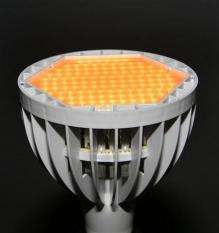
An Array PAR30 LED lamp from Nexxus Lighting is shown at Lightfair International trade show Tuesday, May 5, 2009 in New York. The $100 lamp, which contains 120 light emitting diodes, uses less than 8 watts of energy and produces the equivalent light of a 75 watt incandescent bulb. (AP Photo/Mark Lennihan)

(AP) -- Light-emitting diodes are prime candidates for replacing inefficient incandescent bulbs, but have a few things working against them. They can provide a pleasing warm light or they can be energy-efficient, but they haven't been able to be both at the same time.

On Tuesday, two small companies showed off an LED lamp that's both very power-efficient and produces a light similar to that of a standard tungsten or halogen bulb.

The LEDs in the lamp shine through a thin layer of "," a scattering of particles of very small but precisely controlled size. When light hits them, they emit light of a different color, much like the "phosphor" layer of a fluorescent tube. The magic of quantum dots is that the color they emit can be controlled very accurately by adjusting their size, which means less wasted energy and more pleasing color.

The dots are so small that more than 10,000 of them could be could be lined up over the width of a human hair.

The Quantum Light lamp is made by Nexxus Lighting Inc. of Charlotte, N.C., which demonstrated it at the Light Fair trade show in New York. The lamp will go on sale late this year at an as yet undetermined price. Nexxus already sells a version of it that lacks quantum dots, yielding a bluer, harsher light, for around $100.

The more pleasing light produced by quantum dots could allow LEDs to outshine compact fluorescent bulbs, which are energy-efficient but have taken time to win over consumers, said Bill Blackley, vice president at Nexxus.

"A hundred years, incandescents have been around. That's what people want," Blackley said.

Given the high price of LED lights, the main use for them so far has been in commercial applications, like restaurants and hotels, where the longevity of the lamps makes up for their purchase cost. Nexxus says the lamps last up to 25 times longer than halogen alternatives.

The layer of quantum dots in the lamp are the first commercial product of QD Vision Inc., a Massachusetts Institute of Technology spinoff based in Watertown, Mass. It hopes to spread their use to many other applications, including TV backlights, where they could improve brightness and color saturation.

Quantum dots have shown up in an lighting product before - in strings of colored Christmas lights launched last year by QD Vision competitor Evident Technologies Inc. of Troy, N.Y.

---

On the Net:

http://www.nexxuslighting.com

http://www.qdvision.com

©2009 The Associated Press. All rights reserved. This material may not be published, broadcast, rewritten or redistributed.

Explore further: Researchers develop method to inkjet print highly conductive, bendable layers of graphene

add to favorites email to friend print save as pdf

Related Stories

A Halogen Bulb

Sep 26, 2004

In a new development, halogen light now comes in the form of the classic filament bulb. Fitted with the Osram Halolux Classic, even the oldest of lamps will shine with a new luster. The new lamp not only has ...

Powerful Little Light: LED With 1,000 Lumens

Mar 15, 2007

Osram has developed a small light-emitting diode spotlight that achieves an output of more than 1,000 lumens for the first time. That’s brighter than a 50-watt halogen lamp, thereby making the device suitable ...

Researchers set new record for brightness of quantum dots

Sep 25, 2007

By placing quantum dots on a specially designed photonic crystal, researchers at the University of Illinois have demonstrated enhanced fluorescence intensity by a factor of up to 108. Potential applications include high-brightness ...

Scientists develop novel multi-color light-emitting diodes

May 18, 2005

A team of University of California scientists at Los Alamos National Laboratory have developed the first completely inorganic, multi-color light-emitting diodes (LEDs) based on colloidal quantum dots encapsulated in a gallium ...

Recommended for you

Kinks and curves at the nanoscale

May 19, 2013

One of the basic principles of nanotechnology is that when you make things extremely small—one nanometer is about five atoms wide, 100,000 times smaller than the diameter of a human hair—they are going ...

Snake's ultra-black spots may aid high-tech quest

May 16, 2013

Scientists have identified nanostructures in the ultra-black skin markings of an African viper which they said Thursday could inspire the quest to create the ultimate light-absorbing material.

User comments : 0

More news stories

How gold nanoparticles can help fight ovarian cancer

Positively charged gold nanoparticles are usually toxic to cells, but cancer cells somehow manage to avoid nanoparticle toxicity. Mayo Clinic researchers found out why, and determined how to make the nanoparticles effective ...

Advance in nanotech gene sequencing technique

(Phys.org) —The allure of personalized medicine has made new, more efficient ways of sequencing genes a top research priority. One promising technique involves reading DNA bases using changes in electrical ...