Plants may affect the effect of wildfires
May 01, 2009
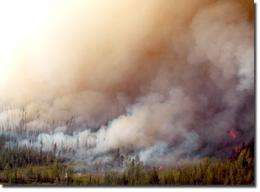
A wildfire burns in boreal forests of the Yukon Flats Alaska, in summer of 2006.

(PhysOrg.com) -- Rising temperatures may lead to more tinder-dry vegetation, but that doesn't mean there will be a higher risk for wildfires in a particular area.

It all depends on the type of vegetation. A new study on the cover of the May issue of Ecological Monographs shows that, in some cases, the types of plants growing in an area could override the effects of climate change on wildfire occurrence.

Lawrence Livermore National Laboratory scientist Tom Brown, along with Philip Higuera of Montana State University and colleagues, looked at the direct and indirect impacts of millennial-scale climate change on occurrence in the south-central Brooks Range in Alaska.

The team looked at historical fire occurrence by analyzing sediments found in the bottom of lakes.

Using the Lab's Center for Accelerator Mass Spectrometry, they carbon dated the deposits in the sediment and reconstructed fire occurrences from 15,000 B.C. to the present. Then they measured the amount of plant parts, such as fossil pollen, to figure out what type of vegetation dominated the area during the different time periods.

The conclusion: Fire frequencies coincided with changes in the type of vegetation in the area, more so than rising temperatures alone.

"If all we did was look at rising temperatures and ignore the vegetation in the area, that wouldn't be a good predictor of the likelihood of wildfires in a particular region," Brown said. "You have to look at the whole picture."

Although changing temperatures and moisture content set the stage for changes in wildfire frequency, they often can be trumped by changes in the distribution and abundance of plants.

Earlier studies have shown that the area burned across arctic and boreal regions will increase over the next century as climate change lengthens the fire season, decreases moisture and increases ignition rates. However, vegetation can alter the direct link between climate and fire by influencing the abundance, structure and moisture content of fuels across space and time, Brown said.

"There's a complex relationship between fuels and climate," he said. "Vegetation can have a profound impact on fire occurrences that are opposite or independent of climate's direct influence on fire."

In the recent study, the researchers found that changes in climate were less important than changes in vegetation. Despite a transition from a cool, dry climate to a warm, dry climate about 10,500 years ago, the researchers found a sharp decline in the frequency of fires. Their sediment cores from that time period revealed a vegetation change from flammable shrubs to fire-resistant deciduous trees.

"In this case, a warmer climate was likely more favorable for fire occurrence, but the development of deciduous trees on the landscape offset this direct climatic effect," Higuera said.

The research implies that the impacts of on modern-day fire frequencies could be strongly mediated by changes in vegetation.

"This could give fire managers a good indication that vegetation can substantially alter the direct effects of on fire occurrence," Brown said.

Source: Lawrence Livermore National Laboratory

Explore further: Detour ahead: Cities, farms reroute animals seeking cooler climes

add to favorites email to friend print save as pdf

Related Stories

Warming climate may cause arctic tundra to burn

Mar 05, 2008

Research from ancient sediment cores indicates that a warming climate could make the world’s arctic tundra far more susceptible to fires than previously thought. The findings, published this week in the online journal, ...

Massive California fires consistent with climate change

Oct 24, 2007

The catastrophic fires that are sweeping Southern California are consistent with what climate change models have been predicting for years, experts say, and they may be just a prelude to many more such events in the future ...

Climate change to spur rapid shifts in wildfire hotspots

Apr 08, 2009

(PhysOrg.com) -- Climate change will bring about major shifts in worldwide fire patterns, and those changes are coming fast, according to a first-of-its-kind analysis led by researchers at the University of ...

Recommended for you

Hong Kong dolphin numbers dwindling quickly

16 hours ago

Conservationists Tuesday warned that the number of rare Chinese white dolphins in Hong Kong waters has fallen to its lowest level in a decade of monitoring, and urged the government to immediately create more protected areas.

WWF urges Romania, Bulgaria to protect wild sturgeon

19 hours ago

Conservationist group WWF on Tuesday urged Romania and Bulgaria, home to the last viable wild sturgeon populations in the European Union, to protect the species, threatened by illegal fishing and caviar trade.

New resource to record Britain's trees launched

21 hours ago

Treezilla, the monster map of trees, was launched by The Open University and partners on 14 June 2013. The citizen science project aims to map every tree in Britain through Treezilla.org and the related apps.

Study reveals disease-causing parasites in dead otters

23 hours ago

Research undertaken by the Cardiff University Otter Project has revealed a number of disease-causing parasites in the bodies of dead otters. The findings were revealed at the BBC Summer of Wildlife event ...

User comments : 1

Adjust slider to filter visible comments by rank

Display comments: newest first

Mercury_01
not rated yet May 01, 2009
This is such bunk, I dont know where to start.

"(PhysOrg.com) -- Rising temperatures may lead to more tinder-dry vegetation, but that doesn't mean there will be a higher risk for wildfires in a particular area."

I am a seventh year wildland firefighter. This statement is in direct opposition to hundreds of years of statistical fact. When it is hot and dry, there are more and bigger fires.

Fuels are a deciding factor in fire behavior, not fire frequency. There has always been lightning, and there has always been an ignition point that will spread depending on temperature, humidity, and fuel type/ load, weather, and terrain.

If they are taking studying the strata for a given are, that gives them absolutely NO indication of the frequency of fires for that era of time. It only means that in times where the ground there was covered with fire resistant fuels, or too sparse to burn, that the fires did not encroach on that particular localized area. Every firefighter knows this. There are just as many fire starts in the eastern US as in the west. The only difference is that the pine forests of the west allow for a greater rate of spread and larger fires. I hope we didn't pay these people too much for this useless information.


More news stories

Origins of 'The Hoff' crab revealed (w/ Video)

The history of a new type of crab, nicknamed 'The Hoff' because of its hairy chest, which lives around hydrothermal vents deep beneath the Southern Ocean and Indian Ocean, has been revealed for the first ...

Cape Wind gets $200M investment from Danish fund

The Cape Wind offshore wind project has secured a $200 million investment from a Danish pension fund in what the wind farm's president said Tuesday is a milestone for the long-delayed project.