Analysis of Flickr photos could lead to online travel books
Apr 28, 2009 By Paul Redfern
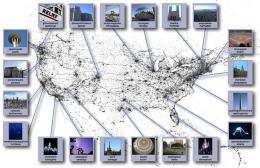
Representative images for the top landmark in each of the top 20 North American cities. All parts of the figure, including images, textual labels and the map itself, were produced automatically from the researchers' geo-tagged photos. (Image: David Crandall)

(PhysOrg.com) -- Cornell scientists have downloaded and analyzed nearly 35 million Flickr photos taken by more than 300,000 photographers from around the globe, using a supercomputer at the Cornell Center for Advanced Computing (CAC).

Their research, which was presented at the International Conference in Madrid, April 20-24, provides a new and practical way to automatically organize, label and summarize large-scale collections of digital images. The scalability of the method allows for mining information latent in very large sets of images, raising the intriguing possibility of an online travel guidebook that could automatically identify the best sites to visit on a vacation, as judged by the collective wisdom of the world's photographers.

The research also generated statistics on the world's most photographed cities and landmarks, gleaned from the analysis of the multi-terabyte photo collection:

• The top 25 most photographed cities in the Flickr data are (in order): New York City, London, San Francisco, Paris, Los Angeles, Chicago, Washington, D.C., Seattle, Rome, Amsterdam, Boston, Barcelona, San Diego, Berlin, Las Vegas, Florence, Toronto, Milan, Vancouver, Madrid, Venice, Philadelphia, Austin, Dublin and Portland.

• The top seven most photographed landmarks are (in order): Eiffel Tower, Paris; Trafalgar Square, London; Tate Modern museum, London; Big Ben, London; Notre Dame, Paris; The Eye, London; and the Empire State Building, New York City.

Interestingly, the Apple Store in midtown Manhattan was the fifth-most photographed place in New York City -- and the 28th-most photographed place in the world.

The researchers developed techniques to identify places that people find interesting to photograph, showing results for thousands of locations at both city and landmark scales.

"We developed classification methods for characterizing these locations from visual, textual and temporal features," said Daniel Huttenlocher, the John P. and Rilla Neafsey Professor of Computing, Information Science and Business and Stephen H. Weiss fellow. "These methods reveal that both visual and temporal features improve the ability to estimate the location of a photo compared to using just textual tags."

As the creation of digital data accelerates, said CAC director David Lifka, "supercomputers and high-performance storage systems will be essential in order to quickly store, archive, preserve and retrieve large-scale data collections."

The research was supported in part by the National Science Foundation (NSF) and by funding from Google, Yahoo! and the John D. and Catherine T. MacArthur Foundation. The CAC is supported by Cornell, the NSF, the Department of Defense, the Department of Agriculture and members of its corporate program.

The paper is available for download at www.cs.cornell.edu/~dph/papers/photomap-www09.pdf .

Provided by Cornell University (news : web)

Explore further: Computer scientist publishes new algorithm cluster to data mine health records

add to favorites email to friend print save as pdf

Related Stories

Vacation photos create 3-D models of world landmarks

Nov 01, 2007

More than 10 million members of the photo-sharing Web site Flickr snap pictures of their surroundings and then post those photos on the Internet. One group at the University of Washington is doing the reverse ...

U.S. cities rated for 'sustainability'

Jun 01, 2006

SustainLane has issued its 2006 ranking of U.S. cities across 12 major "sustainability" categories, with West Coast cities taking the top spots.

New system estimates geographic location of photos

Jun 18, 2008

Researchers at Carnegie Mellon University have devised the first computerized method that can analyze a single photograph and determine where in the world the image likely was taken. It's a feat made possible ...

Photo software creates 3-D world

Feb 20, 2007

In the digital age, organizing a photo collection has gone from bad to worse. The saying used to be that a picture is worth a thousand words. Now the question arises: what are a thousand pictures worth? In ...

Recommended for you

The brain as a model for future supercomputers

May 14, 2013

(Phys.org) —The brain's repute took a big hit in 1997 when an IBM supercomputer defeated world chess champion Gary Kasparov in a match reported around the world. But in the second round, the brain is back.

User comments : 2

Adjust slider to filter visible comments by rank

Display comments: newest first

tehjamez
not rated yet Apr 29, 2009
Does this mean that all those photos of my ass I tagged with Paris are now a 'must-see' landmark?
Milou
not rated yet Apr 29, 2009
I tag my photos incorrectly just to throw them off.

More news stories

Morocco to harness the wind in energy hunt

Morocco is ploughing ahead with a programme to boost wind energy production, particularly in the southern Tarfaya region, where Africa's largest wind farm is set to open in 2014.

US seizes Bitcoin operator accounts

US authorities seized the accounts of a Bitcoin digital currency exchange operator, claiming it was functioning as an "unlicensed money service business," court documents showed Friday.

Yahoo Japan suspects 22 million IDs stolen

Yahoo Japan Corp. has said it suspects up to 22 million user IDs may have been stolen during an unauthorised attempt to access the administrative system of its Yahoo! Japan portal.

Galaxy's Ring of Fire

Johnny Cash may have preferred this galaxy's burning ring of fire to the one he sang about falling into in his popular song. The "starburst ring" seen at center in red and yellow hues is not the product of ...

Alaska volcano shoots ash 15,000 feet into the air

(AP)—One of Alaska's most restless volcanoes has shot an ash cloud 15,000 feet into the air in an ongoing eruption that has drawn attention from a nearby community but isn't expected to threaten air traffic.