Scientists bring ancient Egypt to life with virtual model of historic temple complex (w/Video)
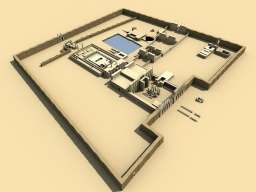
(PhysOrg.com) -- For the past two years, a team of UCLA Egyptologists, digital modelers, web designers, staff and students has been building a three-dimensional virtual-reality model of the ancient Egyptian religious site known as Karnak, one of the largest temple complexes ever constructed.
The result is Digital Karnak, a high-tech model that runs in real time and allows users to navigate 2,000 years of history at the popular ancient Egyptian tourist site near modern-day Luxor, where generations of pharaohs constructed temples, chapels, obelisks, sphinxes, shrines and other sacred structures beginning in the 20th century B.C.
Developed by UCLA's Experiential Technologies Center — which has helped pioneer the digital reconstruction of historical sites, including the innovative Rome Reborn, released in 2006 — the Karnak model and a host of additional digital resources are now available for educators, students, scholars and the public to explore for free at dlib.etc.ucla.edu/projects/Karnak .
The website features videos from the 3-D model, instructional resources for educators, a Google Earth version of the model and pages detailing the chronology and construction of individual structures at the temple complex. The collective resources offer a window onto the incredibly rich architectural, religious, economic, social and political history of ancient Egypt.
"The Digital Karnak project builds upon UCLA's expertise merging research and multidimensional technologies to inform and preserve knowledge about historic sites," said project director Diane Favro, a professor in the architecture and urban design department at the UCLA School of the Arts and Architecture. "This learning platform allows educators and researchers to geo-temporally situate information and thus visualize and interrogate the evolution of Karnak over 2,000 years."
In recent years, scientists, historians and archaeologists around the world have embraced the 3-D modeling of cultural heritage sites. Information technology has permitted them to recreate buildings and monuments that no longer exist or to digitally restore sites that have been damaged by the passage of time. The results can be used both in research, to test new theories, and in teaching, to take students on virtual tours of historical sites they are studying.
Provided by University of California Los Angeles (news : web)


