The Surprising Shape of Solar Storms (w/Video)
Apr 14, 2009
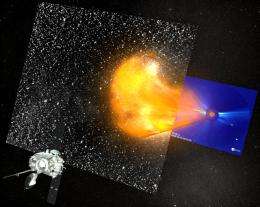
This artist’s animation depicts STEREO’s COR1 imager capturing a coronal mass ejection (CME) as it erupts from the sun and speeds toward Earth. Credit: Walt Feimer, NASA's Goddard Spaceflight Center

(PhysOrg.com) -- Twin NASA spacecraft have provided scientists with their first view of the speed, trajectory, and three-dimensional shape of powerful explosions from the sun known as coronal mass ejections, or CMEs. This new capability will dramatically enhance scientists' ability to predict if and how these solar tsunamis could affect Earth.

When directed toward our planet, these ejections can be breathtakingly beautiful and yet potentially cause damaging effects worldwide. The brightly colored phenomena known as auroras -- more commonly called Northern or Southern Lights -- are examples of Earth's upper atmosphere harmlessly being disturbed by a CME. However, ejections can produce a form of solar cosmic rays that can be hazardous to spacecraft, astronauts and technology on Earth.

Space weather produces disturbances in electromagnetic fields on Earth that can induce extreme currents in wires, disrupting power lines and causing wide-spread blackouts. These sun storms can interfere with communications between ground controllers and satellites and with airplane pilots flying near Earth's poles. Radio noise from the storm also can disrupt cell phone service. Space weather has been recognized as causing problems with new technology since the invention of the telegraph in the 19th century.

This video is not supported by your browser at this time.
A computer model of a croissant-shaped CME. Models like this can be rapidly fit to real CMEs as soon as they are observed, allowing forecasters to accurately estimate the speed and trajectory of the storms. Credit: NASA.

NASA's twin Solar Terrestrial Relations Observatory, or STEREO, spacecraft are providing the unique scientific tool to study these ejections as never before. Launched in October 2006, STEREO's nearly identical observatories can make simultaneous observations of these ejections of plasma and magnetic energy that originate from the sun's outer atmosphere, or corona. The spacecraft are stationed at different vantage points. One leads Earth in its orbit around the sun, while the other trails the planet.

Using three-dimensional observations, solar physicists can examine a CME's structure, velocity, mass, and direction in the corona while tracking it through interplanetary space. These measurements can help determine when a CME will reach Earth and predict how much energy it will deliver to our magnetosphere, which is Earth's protective magnetic shield.

"Before this unique mission, measurements and the subsequent data of a CME observed near the sun had to wait until the ejections arrived at Earth three to seven days later," said Angelos Vourlidas, a solar physicist at the Naval Research Laboratory in Washington. Vourlidas is a project scientist for the Sun Earth Connection Coronal and Heliospheric Investigation, STEREO's key science instrument suite. "Now we can see a CME from the time it leaves the solar surface until it reaches Earth, and we can reconstruct the event in 3D directly from the images."

These ejections carry billions of tons of plasma into space at thousands of miles per hour. This plasma, which carries with it some of the magnetic field from the corona, can create a large, moving disturbance in space that produces a shock wave. The wave can accelerate some of the surrounding particles to high energies that can produce a form of solar cosmic rays. This process also can create disruptive during and following the CME's interaction with Earth's magnetosphere and .

"The new vantage point of these spacecraft has revolutionized the study of solar physics," said Madhulika Guhathakurta, STEREO program scientist at NASA Headquarters in Washington. "We can better determine the impact of CME effects on Earth because of our new ability to observe in 3D."

STEREO is part of NASA's Solar Terrestrial Probes Program in NASA's Science Mission Directorate in Washington. The program seeks to understand the fundamental physical processes of the space environment from the to and other planets.

The Solar Terrestrial Probes Program also seeks to understand how society, technological systems and the habitability of planets are affected by solar processes. This information may lead to a better ability to predict extreme and dynamic conditions in space, and the development of new technologies to increase safety and productivity of human and robotic space exploration.

Provided by JPL/NASA (news : web)

Explore further: NASA head views progress on asteroid lasso mission

add to favorites email to friend print save as pdf

Related Stories

NASA releases first 3-D images of the sun from STEREO

Apr 23, 2007

NASA's twin Solar Terrestrial Relations Observatory (STEREO) spacecraft have made the first three-dimensional images of the sun. The new view will greatly aid scientists' ability to understand solar physics ...

STEREO Sends Back First Solar Images

Dec 19, 2006

NASA's twin Solar Terrestrial Relations Observatories (STEREO) sent back their first images of the sun this week and with them a view into the sun's mounting activity.

NASA satellite sees solar hurricane detach comet tail

Oct 01, 2007

A NASA satellite has captured the first images of a collision between a comet and a solar hurricane. It is the first time scientists have witnessed such an event on another cosmic body. One of NASA's pair ...

Satellites Will Improve Understanding of the Sun

Aug 17, 2006

NASA's Solar Terrestrial Relations Observatory mission will dramatically improve understanding of the powerful solar eruptions that can send more than a billion tons of the sun's outer atmosphere hurtling into ...

Screaming CMEs Warn of Radiation Storms

May 28, 2007

A CME (Coronal Mass Ejection) is a solar body slam to our high-tech civilization. CMEs begin when the sun launches a billion tons of electrically conducting gas (plasma) into space at millions of miles per hour. A CME cloud ...

Sunspot Creates a Stir; Auroras Likely

Jan 19, 2005

Beyond the winter chill that many of us have to contend with, there's also stormy space weather in the forecast for the week. A fast-growing sunspot group designated AR 10720 has been causing a stir as it ...

Recommended for you

NASA head views progress on asteroid lasso mission

7 hours ago

Surrounded by engineers, NASA chief Charles Bolden inspected a prototype spacecraft engine that could power an audacious mission to lasso an asteroid and tow it closer to Earth for astronauts to explore.

Ecuador satellite collides with Russian space junk

7 hours ago

A small Ecuadoran satellite collided in orbit with the remains of a Russian rocket, but it is too soon to know how much damage it might have sustained, Quito's space agency said Thursday.

Forecast for Titan: Wild weather could be ahead

May 22, 2013

(Phys.org) —Saturn's moon Titan might be in for some wild weather as it heads into its spring and summer, if two new models are correct. Scientists think that as the seasons change in Titan's northern hemisphere, ...

SDO observes mid-level solar flare

May 22, 2013

UPDATE 16:30 p.m. EDT: The M7-class flare was also associated with a coronal mass ejection or CME, another solar phenomenon that can send billions of tons of particles into space. While this CME was not Ea ...

User comments : 1

Adjust slider to filter visible comments by rank

Display comments: newest first

denijane
not rated yet Apr 15, 2009
The video is quite cool!

More news stories

A hidden population of exotic neutron stars

(Phys.org) —Magnetars – the dense remains of dead stars that erupt sporadically with bursts of high-energy radiation - are some of the most extreme objects known in the Universe. A major campaign using ...

Hubble reveals the ring nebula's true shape

(Phys.org) —The Ring Nebula's distinctive shape makes it a popular illustration for astronomy books. But new observations by NASA's Hubble Space Telescope of the glowing gas shroud around an old, dying, ...

NASA head views progress on asteroid lasso mission

Surrounded by engineers, NASA chief Charles Bolden inspected a prototype spacecraft engine that could power an audacious mission to lasso an asteroid and tow it closer to Earth for astronauts to explore.

Controlling mood through the motions of mitochondria

(Medical Xpress)—Regulating the distribution of power in neurons is done by a system that makes the national electric grid look simple by comparison. Each neuron has several thousand mitochondria confined ...

A quantum simulator for magnetic materials

Physicists understand perfectly well why a fridge magnet sticks to certain metallic surfaces. But there are more exotic forms of magnetism whose properties remain unclear, despite decades of intense research. ...