World’s First Nanofluidic Device with Complex 3-D Surfaces Built
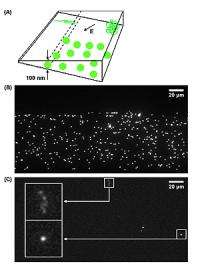
(A) Schematic of the NIST-Cornell nanofluidic device with complex 3-D surfaces. Each “step” of the “staircase” seen on the side marks a different depth within the chamber. The letter “E” shows the direction of the electric field used to move the nanoparticles through the device. The green balls are spheres with diameters of 100 nanometers whose size restricts them from moving into the shallower regions of the chamber. The coil in the deep end of the chamber (upper right corner) is a single DNA strand that elongates (upper left corner) in the shallow end. (B) Photomicrograph showing fluorescently tagged spherical nanoparticles stopped at the 100-nanometer level of the chamber, the depth that corresponds to their diameter. (C) Photomicrograph of a single DNA strand that is coiled in the deep end of chamber (box at far right) and elongated in the shallow end (box at far left). Larger boxes are closeups showing the fluorescently tagged strands. Credit: NIST
(PhysOrg.com) -- Researchers at the National Institute of Standards and Technology and Cornell University have capitalized on a process for manufacturing integrated circuits at the nanometer level to engineer the first-ever nanoscale fluidic device with complex three-dimensional surfaces. As described in a recent paper in the journal Nanotechnology,* the Lilliputian chamber is a prototype for future tools with custom-designed surfaces to manipulate and measure different types of nanoparticles in solution.
Among the potential applications are processing nanoscale materials for manufacturing products such as pharmaceuticals, sorting mixtures of nanoparticles for environmental health and safety investigations, and isolating and confining individual DNA strands for scientific study.
Nanofluidic devices are usually fabricated by etching tiny channels into a glass or silicon wafer with the same “lithographic” procedures used for making integrated circuits. To date, these flat rectangular channels have had simple surfaces with only a few depths. This limits their ability to separate mixtures of nanoparticles with different sizes or study the nanoscale behavior of biomolecules (such as DNA) in detail.
To solve the problem, the researcher team developed a lithographic process to fabricate complex 3-D surfaces. To demonstrate their method, they constructed a nanofluidic chamber with a “staircase” geometry etched into the floor. The “steps” in this staircase—each level giving the device a progressively increasing depth from 10 nanometers (about 6,000 times smaller than the width of a human hair) at the top to 620 nanometers at the bottom—are what give the device its ability to manipulate nanoparticles by size in the same way a coin sorter separates nickels, dimes and quarters.
In these novel experiments, the researchers tested their device with two different solutions: one containing 100-nanometer-diameter polystyrene spheres and the other containing 20-micrometer (millionth of a meter)-length DNA molecules from a virus. In each experiment, the researchers injected the solution into the chamber’s deep end and then used electric fields to drive their sample across the device from deeper to shallower levels. Both the spheres and DNA strands were tagged with fluorescent dye so that their movements could be tracked with a microscope.
In the trials using rigid nanoparticles, size exclusion occurred when the region of the chamber where the channels were less than 100 nanometers in depth stayed free of the particles. In the viral DNA trials, the genetic material was coiled in the deeper channels and elongated when forced into the shallower ones. These results demonstrate the utility of the NIST-Cornell 3-D nanofluidic device to perform more complicated nanoscale operations.
Currently, the researchers are working to separate and measure mixtures of different-sized nanoparticles and investigate the behavior of DNA captured in a 3-D nanofluidic environment. For more information and images, see “NIST-Cornell Team Builds World’s First Nanofluidic Device with Complex 3-D Surfaces.”
More information: * S.M. Stavis, E.A. Strychalski and M.Gaitan. Nanofluidic structures with complex three-dimensional surfaces. Nanotechnology Vol. 20, Issue 16 (online March 31, 2009; in print April 22, 2009).
Provided by National Institute of Standards and Technology (news : web)
-
From lemons to lemonade: Reaction uses carbon dioxide to make carbon-based semiconductor,
32 comments
-
Thioridazine kills cancer stem cells in human while avoiding toxic side-effects of conventional cancer treatments,
3 comments
-
SpaceX private rocket blasts off for space station (Update),
42 comments
-
Climate scientists say they have solved riddle of rising sea,
31 comments
-
SpaceX capsule has 'new car' smell, astronauts say (Update),
4 comments
-
osmotic pressure vs diffusion
1 hour ago
-
What would stain as translucent on light-coloured fabric?
May 26, 2012
-
How do I identify different bacteria on culture plates?
May 26, 2012
-
Why Do Dogs do Strange things...
May 25, 2012
-
What does exophillic and endophillic mean in terms of mosquito and their control?
May 24, 2012
-
Semen stains glows under black lights (uv light)?
May 23, 2012
- More from Physics Forums - Biology
More news stories
Stunning image of smallest possible five-ringed structure
Scientists have created and imaged the smallest possible five-ringed structure about 100,000 times thinner than a human hair and you'll probably recognise its shape.
3 hours ago |
4.8 / 5 (4) |
1
|
'Unzipped' carbon nanotubes could help energize fuel cells, batteries
Multi-walled carbon nanotubes riddled with defects and impurities on the outside could replace some of the expensive platinum catalysts used in fuel cells and metal-air batteries, according to scientists at ...
Nanotechnology / Nanomaterials
9 hours ago |
3 / 5 (2) |
0
|
Dopant gives graphene solar cells highest efficiency yet
(Phys.org) -- By taking advantage of graphenes favorable electrical and optical properties, and then adding an organic dopant, researchers have achieved the highest power conversion efficiency yet for ...
In nanorod crystal growth, nanoparticles seen as artificial atoms
In the growth of crystals, do nanoparticles act as "artificial atoms" forming molecular-type building blocks that can assemble into complex structures? This is the contention of a major but controversial theory ...
May 24, 2012 |
4.8 / 5 (6) |
0
|
First direct observation of oriented attachment in nanocrystal growth
Berkeley Lab researchers have reported the first direct observation of nanoparticles undergoing oriented attachment, the critical step in biomineralization and the growth of nanocrystals. A better understanding ...
May 24, 2012 |
4.7 / 5 (3) |
0
|
Change in developmental timing was crucial in the evolutionary shift from dinosaurs to birds: study
At first glance, it's hard to see how a common house sparrow and a Tyrannosaurus Rex might have anything in common. After all, one is a bird that weighs less than an ounce, and the other is a dinosaur that ...
Computer model used to pinpoint prime materials for efficient carbon capture
When power plants begin capturing their carbon emissions to reduce greenhouse gases and to most in the electric power industry, it's a question of when, not if it will be an expensive undertaking.
T cells 'hunt' parasites like animal predators seek prey, study shows
By pairing an intimate knowledge of immune-system function with a deep understanding of statistical physics, a cross-disciplinary team at the University of Pennsylvania has arrived at a surprising finding: T cells use a movement ...
Land and sea species differ in climate change response: study
(Phys.org) -- Marine and terrestrial species will likely differ in their responses to climate warming, new research by Simon Fraser University and Australia’s University of Tasmania has found.
Yale study concludes public apathy over climate change unrelated to science literacy
Are members of the public divided about climate change because they don't understand the science behind it? If Americans knew more basic science and were more proficient in technical reasoning, would public consensus match ...
10 million years needed to recover from mass extinction
It took some 10 million years for Earth to recover from the greatest mass extinction of all time, latest research has revealed.
Apr 08, 2009
Rank: not rated yet