Carbon Nanotubes Toughen a Common Plastic
Apr 07, 2009 by Laura Mgrdichian feature
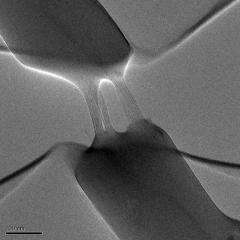
A nanotube-enforced PMMA fiber being stretched, forming narrow “necks.” Image courtesty H. Daniel Wagner.

(PhysOrg.com) -- A research group from the Weizmann Institute of Science in Israel has discovered that adding carbon nanotubes to a widely used commercial plastic can greatly strengthen it. Their work is one example of how incorporating carbon nanotubes into plastics and other materials can yield composites with much improved properties.

The plastic, known as PMMA, is most commonly used to make shatterproof glass-substitute materials, such as the brands Plexiglas and Lucite. The researchers reinforced PMMA with both single-walled and multi-walled carbon nanotubes and found that, while both types were effective, the highest was achieved with the multi-walled nanotubes, which resemble several single-walled nanotubes nested together.

Bulk materials reinforced with nanostructures are the future of materials, beginning to replace composites made with micrometer-sized particles. Carbon nanotubes are a natural choice because they are exceptionally strong, and the multi-walled varieties are especially tough because of their more complex structures; they can contain up to 50 nested nanotubes.

But achieving significant improvements in a material's strength via nanotube reinforcement doesn’t happen often because of hard-to-avoid issues like nanotube clustering—some nanotubes randomly aggregate rather than distribute evenly. This may even reduce a material's strength.

“Despite the large numbers of studies being done, there are still contradictory findings on the role of carbon nanotubes as reinforcement agents and the role of nanotube type—multi-walled versus single-walled—has not been adequately addressed,” said the study's lead scientist, H. Daniel Wagner, to PhysOrg.com.

He continued, “Another major challenge in preparing nanocomposites is developing procedures that distribute nanostructures in ordered ways. We used electrospinning, which is both simple and effective in creating large-scale nanocomposite materials.”

Electrospinning involves using an electric charge to draw very fine fibers or structures (typically on the micro- or nanoscale) from a liquid and deposit them elsewhere. It is used in many areas of science and technology, from making textiles to creating components for artificial organs.

Wagner and colleague Xiaomeng Sui electrospun both pure PMMA fibers and fibers reinforced with either single-walled carbon nanotubes (SWCNTs) or multi-walled carbon nanotubes (MWCNTs). Their analysis shows that the nanotubes embedded among the fibers were nicely aligned along the fiber axis. The SWCNTs formed long, thick ropes, which turn out to triple the composite's toughness. The MWCNTs, on the other hand, were more evenly dispersed, leading to even larger toughness enhancements.

Wagner and Sui tested each composite's strength using a “nanotensile” device they designed, which stretched the fibers until they broke. They watched the process under an electron microscope. To eliminate the effect of fiber diameter on the results, they limited their scope to samples with diameters between 500 and 750 nanometers.

The addition of carbon nanotubes to the PMMA fibers causes a “striking” transformation, they found. The pure PMMA fibers developed thin “necks” and broke under relatively small strains. Both composites also experienced necking, but only failed at strain values that were comparatively enormous. That is, they deformed but did not break under much more forceful stretching than that applied to the pure fibers.

Theses findings are published in the March 2, 2009, online edition of Nano Letters.

Citation: Nano Lett., Article ASAP DOI: 10.1021/nl803241y

Copyright 2009 PhysOrg.com.
All rights reserved. This material may not be published, broadcast, rewritten or redistributed in whole or part without the express written permission of PhysOrg.com.

Explore further: Hybrid material as gold-leaf substitute

add to favorites email to friend print save as pdf

Related Stories

'Nanostitching' could strengthen airplane skins, more

Mar 04, 2009

MIT engineers are using carbon nanotubes only billionths of a meter thick to stitch together aerospace materials in work that could make airplane skins and other products some 10 times stronger at a nominal ...

High Value Semiconducting Carbon Nanotubes

Jul 12, 2004

A simple technique has been developed for producing high value semiconducting carbon nanotubes from samples of single and multi walled carbon nanotubes. The Oxford Invention is a technique for purifying samp ...

How to Shrink a Carbon Nanotube

Nov 30, 2006

A research group has devised a way to control the diameter of a carbon nanotube – down to essentially zero nanometers. This useful new ability, designed by scientists from the University of California at ...

Method sorts out double-walled carbon nanotube problem

Dec 14, 2008

It's hard to study something with any rigor if the subject can't be produced uniformly and efficiently. Researchers who study double-walled carbon nanotubes -- nanomaterials with promising technological applications -- find ...

Recommended for you

Hybrid material as gold-leaf substitute

20 hours ago

(Phys.org) —A team of researchers headed by Professor Raffaele Mezzenga has created a hybrid material out of gold and milk proteins that looks like a wafer-thin gold leaf. Thanks to its properties, it could ...

Antioxidant with a long shelf life

Jun 17, 2013

(Phys.org) —Scientists from ETH Zurich have developed a nanomaterial that protects other molecules from oxidation. Unlike many such active substances in the past, the ETH-Zurich researchers' antioxidant ...

Fast pollutant degradation by nanosheets

Jun 17, 2013

(Phys.org) —Waste from textile and paint industries often contains organic dyes such as methylene blue as pollutants. Photocatalysis is an efficient means of reducing such pollution, and molybdenum trioxide ...

Unzipped nanotubes unlock potential for batteries

Jun 13, 2013

(Phys.org) —Researchers at Rice University have come up with a new way to boost the efficiency of the ubiquitous lithium ion (LI) battery by employing ribbons of graphene that start as carbon nanotubes.

Nanoparticle opens the door to clean-energy alternatives

Jun 13, 2013

(Phys.org) —Cheaper clean-energy technologies could be made possible thanks to a new discovery. Research team members led by Raymond Schaak, a professor of chemistry at Penn State University, have found ...

User comments : 2

Adjust slider to filter visible comments by rank

Display comments: newest first

ronplk84
not rated yet Apr 11, 2009
thought provoking & hopes it would strengthen bullet proof vests.
mtulloch
4 / 5 (1) Apr 12, 2009
wonder how it affects transparency?
Could this approach also be used in the plastic fibers woven into ropes?

More news stories

3D printing tiny batteries

(Phys.org) —3D printing can now be used to print lithium-ion microbatteries the size of a grain of sand. The printed microbatteries could supply electricity to tiny devices in fields from medicine to communications, ...

Future looks bright for carbon nanotube solar cells

(Phys.org) —In an approach that could challenge silicon as the predominant photovoltaic cell material, University of Wisconsin-Madison materials engineers have developed an inexpensive solar cell that exploits ...

Hybrid material as gold-leaf substitute

(Phys.org) —A team of researchers headed by Professor Raffaele Mezzenga has created a hybrid material out of gold and milk proteins that looks like a wafer-thin gold leaf. Thanks to its properties, it could ...

World's most powerful microscope ready for research

(Phys.org) —The world's most powerful microscope, which resides in a specially constructed room at the University of Victoria, has now been fully assembled and tested, and has a lineup of scientists and businesses eager ...