The biochemical buzz on career changes in bees
Apr 06, 2009
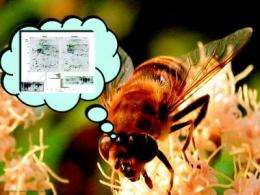
Scientists are reporting differences in the brains of nurse bees and forager bees. Credit: The American Chemical Society

Adults facing unexpected career changes, take note. Scientists from Brazil and Cuba are reporting that honey bees — a mainstay for behavioral research that cannot be done in other animals — change their brains before transitioning to that new job. Appears in the current edition of ACS' monthly Journal of Proteome Research, the research provides valuable insight into the biochemistry behind the behavior, feats of navigation, and social organization in these animals.

In the study, Marcelo Valle de Sousa and colleagues point out that worker begin adult life by performing tasks in the nest such as brood nursing. By 2-3 weeks of age, however, these females — equivalent to middle age in human years —switch to foraging for nectar and pollen. Foraging requires a new skill set that includes uncanny ability to navigate to and from feeding sites, communicating the location of food to other bees, and flights of hundreds of miles in a lifetime.

The researchers collected and analyzed hundreds of bee brains, comparing the proteins scripted by the genes in nurses and foragers in order to find proteins related to the genetic and behavioral shifts during these career transitions. The brains of nurse bees have higher levels of certain "royal jelly" proteins involved in caste determination. Experienced foragers, in contrast, over expressed proteins linked to energy production and other activities.

"Our study demonstrated clear brain proteome differences between honey bee nurse and forager subcastes with distinct social roles," the study says. - AD

More information: "Proteomic Analysis of Honey Bee Brain upon Ontogenetic and Behavioral Development," pubs.acs.org/stoken/presspac/presspac/full/10.1021/pr800823r

Provided by American Chemical Society (news : web)

Explore further: New canary seed is ideal for gluten-free diets in celiac disease

add to favorites email to friend print save as pdf

Related Stories

Honey bee genome holds clues to social behavior

Oct 23, 2006

By studying the humble honey bee, researchers at the University of Illinois at Urbana-Champaign have come a step closer to understanding the molecular basis of social behavior in humans.

Honey bee chemoreceptors found for smell and taste

Oct 25, 2006

Honey bees have a much better sense of smell than fruit flies or mosquitoes, but a much worse sense of taste, according to researchers at the University of Illinois at Urbana-Champaign.

Sky's the limit for bee brain power

Mar 05, 2008

Families flocked to see the latest animated hit Bee Movie, but scientists from UQ's Queensland Brain Institute (QBI) have long embraced the bee for very different reasons.

Bee species outnumber mammals and birds combined

Jun 11, 2008

Scientists have discovered that there are more bee species than previously thought. In the first global accounting of bee species in over a hundred years, John S. Ascher, a research scientist in the Division of Invertebrate ...

Recommended for you

Long distance calls by sugar molecules

18 hours ago

All our cells wear a coat of sugar molecules, so-called glycans. ETH Zurich and Empa researchers have now discovered that glycans rearrange water molecules over long distances. This may have an effect on ...

Researchers discover a way to detect new viruses

Jun 17, 2013

(Phys.org) —In research published in Biochemical and Biophysical Research Communications, Saint Louis University researchers describe a technology that can detect new, previously unknown viruses. The te ...

User comments : 0

More news stories

Pearly perfection

The mystery of how pearls form into the most perfectly spherical large objects in nature may have an unlikely explanation, scientists are proposing in a new study. It appears in ACS' journal Langmuir, named ...

DNA constructs antenna for solar energy

Researchers at Chalmers University of Technology have found an effective solution for collecting sunlight for artificial photosynthesis. By combining self-assembling DNA molecules with simple dye molecules, ...

Sound waves precisely position nanowires

(Phys.org) —The smaller components become, the more difficult it is to create patterns in an economical and reproducible way, according to an interdisciplinary team of Penn State researchers who, using ...