Bone Deformities Linked to Inbreeding in Wolves of Isle Royale
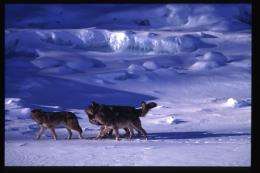
(PhysOrg.com) -- The wolves on Isle Royale are suffering from genetically deformed bones. Scientists from Michigan Technological University blame the extreme inbreeding of the small, isolated wolf population at the island National Park in northern Lake Superior.
Researchers have collected the first scientific evidence that inbreeding has caused genetic deterioration of the bones of the wolves of Isle Royale. Rolf Peterson and John Vucetich of Michigan Tech and their colleagues, Jannikke Raikkonen of the Swedish Museum of Natural History and Michael P. Nelson at Michigan State University, report on the congenital bone deformities in the latest issue of the journal Biological Conservation. The work is supported in part by the National Science Foundation.
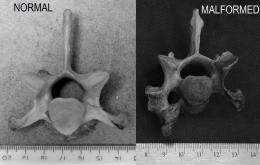
The scientists found that 58 percent of the wolves on Isle Royale exhibit a congenital malformation in the lumbosacral region or lower back, and 33 percent display a specific deformity—lumbosacral transitional vertebrae—which can cause full or partial paralysis of the rear legs and tail, as well as back pain. It is a condition also seen in domestic dogs. Other malformations were found in the wolves as well.
For the last 12 years, every one of the dead wolves the researchers have found has displayed bone deformities. In contrast, these deformities occur in only 1 percent of studied wolf populations that are not inbred.
"Until recently, we didn’t know if the inbreeding was causing problems for the wolves," says Vucetich.
"There is now good reason to think that Isle Royale wolves have been suffering from genetic deterioration due to inbreeding," the researchers say in their journal article.
Peterson and Vucetich head a study of wolves and moose on Isle Royale that has been ongoing continuously for more than 50 years. The four packs there comprise 24 wolves, all descended from one female and one or two males who crossed an ice bridge from Canada during an unusually cold winter in the 1940s. Since then they have been isolated on the islands that make up Isle Royale National Park.
Winter Study 2009
Each winter since 1959, researchers have been tracking and observing the wolves and the moose that are virtually their only prey. During this year's Winter Study, Vucetich and Peterson found two dead wolves with misshapen vertebrae, one killed by other wolves and the other, which also had severe arthritis, frozen under the ice of a lake.
This was a particularly cold, hard year on the wolves and moose of Isle Royale. The researchers counted 24 wolves, close to the long-term average population size, but two of the four wolf packs did not have any pups that survived, Vucetich reported. East Pack's numbers declined to a sole surviving female who has taken a new mate from one of the other packs.
The researchers estimated the moose population at 530 this winter, a decrease from last year and not even half the average long-term population size.
Not only are fewer moose surviving, making food harder for the wolves to find, but the wolves are having to hunt older, more arthritic moose, Vucetich and Peterson found. Three years ago, the average age of a moose killed by a wolf on Isle Royale during the winter was 12 years old. Two years ago, it was 13, and now it is 14.
Atypically, the wolves didn't kill any moose calves this winter, although calf numbers were low, "so the wolves probably didn't save any for the winter," said Vucetich. In fact, a pair of moose calf twins both survived, a rare occurrence.
Genetic Rescue?
"What we learned raises the question of whether the wolves of Isle Royale should be genetically rescued," Vucetich said.
Up to now, wildlife management agencies in the US and Scandinavia have cited the Isle Royale wolves as proof that small wolf populations can avoid genetic deterioration and remain viable.
"Our study removes one more example that some use to downplay the consequences of genetic deterioration," the Swedish scientist Raikkonen says.
Whether to intervene is a question that should be revisited, the researchers suggest. They are inviting the public to weigh in on the matter, through a blog on their Isle Royale Wolf-Moose Study web site, www.isleroyalewolf.org .
The decision is complicated, Vucetich observes."It involves balancing values associated with wilderness, scientific knowledge, healthy ecosystems and animal welfare," he points out. "If only one value mattered, the decision would be easier, but here the values are competing."
Adds Peterson, "This is not a decision just for scientists to make any more."
Provided by Michigan Technological University


