Shuttle lands in Florida, ending 13-day voyage
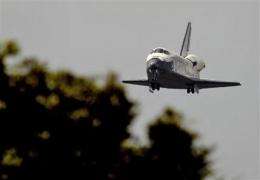
(AP) -- Shuttle Discovery and its crew of seven returned to Earth on Saturday and successfully wrapped up a construction mission that left the international space station with all its solar wings and extra electrical power.
Discovery swooped through a cloudy sky and landed at NASA's spaceport in midafternoon, a little later than initially planned.
"Welcome home, Discovery, after a great mission," Mission Control radioed.
"It's good to be back home," said Discovery's commander, Lee Archambault.
Mission Control delayed Discovery's homecoming by about 90 minutes because of windy, cloudy weather. But the wind shifted and conditions improved enough for the second and final landing opportunity of the day.
Discovery's 13-day flight - which ended just as a new Russian-launched crew was settling into the space station - was highlighted by the installation and unfurling of the space station's last pair of solar wings. The $300 million addition brought the orbiting outpost up to full power, a vital part of NASA's plan to double the space station population and boost the amount of science research in a few months.
The shuttle mission spanned more than 5 million miles and 202 orbits.
NASA conducted a heat shield test during Discovery's re-entry, as the shuttle crossed the Gulf of Mexico on its way to Florida.
A new type of tile with a slight bump was attached beneath Discovery's left wing to disrupt the hypersonic air flow. Engineers wanted to measure the extra heat generated on downstream tiles and insisted it would not be excessive and that the experiment was safe.
The space agency designed the new tile as a potential improvement for the shuttles - a matter of keen interest ever since Columbia was destroyed during re-entry in 2003 - and the new rocketships that will replace them.
Discovery brought back former space station resident Sandra Magnus, who logged 134 days in orbit and received warm greetings from NASA. She flew up in mid-November. Her replacement, a Japanese astronaut, was launched aboard Discovery on March 15.
The shuttle also ferried five months' worth of science samples from the space station, mostly blood, urine and saliva collected by its crew members. As many vials as possible were stuffed into the shuttle freezer, with the rest put in ice packs.
Also coming back for NASA scientists: four to five liters of recycled water that had been the astronauts' own urine and sweat. The water was produced after Discovery delivered a new urine processor that fixed the recycling machine.
NASA hopes to have the water samples tested within a month. If the toxicology results are good, the three space station residents will be given the all-clear to start drinking the recycled water.
Discovery's astronauts performed three spacewalks to hook up the solar wings and perform other chores. They were unable to deploy a pair of equipment storage platforms, after one of the shelves jammed.
NASA has until late this year to set up the shelves. That's when the items that will be placed there - crucial spare parts for the space station - are launched.
The space station, meanwhile, got more guests Saturday with the arrival of a Russian Soyuz capsule, just three days after Discovery's departure.
Two of the newcomers - an American and a Russian - will swap places with commander Mike Fincke and cosmonaut Yuri Lonchakov, who have been in orbit six months.
Billionaire space tourist Charles Simonyi, a former Microsoft executive, also flew up on the Soyuz.
NASA's next shuttle mission, a long-delayed repair effort at the Hubble Space Telescope, is scheduled for May. Atlantis will be moved to its launching pad Tuesday.
---
On the Net:
NASA: http://spaceflight.nasa.gov
©2009 The Associated Press. All rights reserved. This material may not be published, broadcast, rewritten or redistributed.


