Microsoft's WorldWide Telescope to focus on Mars
Mar 24, 2009
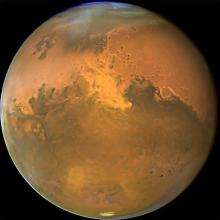
This NASA Hubble Space Telescope image shows Mars in 2005. Microsoft and NASA on Tuesday announced an alliance to focus the software giant's virtual WorldWide Telescope on space agency images of Mars and other celestial bodies.

Microsoft and NASA on Tuesday announced an alliance to focus the software giant's virtual WorldWide Telescope on space agency images of Mars and other celestial bodies.

NASA and will jointly develop a system to make high-resolution images and scientific data from , the moon and elsewhere in the cosmos available for people to "explore" online at worldwidetelescope.org.

"Making ?s scientific and astronomical data more accessible to the public is a high priority for NASA," said the US agency's science mission directorate associate administrator Ed Weiler.

"Especially given the new administration?s recent emphasis on open government and transparency."

Google teamed up with the National Aeronautics and Space Administration several years ago to enhance Google Earth with space agency images.

Google Earth features 3D images of Mars, real-time spacecraft tracking, and virtual tours of the red planet at the free online service.

More than 100 terabytes of NASA data, including images from a that has been studying the planet since 2006, will be incorporated into later this year, according to Microsoft.

"This collaboration will enable people around the world to explore new images of the moon and Mars in a rich, interactive environment," said Microsoft vice president of external research Tony Hey.

"WorldWide Telescope serves as a powerful tool for computer science researchers, educators and students to explore space and experience the excitement of computer science."

Images from a camera aboard a Lunar Reconnaissance Orbiter to be launched by NASA in May will also be made available.

Worldwide Telescope went live online about a year ago and combines images from ground- and space-based telescopes to simulate peering into the cosmos.

"NASA is excited to collaborate with Microsoft to share its portfolio of planetary images with students and lifelong learners," said Pete Worden, director of NASA's Ames Research Center in Northern California.

"This is a compelling astronomical resource and will help inspire our next generation of astronomers."

(c) 2009 AFP

Explore further: Mice, gerbils perish in Russia space flight

add to favorites email to friend print save as pdf

Related Stories

NASA and Google Launch Virtual Exploration of Mars

Feb 02, 2009

(PhysOrg.com) -- NASA and Google announced Monday the release of a new Mars mode in Google Earth that brings to everyone's desktop a high-resolution, three-dimensional view of the Red Planet.

NASA joins Google in mapping the moon

Sep 19, 2007

The National Aeronautics and Space Administration has joined with Google Inc. in producing new higher-resolution lunar imagery and maps.

NASA and Google to Bring Space Exploration Down to Earth

Dec 18, 2006

NASA Ames Research Center and Google have signed a Space Act Agreement that formally establishes a relationship to work together on a variety of challenging technical problems ranging from large-scale data management and ...

NASA's New Mars Orbiter Returns Test Images

Mar 24, 2006

The first test images of Mars from NASA's newest spacecraft provide a tantalizing preview of what the orbiter will reveal when its main science mission begins next fall.

NASA Spacecraft to Carry Russian Science Instruments

Oct 03, 2007

NASA and the Russian Federal Space Agency Roscosmos have agreed to fly two Russian scientific instruments on NASA spacecraft that will conduct unprecedented robotic missions to the moon and Mars.

Recommended for you

Mice, gerbils perish in Russia space flight

7 hours ago

A number of mice and eight gerbils sent into space in a Russian capsule destined to find out how well organisms can withstand extended flights perished during their journey, scientists said Sunday as the ...

Mars rover Opportunity examines clay clues in rock

May 18, 2013

(Phys.org) —NASA's senior Mars rover, Opportunity, is driving to a new study area after a dramatic finish to 20 months on "Cape York" with examination of a rock intensely altered by water.

NASA's STEREO detects a CME from the sun

May 17, 2013

On 5:24 a.m. EDT on May 17, 2013, the sun erupted with an Earth-directed coronal mass ejection or CME, a solar phenomenon that can send billions of tons of solar particles into space that can reach Earth ...

Nine-year-old Mars rover passes 40-year-old record

May 17, 2013

While Apollo 17 astronauts Eugene Cernan and Harrison Schmitt visited Earth's moon for three days in December 1972, they drove their mission's Lunar Roving Vehicle 19.3 nautical miles (22.210 statute miles ...

Bright explosion on the Moon

May 17, 2013

For the past 8 years, NASA astronomers have been monitoring the Moon for signs of explosions caused by meteoroids hitting the lunar surface. "Lunar meteor showers" have turned out to be more common than anyone ...

User comments : 0

More news stories

Bold action, big money needed to curb Asia floods

Asia's flood-prone megacities should fund major drainage, water recycling and waste reduction projects to stem deluges and secure clean supply for their booming populations, experts said Sunday.

Mice, gerbils perish in Russia space flight

A number of mice and eight gerbils sent into space in a Russian capsule destined to find out how well organisms can withstand extended flights perished during their journey, scientists said Sunday as the ...

Heat-related deaths in Manhattan projected to rise

Residents of Manhattan will not just sweat harder from rising temperatures in the future, says a new study; many may die. Researchers say deaths linked to warming climate may rise some 20 percent by the 2020s, ...

Honeybees trained in Croatia to find land mines

(AP)—Mirjana Filipovic is still haunted by the land mine blast that killed her boyfriend and blew off her left leg while on a fishing trip nearly a decade ago. It happened in a field that was supposedly ...