Scientist warns that palm oil development may threaten Amazon
Oil palm cultivation is a significant driver of tropical forest destruction across Southeast Asia. It could easily become a threat to the Amazon rainforest because of a proposed change in Brazil's legislation, new infrastructure and the influence of foreign agro-industrial firms in the region, according to William F. Laurance, senior scientist at the Smithsonian Tropical Research Institute in Panama.
Laurance and Rhett A. Butler, founder of environmental science Web site Mongabay.com, warn in the open-access journal Tropical Conservation Science, that oil palm expansion in the Brazilian Amazon is likely to occur at the expense of natural forest as a result of a proposed revision to the forest code that requires landowners to retain 80 percent forest on lands in the Amazon. The new law would allow up to 30 percent of this reserve to consist of oil palm.
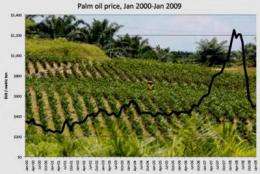
Expansion may be driven by economics. As the world's highest-yielding oil-containing seed source, oil palm is likely to offer better financial returns and to employ larger numbers of people than cattle ranching and mechanized soy farming, the dominant agricultural activities in Brazilian Amazon. Furthermore, oil palm producers will benefit from a "logging subsidy," whereby timber harvested from a tract of land helps to offset the cost of establishing a plantation. Before the recent run-up in palm oil prices, logging had been a factor in the profitability of oil palm plantations in Southeast Asia.
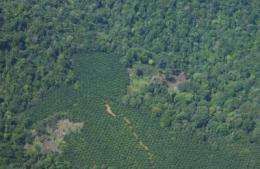
"Oil palm expansion could be accelerated by, as well as contribute to, the drivers promoting forest loss by buoying the price of land, encouraging infrastructure expansion and offering a new form of land use in the region," said Laurance. "Oil palm plantations are effectively biological deserts relative to even logged forests; research in Asia suggests an 80 percent drop-off among major animal groups."
Expansion of oil palm cultivation could also have an impact on the climate. According to research by scientists at the Woods Hole Research Center, the 2.3 million square kilometers of land in the Brazilian Amazon suitable for oil palm cultivation store 42 billion tons of carbon. Conversion of primary forest to plantations releases at least 60 percent of above-ground biomass.
While Laurance and Butler are concerned that oil palm development could spur large-scale forest conversion in Amazonia, they propose ways to temper the most serious environmental impact of the expansion.
"Developers can be encouraged to adopt cultivation methods promoted by the Roundtable on Sustainable Palm Oil, an industry-led initiative to improve its environmental performance. These include using natural pest control and composting in place of synthetic pesticides and fertilizers whenever possible, implementing no-burn policies and creating catchment ponds to reduce water pollution," said Butler. "The Brazilian government could require oil palm plantations to establish riparian buffer zones, maintain habitat corridors and protect wetlands areas to reduce impacts on biodiversity."
"Because oil palm plantations offer higher yields on a per hectare basis than either soy or beef production, one could argue that the replacement of existing cattle pasture with oil palm—without displacing ranchers or farmers into forest areas—might not be such a bad thing," said Butler. "But it is absolutely critical that the transition be managed responsibly. Otherwise, destruction of the Amazon by industrial forces will continue apace."
Source: Smithsonian Tropical Research Institute


