Earth's crust melts easier than previously thought
Mar 18, 2009
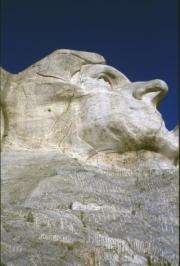
Mt. Rushmore granite crystallized from a magma that was generated 1.7 billion years ago during collision of smaller tectonic plates that together produced the nucleus of the North American continent. Reduced heat diffusion in colliding and deforming tectonic plates, as reported in the paper, contributed to melting of crustal rocks in the ancient mountain belt, in a manner analogous to granite production in the active Himalayan continental collision. Photo courtesy of Peter Nabelek.

A University of Missouri study published in Nature this week has found that the Earth's crust melts easier than previously thought. In the study, researchers measured how well rocks conduct heat at different temperatures and found that as rocks get hotter in the Earth's crust, they become better insulators and poorer conductors. This finding provides insight into how magmas are formed and will lead to better models of continental collision and the formation of mountain belts.

"In the presence of external heat sources, rocks will heat up more efficiently than previously thought," said Alan Whittington, professor of geological sciences in the MU College of Arts and Science. "We applied our findings to computer models that predict what happens to rocks when they get buried and heat up in mountain belts, such as the Himalayas today or the Black Hills in South Dakota in the geologic past. We found that strain heating, caused by during mountain belt formation, quite easily triggers crustal melting."

In the study, researchers used a laser-based technique to determine how long it took heat to conduct through different samples. In all of the samples, , or how well a material conducts heat, decreased rapidly with increasing temperatures. Researchers found the thermal diffusivity of hot rocks and magmas to be half that of what had been previously assumed.

"Most crustal melting on the Earth comes from intrusions of hot from the Earth's mantle," said Peter Nabelek, professor of geological sciences in the MU College of Arts and Science. "The problem is that during , we don't see intrusions of basaltic magma into continental crust. These experiments suggest that because of low thermal diffusivity, strain heating is much faster and more efficient, and once rocks get heated, they stay hotter for much longer. Of course, these processes take millions of years to occur and we can only simulate them on a computer. This new data will allow us to create computer models that more accurately represent processes that occur during continental collisions."

More information: The study, "Temperature-dependent thermal diffusivity of the Earth's crust and implications for magmatism," was published in this week's Nature and was co-authored by Whittington, Nabelek and Anne Hofmeister, a professor at Washington University.

Source: University of Missouri-Columbia (news : web)

Explore further: Alaska volcano shoots ash 15,000 feet into the air

add to favorites email to friend print save as pdf

Related Stories

Bias in the rock record?

Jan 14, 2009

(PhysOrg.com) -- The fossil record is known to be biased by the unevenness of geographical and stratigraphical sampling, and the lack of exposed rocks containing fossils. In a recent Perspective in Science [2 Jan ...

Early Earth Likely Had Livable Continents

Nov 21, 2005

A surprising new study by an international team of researchers has concluded Earth's continents most likely were in place soon after the planet was formed, overturning a long-held theory that the early planet ...

Diamonds show how Earth is recycled

Jul 30, 2008

(PhysOrg.com) -- Tiny minerals found inside diamonds have provided us with a rare glimpse of the Earth’s deepest secrets. This exciting new research by a team of scientists, led by the University of Bristol, ...

Recommended for you

Alaska volcano shoots ash 15,000 feet into the air

21 hours ago

(AP)—One of Alaska's most restless volcanoes has shot an ash cloud 15,000 feet into the air in an ongoing eruption that has drawn attention from a nearby community but isn't expected to threaten air traffic.

NASA sees Cyclone Mahasen hit Bangladesh

May 17, 2013

NASA's Tropical Rainfall Measuring Mission satellite known as TRMM measured Cyclone Mahasen's rainfall rates from space as it made landfall on May 16. Mahasen has since dissipated over eastern India.

Rapid climate change ruled out ice age trees

May 17, 2013

Short, sharp fluctuations in the Earth's climate throughout the last ice age may have stopped trees from getting a foothold in Europe and northern Asia, scientists say.

Earth's iron core is surprisingly weak, researchers say

May 17, 2013

The massive ball of iron sitting at the center of Earth is not quite as "rock-solid" as has been thought, say two Stanford mineral physicists. By conducting experiments that simulate the immense pressures deep in the planet's ...

User comments : 5

Adjust slider to filter visible comments by rank

Display comments: newest first

brane
1 / 5 (6) Mar 18, 2009
stoopid
mattytheory
2.3 / 5 (3) Mar 18, 2009
^No, no I think you're wrong.
GrayMouser
1.5 / 5 (4) Mar 18, 2009
Now we'll have to study 'human induced global melting' ;-)
out7x
1 / 5 (2) Mar 19, 2009
Stress and strain heating caused by subduction zones and faulting, are both factors.
Razzbar
not rated yet Apr 29, 2009
You're getting closer!
Now can you imagine what might happen if you eliminated magma wholly from the equation. It is always 'assumed' that the source of heat must tie back to magma. What if...

More news stories

Galaxy's Ring of Fire

Johnny Cash may have preferred this galaxy's burning ring of fire to the one he sang about falling into in his popular song. The "starburst ring" seen at center in red and yellow hues is not the product of ...

Alaska volcano shoots ash 15,000 feet into the air

(AP)—One of Alaska's most restless volcanoes has shot an ash cloud 15,000 feet into the air in an ongoing eruption that has drawn attention from a nearby community but isn't expected to threaten air traffic.

Chinese, Indian airlines face EU pollution fines

Eight Chinese and two Indian airlines face fines of up to several million euros for not paying for their greenhouse gas emissions during flights within the bloc, the European Commission said on Friday.

Morocco to harness the wind in energy hunt

Morocco is ploughing ahead with a programme to boost wind energy production, particularly in the southern Tarfaya region, where Africa's largest wind farm is set to open in 2014.

US seizes Bitcoin operator accounts

US authorities seized the accounts of a Bitcoin digital currency exchange operator, claiming it was functioning as an "unlicensed money service business," court documents showed Friday.