NASA says space station safe from debris
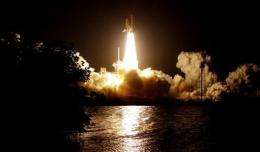
(AP) -- NASA gave the all-clear to the international space station Monday, telling its astronauts they would not need to steer away from an orbiting piece of satellite junk.
Experts had been keeping close tabs on the debris all day, at one point believing it might pass within a half-mile of the space station Tuesday, just ahead of the shuttle Discovery's arrival.
But as they studied the path of the debris from an old busted-up Soviet satellite, engineers ascertained it would remain at a safe distance.
A maneuver by the space station would have forced Discovery to adjust its course for docking late Tuesday afternoon. The shuttle is delivering one last set of solar wings for the station.
Mission Control radioed up the good news to both space crews early Monday evening.
"That makes things easier for (the station) and for us as well," Mission Control told the shuttle astronauts.
On Thursday, the three space station residents had to move into their emergency getaway capsule because another piece of space junk came uncomfortably close 220 miles above Earth. In that case, there was short notice and the astronauts did not have enough time to steer out of the way.
LeRoy Cain, chairman of the mission management team, said the back-to-back debris threats were random.
"It's part of the business. It comes with the territory," Cain told reporters.
NASA has moved the space station to dodge debris eight times in the past, most recently in August. Generally, engines on the Russian living quarters or the attached Russian supply ships are fired to alter the path of the entire station. It's a relatively easy job, but uses up precious fuel.
The debris this time was from a Soviet military satellite called Kosmos 1275, which broke up somewhat mysteriously shortly after its 1981 launch. NASA orbital debris scientist Mark Matney said it may have crashed with another object that wasn't being tracked, although the Russians believe a battery explosion did the satellite in. In any event, the result was a cloud of 310 pieces of debris that slowly are falling into lower orbits, he said.
Meanwhile, on board Discovery, the seven astronauts conducted an in-depth inspection of their ship's wings and nose with a laser-tipped boom Monday afternoon. It's standard procedure the day after launch to check for any damage that may have occurred during liftoff.
Cain said it appears, at least initially, as though Discovery made it through the launch "very, very clean."
A preliminary review of the launch video showed nothing of significance coming off Discovery's external fuel tank and striking the spaceship Sunday evening. Debris has been an overriding concern for NASA since a chunk of foam insulation broke off the external fuel tank and cracked open Columbia's wing in 2003. The shuttle broke apart during re-entry, and all seven astronauts were killed.
The shuttle flight has been reduced by one day and one spacewalk because of repeated delays in taking off.
Mission managers said the astronauts still should be able to complete most of their objectives during their 13 days in orbit. Besides installing the new solar wings, the crew will drop off a new urine processor for the space station's water-recycling system, as well as a new station resident, Japanese astronaut Koichi Wakata. Three spacewalks are now planned.
---
AP Science Writer Seth Borenstein in Washington contributed to this report.
---
On the Net:
NASA: http://spaceflight.nasa.gov
©2009 The Associated Press. All rights reserved. This material may not be published, broadcast, rewritten or redistributed.


