Launch of European gravity probe delayed
Mar 16, 2009
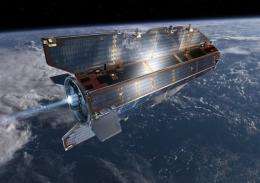
A computer-generated image of the GOCE satellite. The launch of a pioneering European satellite intended to measure Earth's gravity field was delayed due to technical problems and will take place on March 17.

The launch of a pioneering European satellite designed to map Earth's gravity field was delayed due to technical problems and will take place Tuesday, Russia's Khrunichev Space Centre said.

"The was delayed until the back-up date, tomorrow. The reasons are being checked. It is due to technical reasons connected to the ground services," a spokesman for the centre said.

He explained there was no problem with the rocket or the (ESA) probe, known as the field and steady-state Explorer, or .

A spokesman at the European Space Agency's Centre for Earth Observation in Frascati, Italy, near Rome, confirmed the delay.

"The service tower did not pull back" automatically, as it should have, he told journalists.

GOCE has suffered several delays since its original launch date of September 10 from the Plesetsk cosmodrome, 800 kilometres (500 miles) north of Moscow.

The satellite's launcher is a Rockot, derived from a Russian intercontinental ballistic missile and operated by a joint venture between EADS Astrium and the Khrunichev Space Centre.

Part of ESA's "Earth Explorer" programme initiated in 1999, GOCE's mission is to deepen understanding about fundamentals of the planet -- its atmosphere, oceans, biosphere and interior.

Scientists say it will be especially useful in gathering data about climate change, and its impact on Earth.

(c) 2009 AFP

Explore further: British astronaut 'Major Tim' to fly to ISS

add to favorites email to friend print save as pdf

Related Stories

March launch planned for GOCE gravity mission (Video)

Feb 04, 2009

(PhysOrg.com) -- ESA is now gearing up to return to Russia to oversee preparations for the launch of its GOCE satellite - now envisaged for launch on 16 March 2009. This follows implementation of the corrective ...

Last-ever look at ESA's gravity satellite GOCE

Sep 04, 2008

(PhysOrg.com) -- As preparations for the launch of GOCE on 10 September continue on schedule, an important milestone has just been achieved as engineers at the Plesetsk Cosmodrome in northern Russia say farewell ...

ESA's Earth Explorer gravity satellite on show

Jul 19, 2007

GOCE, ESA’s first satellite dedicated to measuring the Earth’s gravity field, has been presented to the press today in Turin, Italy, before being shipped to ESTEC – the space agency’s research and ...

GOCE satellite launch delayed until 2009

Oct 24, 2008

(PhysOrg.com) -- The Russian authorities responsible for the Rockot launcher that shall carry ESA's GOCE Earth Explorer satellite into orbit have completed the investigation of a failure in the guidance and ...

Recommended for you

Proba-V opens its eyes

7 hours ago

(Phys.org) —Earth watcher Proba-V is in good health following its launch last week. The Vegetation imager has been switched on and the first image has been captured over western France.

Mice, gerbils perish in Russia space flight

May 19, 2013

A number of mice and eight gerbils sent into space in a Russian capsule destined to find out how well organisms can withstand extended flights perished during their journey, scientists said Sunday as the ...

Mars rover Opportunity examines clay clues in rock

May 18, 2013

(Phys.org) —NASA's senior Mars rover, Opportunity, is driving to a new study area after a dramatic finish to 20 months on "Cape York" with examination of a rock intensely altered by water.

NASA's STEREO detects a CME from the sun

May 17, 2013

On 5:24 a.m. EDT on May 17, 2013, the sun erupted with an Earth-directed coronal mass ejection or CME, a solar phenomenon that can send billions of tons of solar particles into space that can reach Earth ...

User comments : 0

More news stories

Unraveling the Napo's mystery

In the United States, rivers and their floodplains are well-documented and monitored. Ecuador's largest river, however, remains largely mysterious. Research led by Michigan State University is helping the ...

Slow earthquakes: It's all in the rock mechanics

(Phys.org) —Earthquakes that last minutes rather than seconds are a relatively recent discovery, according to an international team of seismologists. Researchers have been aware of these slow earthquakes, ...

Hong Kong launches plan to tackle waste crisis

Hong Kong on Monday launched a ten-year plan to reduce waste by 40 percent per person as part of efforts to catch up with other leading Asian cities and avert a looming environmental crisis.

Study shows how bilinguals switch between languages

(Medical Xpress)—Individuals who learn two languages at an early age seem to switch back and forth between separate "sound systems" for each language, according to new research conducted at the University of Arizona.

Non-wetting fabric drains sweat

(Phys.org) —Waterproof fabrics that whisk away sweat could be the latest application of microfluidic technology developed by bioengineers at the University of California, Davis.

Lab sets a new record for creating heralded photons

(Phys.org) —Entanglement, by general consensus of physicists, is the weirdest part of quantum science. To say that two particles, A and B, are entangled means that they are actually two parts of an inseparable ...