Researchers Study Cave's 'Breathing' for Better Climate Clues
Mar 09, 2009
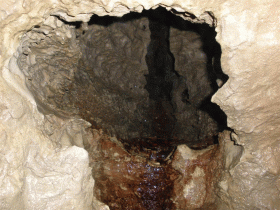
University of Arkansas researchers are studying carbon isotopes found in the cave's atmosphere and in water that flows through the cave.

(PhysOrg.com) -- A University of Arkansas researcher studying the way caves "breathe" is providing new insights into the process by which scientists study paleoclimates.

Katherine Knierim, a graduate student at the , together with Phil Hays of the geosciences department and the U.S. Geological Survey and Erik Pollock of the University of Arkansas Stable Isotope Laboratory, are conducting close examinations of cycling in an Ozark . Caves “breathe” in the sense that air flows in and out as changes.

The researchers have found that carbon dioxide pressures vary with external temperatures and ground cover, indicating a possible link between the carbon found in rock formations in the caves and seasonal changes. They presented their findings at a recent meeting of the American Geophysical Union.

The movement of carbon in cave systems is controlled by the concentration of carbon dioxide. When conditions are right, this carbon can be deposited as layers in stalagmites, stalactites and soda straws. These layers resemble the rings found in trees, except that they can date back millions of years, hold information about cave conditions.

“People have been using these formations as ,” Hays said. However, researchers make an assumption when they do so.

“The problem is that you have to assume you are getting even carbon and oxygen isotope exchange,” Knierim said. Isotopes, or atoms of the same type but with slightly different weights, are found in plants, animals, organic matter and rocks. Different types of material have unique “signatures,” or proportions of a particular atom at a particular .

By looking at ratios in cave topsoils, the cave atmosphere and the stream within the cave, Knierim and her colleagues will be able to determine the different contributions of carbon sources to the formations. This will help scientists develop more accurate paleoclimate conditions from cave formations.

A greater knowledge of how carbon cycles through cave systems also will help scientists develop better methods for watershed management.

Provided by University of Arkansas

Explore further: Sea level influenced tropical climate during the last ice age

add to favorites email to friend print save as pdf

Related Stories

Earliest evidence of our cave-dwelling human ancestors

Dec 19, 2008

A research team led by Professor Michael Chazan, director of the University of Toronto's Archaeology Centre, has discovered the earliest evidence of our cave-dwelling human ancestors at the Wonderwerk Cave in South Africa.

Mathematical Theory For Ideal Shape in Nature

Dec 06, 2004

No matter whether they're big, little, long, short, skinny or fat -- classic stalactites have the same singular shape. Almost everyone knows that stalactites, formations that hang from the roof of caves, are ...

Recommended for you

Alaska volcano shoots ash 15,000 feet into the air

May 18, 2013

(AP)—One of Alaska's most restless volcanoes has shot an ash cloud 15,000 feet into the air in an ongoing eruption that has drawn attention from a nearby community but isn't expected to threaten air traffic.

NASA sees Cyclone Mahasen hit Bangladesh

May 17, 2013

NASA's Tropical Rainfall Measuring Mission satellite known as TRMM measured Cyclone Mahasen's rainfall rates from space as it made landfall on May 16. Mahasen has since dissipated over eastern India.

Rapid climate change ruled out ice age trees

May 17, 2013

Short, sharp fluctuations in the Earth's climate throughout the last ice age may have stopped trees from getting a foothold in Europe and northern Asia, scientists say.

User comments : 0

More news stories

Heat-related deaths in Manhattan projected to rise

Residents of Manhattan will not just sweat harder from rising temperatures in the future, says a new study; many may die. Researchers say deaths linked to warming climate may rise some 20 percent by the 2020s, ...

Mice, gerbils perish in Russia space flight

A number of mice and eight gerbils sent into space in a Russian capsule destined to find out how well organisms can withstand extended flights perished during their journey, scientists said Sunday as the ...

Kinks and curves at the nanoscale

One of the basic principles of nanotechnology is that when you make things extremely small—one nanometer is about five atoms wide, 100,000 times smaller than the diameter of a human hair—they are going ...

Honeybees trained in Croatia to find land mines

(AP)—Mirjana Filipovic is still haunted by the land mine blast that killed her boyfriend and blew off her left leg while on a fishing trip nearly a decade ago. It happened in a field that was supposedly ...